Helping Those Who Sacrificed for Freedom and Dignity in Bangladesh

A Historic Revolution Bought With Lives and Limbs

Bangladesh Student Protest

As the month of July 2024 dawned, Bangladesh was suffering under more than a decade of autocratic rule. Thousands were languishing in prisons or faced persecution in the form of frivolous lawsuits, harassment, and torture. Citizens under the age of 35 had never voted in a contested election. The economy was faltering. Few predicted that over the next 36 days, brave students and their civil society supporters would topple this regime, though at a terrible cost of thousands of lost lives and limbs.

In early July, students began protesting civil service recruitment quotas that disadvantaged many young graduates from prized government jobs. When they were brutally suppressed, they regrouped and shifted their demands to include broad-based reform of the dysfunctional government. Again, they were killed and injured by the police, paramilitaries, and the violent student wing of the ruling party. Finally their demands were reduced to one: that the Prime Minister resign.

On August 5, 2024 Prime Minister Sheikh Hasina fled the country in the face of a massive uprising against her dictatorial regime. A new beginning for Bangladesh dawned on August 8, when Nobel Peace Prize laureate Professor Muhammad Yunus was sworn in as Chief Adviser (Interim Prime Minister) with the strong support of student leaders and the vast majority of the country’s citizens.

However, the revolution came at a great cost. Some 1,400 protesters were killed. Most of those who perished were the breadwinners for their families, or were expected to be for decades to come. More than 20,000 citizens were injured, many seriously. Thousands of them will never fully recover their lost limbs or their eyesight. Many face crippling medical bills that have forced them to deplete savings, sell assets, close businesses, or borrow. Some have deferred the care they need due to the costs involved.

The July Martyrs Memorial Foundation Responds

The mission of the July Shaheed Smrity Foundation (JSSF) is “to provide immediate healthcare, financial relief, and long-term support to the families of martyrs and injured, while preserving the legacy of the July revolution for future generations through education, advocacy, and sustainable initiatives.” As an important first step, it is disbursing Tk. 500,000 (US$4,200) to the families of those who were killed, and Tk. 100,000 (US$840) to those who were injured.

Its volunteer board, which is chaired by Professor Yunus, and its mostly volunteer staff are using exacting means to ensure that 100% of funds reach the intended beneficiaries according to the highest possible ethical standards. Its chief executive is Mir Mahbubur Rahman Snigdho, who is the twin brother of martyr Mir Mahfuzur Rahman Mugdho.

The Martyrs Who Deserve Honor and Support

One of Professor Yunus’ first acts after taking the oath of office was to visit the family of Abu Sayed, the iconic martyr whose act of peaceful defiance cost him his life while inspiring a nation. Professor Yunus then established a private foundation to compensate all of the victims and their families, and provided it with $8.3 million, roughly one-fifth of what will be needed to meet the needs of all martyrs and victims.

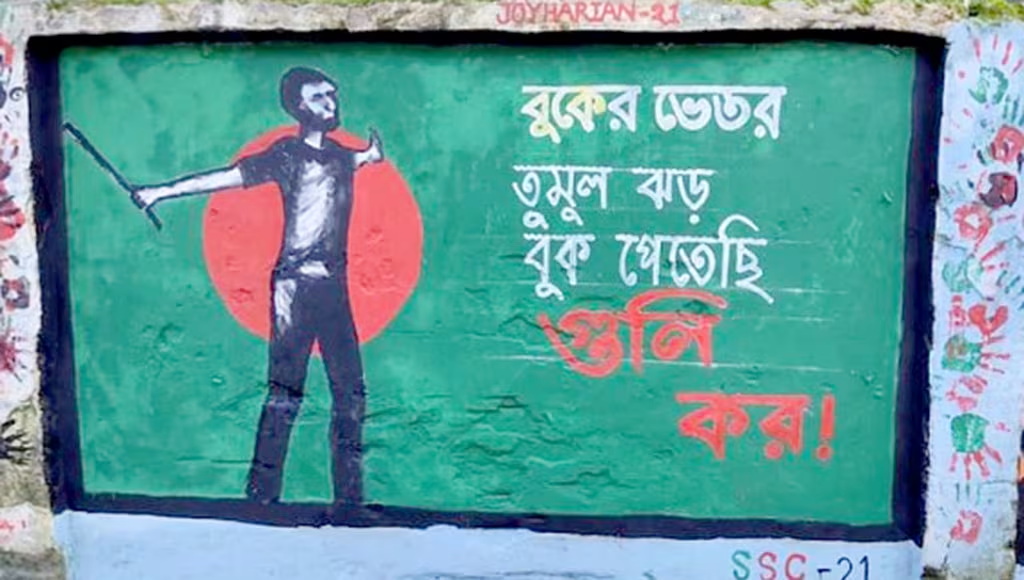
The best known Bangladeshi martyr was Abu Sayed, a brilliant student in the northern district of Rangpur. His family had sacrificed for years to ensure his education, with the hopes that he would succeed and support them. But his commitment to social justice led him to offer himself up as a sacrifice to the police by striking a now iconic pose of outstretched arms. He was shot dead but his martyrdom inspired a nation. Read more about Abu Sayed here.

Nafisa Hossain Marwa was a dedicated female high school student whose father owned a small tea stall and invested all he could in her education. But she felt drawn to march to protest the autocratic regime and headed to Dhaka on August 5 to support the revolution. Minutes after talking to her father for the last time, Nafisa’s group was attacked by police and other forces, including the hated Bangladesh Chhatra League, the student wing of the Awami League. She was at the front of the march when gunfire erupted, and she was shot and killed. Read more about Nasifa Hossain Marwa here.

Many more victims who were brutally attacked survived, but are suffering from their injuries. For example, 35-year-old Dalil Uddin started his own small-scale garment business after working in the industry.  On August 5, Dalil joined a protest led by students.  Police fired indiscriminately at the crowd, and  a one of their bullets struck Dalil near his right ear, exiting through his mouth. The impact shattered his teeth, gums, and tongue. Since then, Dalil has been unable to eat solid food or speak. His family has spent over Tk. 300,000 (US$2,500) on Dalil’s treatment as of early November, relying on savings and loans to cover expenses. Read more about Dalil Uddin here.

Another case is that of Sabbir, a university student in Rajshahi whose family’s economic situation forces him to work 10 hours per day, six days a week even while studying. On July 30, Sabbir became yet another victim of violence when members of Chhatra League severely beat and robbed him. He received basic medical care and returned home, where he was completely bedridden for 10 days. To meet the medical expenses, he and his pregnant wife have had to completely deplete their savings, and go into debt. Because he could not take end of year exams, he lost all credit for his studies in 2024, and will have to start over in 2025.  Read more about Sabbir here.

How You Can Help

Millions of people around the world observed and cheered the revolution against the autocratic regime in Bangladesh, and many wondered what they could do to help. Now, there is a way. U.S. residents can contribute any amount to a fund set up by Myriad USA (a U.S.-based nonprofit) that will support JSSF so that it can help the families of the martyrs and the surviving victims to recover, and in so doing help the birth of a new Bangladesh that has won its second independence. These donations are tax deductible for U.S. taxpayers.

For international donors wishing to make an online donation, click here.  For U.S. donors wishing to send a check, they can do the following: Send a check made out to Myriad USA and be sure to write “Friends of July Shaheed Smrity Foundation” in the memo section of the check. Mail it to Myriad USA, 551 Fifth Avenue, Suite 2400, New York, NY 10176. For information on other ways to give, click here.

Residents of Australia can make tax-deductible donations to Myriad Australia to be used to support JSSF by clicking here.

To make a tax-deductible donation to the July Shaheed Smrity Foundation from Belgium and Germany and the UK), donate here and select your country from the drop-down menu.

Residents of Bangladesh should visit the JSSF website to learn how they can get involved.

Prof. Yunus’ November Address to the Nation (in English and Bengali)

On November 17, 2024, Professor Yunus delivered his fourth address to the nation, which can be viewed here. He covered topics of interest to the citizens of Bangladesh. Immediately below is an English translation of the address, and further below is the original Bengali version.

Dear citizens, children, youth people, men, women, students, and elders: my greetings to everyone.

As-salamu alaykum (peace be upon you)

Before starting, I would like to pay my tribute to the millions of martyrs of our liberation war and those martyred during the student, worker, and mass uprising against fascism in July-August of this year. I offer my heartfelt salutation and deep respect to everyone. I would also like to honor the people who suffered injuries, became disabled, and lost their eyesight while fighting against the fascist force—the people who firmly stood for the nine-point demand, and rallied for the one-point demand. I pay my earnest gratitude to everyone who saved our country from the grasp of dictatorship. With profound gratitude, I acknowledge you, your families, your children, and every courageous individual who participated in this revolution.

We have completed the first 100 days of the interim government. You are all well aware of the circumstances under which we had to take responsibility. Following the mass uprising of students, workers, and the general public, the head of the fascist government fled, and the country was temporarily without a government. The police and administration became completely inactive during this period, creating an alarming situation.

We are all required to rebuild this country that collapsed by authoritarian rule. After the July-August revolution, we found a country in chaos and disorder. The law enforcement forces were turned against the people to maintain the fascist regime. Around 1,500 people, among whom were students, workers, and citizens, were martyred during the July Revolution. Our government is meticulously collecting every detail of the people who were martyred in this revolution. We now know that 19,931 people have been reported to be injured in this uprising. We have identified 13 hospitals in Dhaka and some specialized hospitals for their treatment. Every day new names are being added to the list of martyrs who left this world due to the outrageous actions of the dictatorship. We assure you that we will ensure that everyone gets justice. The trials for the killings of innocent citizens in July-August are progressing. We will also ask for the fallen dictator Sheikh Hasina from India to face justice.

We assure you that we will not only bring justice for the massacres of July-August, but also for every crime that was committed in the past 15 years. Countless people have been murdered and abducted by the past regime. We have formed a commission to investigate the abductions. The head of the commission informed me that they had documented 1,600 cases of abductions. They estimate that this number may ultimately exceed 3,500. Many victims are afraid to file complaints to the commission thinking that they may be hurt and victimized again by the accused perpetrators. I assure you that you should report your complaint to the commission without hesitation. No one can lay hands on you again.

The report on the victims of enforced disappearance that we received from the commission is heartbreaking. After the July-August revolution, the students expressed their feelings on the walls of cities [in the form of the murals they painted]. The people who were victims of abduction have written their agonizing stories on the walls of the hidden cells where they were imprisoned for years. Our hearts are shaken with their tales of suffering. We will ensure that those responsible for these horrendous crimes will face consequences. No matter how powerful they are, or which law enforcement force they belong to, they cannot escape justice. We are also taking steps to ensure actions against them in the international courts. I have already discussed the issue with the chief strategist of the International Criminal Court, Karim Khan. We have signed an international convention against enforced disappearances to ensure that no member of the law enforcement agencies, or anyone else, can get involved in crimes like murder, enforced disappearances, or similar offenses.

You may have noticed that Volker Türk, the United Nations High Commissioner for Human Rights, recently visited Bangladesh. The United Nations has offered to support us in investigating the killings in July-August. They have promised to hand over their report to us by the first week of December. We are also maintaining regular communication with them to investigate past incidents of enforced disappearances. Additionally, they have proposed increasing their staff in Dhaka in order to protect human rights. We have accepted their proposal as well.

Dear Citizens,

As I have already mentioned before, and I’ll repeat, the families of all martyrs from the mass uprising will be rehabilitated. No one will be left behind. The government will take responsibility for the treatment and medical expenses of all injured students, workers, and citizens. Also, to ensure long-term and expensive treatments for the injured and the care of martyr families, a complete list has been prepared under the supervision of the Ministry of Health. We have made arrangements to import corneas from Nepal for those who lost their vision due to bullet injuries. People who require further treatment are being sent abroad at the government’s expense. No martyr or injured individual from the July uprising will be excluded from our rehabilitation and treatment plans. This is a commitment of the interim government.

In memory of these martyrs, the “July Martyrs Memorial Foundation” has been established and is now completely operational. The government has already contributed Tk. 100 crore [US$ 8.3 million] to this foundation. Furthermore, the Ministry of Social Welfare has proposed a US$5 million allocation from the World Bank through the Economic Relations Division to ensure rehabilitation for martyred families and the best medical treatment for the injured from the July-August revolution.

The dethroned dictator used the police force as party workers, and many officers were forced to take part in the massacre. As a consequence, they faced public outrage that badly affected their morale. We are working to establish their confidence and encourage them to maintain law and order. There is some visible progress in this matter. The Bangladesh Army has also been given some executive powers which significantly helped improve the situation.

I would like to express my gratitude to all of the citizens for showing immense patience during this time of crisis. I also thank the political leaders for encouraging their workers to stay calm and avoid engaging in violence. You all also responded to this requested and remained patient. The fascist regime threatened the nation, saying that millions of people would die if they were evicted from power. But we were able to avoid mass violence even with the complete absence of the police force for seven days.

When the Interim Government came to power, our country was in a completely defenseless state. During this period, an attempt has been made to spread unnecessary panic among religious minorities. In some cases, they were attacked. But the hype surrounding it was completely exaggerated. The motive behind these few attacks was purely political whereas some rumors were spread that framed these incidents as communal violence. They intended to destabilize our country. But with our combined effort, we were able to move forward from the crisis.

Within 2-3 months of our government coming to power, Durga Puja was celebrated in approximately 32 thousand temples. We declared an additional public holiday to encourage the festive spirit. We took extensive security measures to ensure the Hindu community could celebrate their biggest festival without any trouble. However, some unpleasant incidents did happen. We are investigating these incidents. We are trying our best to ensure that not only the Hindu community, but also that any other people in the country do not suffer any kind of violence, and we will always try to do so.

As you know, Bangladesh faced six floods in different districts this year. With your cooperation, we could successfully deal with the disasters. Our patriotic armed forces worked alongside the people to combat this crisis. Over US$250 million in grants from the World Bank and Tk. 100 crore (US$ 8.3 million) from local donations were raised to deal with the flood and rehabilitation programs after the flood.

Floods caused severe damage to the crops and hampered the supply chain, leading to the price hike of products we all need on a daily basis. We are trying hard to keep the prices of essential commodities within a reasonable range. To manage the shortage of eggs, we approved the tax-free import of 95 million eggs. We are also taking steps to reduce the dominance of intermediaries so that the producers can directly supply eggs to the market. In many places in Dhaka, government-allocated goods are being sold so that people can afford agricultural products at cheap prices. Also, 5.7 million families—out of the 10 million family TCB (Trading Corporation of Bangladesh) card holders—have been converted into smart cards. Taxes on rice imports have also been exempted to manage the disruption in rice production caused by the flood. The government is having regular meetings with the traders to ensure that the supply and prices of essential goods remain stable during the upcoming month of Ramadan. We are open and honest with the inflation issue, hence we share full information with the public. To control inflation, several policy decisions have been taken, such as increasing interest rates, removing line of credit limits for crop imports, and reducing supply chains.

The price of fuel has been reduced to some degree. We have taken measures to increase the gas supply in the industry, so that local production is not disrupted and exports are not affected. It has also been decided not to increase the price of electricity and gas by executive order without a public hearing. We are also trying to stop extortion in the transport sector. We hope that this will help to bring stability to the market. Moreover, we have made arrangements to bring in hydroelectric power from Nepal.

Along with the management of regular issues, we are also concerned with the future of Bangladesh. As you all know, our most essential responsibility is to arrange a free and fair election and to hand over the power to the a new government elected by the people. We are conducting regular communication with political parties and seeking their opinions on various issues. Their opinions are reflected in many governmental decisions as well. Every suggestion from the parties is considered in this ongoing reform process. We hope the reform commissions will submit their recommendations to the government within the scheduled time, December/January. After getting the recommendations, we will continuously discuss them with the political parties. The final reform proposals will be based on the consensus among all parties.

We are all concerned with the possibilities of the upcoming election. Like everyone, I am also concerned in this matter. As you may have noticed, we have started to take the necessary steps to arrange for elections. The Election Commission will be ready within a few days and will be responsible for making all arrangements for the election. The Election Commission will update the voter lists, along with other tasks, which are directly related holding a free and fair election. We are also working to ensure that emigrants can participate in elections through postal ballots for the first time in Bangladesh’s history.

However, we do not think that our responsibility ends after forming an Election Commission. One of our government’s key commitments is to reform the state system. You have given us the mandate for this. In the beginning, the six reform commissions that we established have significantly progressed. You have seen the updates of their activities in different media outlets. Some reform commissions have created digital platforms as well. I request you to share your opinions on these platforms.

One of the six reform commissions is the Election Commission. Their recommendations are essential for organizing the election. Visit their platforms. Openly share your opinions. You are the owner of this country. Tell us what you need and how you want it. Tell us your every opinion regarding the election without any hesitation. Speak your mind. I request you to talk about reform at the same time. Do not avoid the reform issue. Discuss the need for reform in the electoral process and other areas while speaking about the election. Reforms are the long-term life force of a nation. They will provide our nation, especially our youth, the opportunity to create a better future. Do not deprive the nation of this chance.

One essential commission that requires the opinion of political parties and citizens across the nation to organize the election is the Constitutional Reform Commission. The electoral laws will need to be amended based on which of the recommendations are widely accepted. The process of updating the voter lists will continue simultaneously. I am not certain how much time we will get to implement the proposed reforms. However, I give you my word that if we get enough opportunity, we will complete the essential reforms needed to organize your desired election. Until then, I request that you have patience. We aim to establish an election system that will be followed for the upcoming years. That will protect our country from recurring political crises. Hence I seek enough time from you to achieve these objectives. Once the electoral reform decisions are finalized, you will receive a detailed election roadmap without any delay. This interim government was established to bring principles back into politics and create a new political environment for our country. Do not deprive the nation of this opportunity to fulfill that vision.

The journey toward the election has already begun and this train will not stop. But we need to do some work along the way. How quickly the train will reach the final station depends on how soon we can lay down the tracks, which requires unity among the political parties.

Discussions regarding the recommendations for other reform commissions will continue in the meantime. Additional time may be needed to build consensus on more important reforms beyond elections. We will continue to ask the citizens, especially the political parties, what reforms they want to see completed before the election. Some reforms can happen simultaneously with the election process. The election may also be delayed for some time for reform.

We will leave power within a short time, but I urge everyone—regardless of their political affiliation, gender, religion, age, or profession—to remain firm in ensuring that the historic opportunity is not missed. I sincerely hope you will accept my appeal.

Over one thousand prosecutors have been appointed across different districts to accelerate the judicial process for various crimes in the country. Twenty-three new judges have already been appointed to the High Court. We are making every effort to eliminate corruption and bribery from the judiciary.

The Supreme Judicial Council has been reinstated so that judges can take systematic disciplinary actions. We are trying to prevent widespread corruption in every sector of the nation, not just the judiciary. The reconstruction of the Anti-Corruption Commission is almost complete. A list of 150 influential individuals accused of corruption and money laundering has been prepared, and investigations against 79 of them have begun. The provision that permitted black money or undisclosed assets to be legalized by paying a 15% income tax has been removed.

I can report that 19,084 government officials and employees at various levels have been promoted, 13,429 have been transferred, and disciplinary actions have been taken against 12,636 individuals to streamline government operations. A constitutional body, the Public Service Commission, has been restructured as well. A policy decision has been made to revoke the infamous Cyber Security Act. Cases filed under this law that are related to the right to freedom of expression have been withdrawn. Additionally, 133 laws and regulations have been formulated or amended, and 353 significant policy decisions have been made.

Considering the students’ demands, the age limit for government jobs has already been raised to 32. We understand that you have many more demands. Years of misgovernance, oppression, and injustice have caused much resentment to build up in your hearts. The lack of freedom of speech in the country has prevented any of us from expressing our opinions and demands. We are sympathetic to each of your demands and wish to listen to you patiently. However, if you block roads and create other public inconveniences, it becomes a problem for all of us. We sincerely request you to present your demands through the appropriate channels.

In recent days, there has been significant unrest in our major export sector, the garment industry. The flight of several garment owners who benefitted from the fascist regime created uncertainty regarding workers’ wages and benefits. In many other factories, workers were deprived of fair wages and other rights. To protest these longstanding injustices and free themselves from uncertainty, workers took to the streets. We listened to their concerns and brought them to the negotiation table. We are delighted that an extensive 18-point agreement has been signed between workers and owners. Without any major violence, we have managed to resolve the labour unrest, and workers have returned to production. Bangladesh’s export-oriented industry was also revitalized through this. Despite various adversities, our exports grew by nearly 21% in October.

When we started, the country’s economy was devastated. Foreign exchange reserves were at rock bottom. The reserve situation is now improving. In the last three months, we have been able to repay nearly $2 billion in foreign debt without touching our reserves. We have reduced the accumulated arrears in fuel oil import from $478 million to $160 million. We are making every effort to restore the economy. Various donor agencies, including the World Bank and the IMF, have already pledged about $8 billion in loans and grants, enabling us to mobilize our fragile economy.

The fragile economic situation left behind by the fallen government has made it difficult for the National Board of Revenue to accelerate tax collection. Despite this, there has been an 8.75% growth in revenue collection from July to October. The revised budget of the previous fiscal year had a huge revenue shortfall. This led to the significantly increased revenue target from the start of this year. As a result, even after a nearly 9% revenue increase in the three months following the fall of the autocratic regime, there remains a shortfall of more than 23% compared to the target. To boost tax collection, I am now encouraging online submission of income tax returns.

I had long discussions with the heads of international aid organizations like the World Bank, IMF, and UNDP, etc. They have also expressed their renewed and robust interest in supporting Bangladesh eagerly. In a private meeting with the Chinese Foreign Minister, I received assurances of extensive support from China.

The financial mess we started from 100 days ago is now history. Our economy has rebounded remarkably within the last 100 days. It was driven entirely by our policies. It’s important to note that the aid commitments from our friends around the globe have yet to arrive. Not only that, the friendly states committing significant aid hae also promised me that they’ll start disbursing the funds at the earliest convenience. Once the aid starts flowing, our economy will become a very strong. Foreign investors will also be encouraged with various investment incentives.

We have already started discussions with investors. Our reputation has reached new heights within the international community of nations, as a respected and admired country. Thanks to this, the defeated forces are failing to draw their attention despite using various strategies. Still, they are trying to win your favor with varied ploys. Be free from the conspiracies of the defeated powers, and keep the country free. Don’t do anything that helps their efforts. Disappoint them in every manner possible. If we can ensure this, we don’t need to worry about anything else. On behalf of the government, I assure you that despite all the constraints, we will build a stronger economy while ensuring civil rights. No matter how powerful the opposing forces, no matter how outlandish the plan of sabotage  are, we will be prepared to thwart it all. Be ready at all times so that no one can take away from us the freedom that we have now earned.

You are already made aware that the fallen government and its cronies have smuggled US$12-15 billion out of the country every year. The anti-corruption organisation, Transparency International Bangladesh, recently published this information. We have taken all possible initiatives to recover this money that has been smuggled out. If we succeed, our economy will grow faster. We are taking the help of various international aid organizations in this work.

I also want to extend my thanks to various world leaders. Almost all of them have extended a helping hand in this critical time of Bangladesh. When I attended the UN General Assembly session in September, I had the opportunity to meet with the heads of government of many countries around the world, including the United States, the European Union, Canada, Italy, Holland, and also the UN Secretary-General. They have spontaneously pledged their full cooperation to us. I also had meetings with heads of government of several neighboring countries including Nepal, Maldives, and Pakistan, where I spoke about reviving SAARC.

After returning to the country, the ambassadors from these countries voluntarily met me in Dhaka to reiterate the commitments made by their respective heads of government. They have begun designing a completely new framework of support tailored specifically for us. Ambassadors stationed in Delhi have traveled from there to meet with me here. Among them, 20 ambassadors representing EU member states that are stationed in Delhi will join the seven EU ambassadors stationed in Dhaka to convene in Dhaka to hold discussions with me. This marks a historic moment, as EU ambassadors have never before gathered collectively for such discussions. Nor have so many ambassadors traveled from Delhi together for this purpose. This unprecedented initiative reflects the EU’s expression of support and their intent to build high-level economic cooperation with Bangladesh. Also, I have already met with ambassadors from Saudi Arabia, the United Arab Emirates, Brazil, Turkey, Russia, Finland, Singapore, Libya, and several other nations. They have assured us of various forms of bilateral cooperation, including significant commitments to enhancing trade and investment.

We also call upon expatriate Bangladeshis to invest in the private sector in the country. The private sector is at the root of Bangladesh’s economic development and youth employment. The Executive Chairman of our Investment Board has held individual meetings with CEOs, entrepreneurs, and investors of over two hundred private companies. Lack of policy consistency, lack of communication between the public and private sectors, complex bureaucratic processes, and above all corruption, have created trouble for existing investors. We have already taken many initiatives to address the concerns of the investors. A genuine one-stop service has already been launched, an inter-ministerial committee has been formed to solve investment-related challenges. Advisory councils have been formed for the private sector, and steps have been taken to carry out necessary work without coming to government offices, through digitization. The Investment Development Agency is updating everyone on our progress monthly.

We are working for the welfare of our expatriate citizens living abroad. On my request, the UAE has released 57 convicts and other Bangladeshis. These Bangladeshis protested against fascism at the risk of their own imprisonment. Bangladeshis have protested like this in many other countries. We are immensely indebted to them. A few days ago, I had a conversation with the President of the United Arab Emirates, Mr. Sheikh Mohammed bin Zayed Al Nahyan, in Baku. I thanked him on behalf of Bangladesh. He asked me to inform him if any help is needed for Bangladesh. Our government is taking all possible initiatives for the welfare of expatriates. As you know, Malaysian Prime Minister Anwar Ibrahim recently visited Bangladesh. Around 18,000 Bangladeshis who could not go to Malaysia despite following all of the formalities due to the mismanagement of the fascist government. He assured me that he would open the doors of Malaysia again for them. We have already started working towards this goal.

As you may know, Malaysia will take over the chairmanship of the Southeast Asian Regional Cooperation Organization (ASEAN) next year. We have already applied for ASEAN membership. The Prime Minister of Malaysia has assured us to actively consider our application. We have received similar assurances from Indonesia. Indonesia has also extended an invitation for me to undertake a state visit to their country. Many other countries of the world, including Saudi Arabia, have offered to increase cooperation with us. For the first time, we are appointing ambassadors permanently at OIC headquarters. I had a telephone conversation earlier with Turkish President Recep Tayyip Erdoğan. We had a very intimate discussion with him and his wife during my visit to the COP29 conference. He has repeatedly expressed his special support for Bangladesh. A Turkish trade delegation has already visited Bangladesh. Turkey has announced the establishment of an office of the Turkish Investment Authority (TICA) in Dhaka for the further development of economic relations with the country. Turkey’s increase in investment and trade will be ensured through this initiative. For this purpose, a high-level delegation from Turkey is set to visit Bangladesh later this month.

Dear Countrymen,

A new Hajj package has been announced. It will reduce the Hajj cost by more than Tk. 100,000 (US$833).

We have taken the initiative to build the new Bangladesh as an eco-friendly and bio-diverse country. It is the desire of the young generation—it is ours as well. To that end, I have taken a little step at the very beginning. We banned the use of plastic water bottles in the entire secretariat. Already, initiatives are being taken to stop the use of polythene shopping bags in supermarkets. We have taken initiatives to stop the river pollution that has occurred in the last few decades.

You all are aware of how threatening climate change is to our way of life. In the last year, Bangladesh has suffered about 15 natural disasters. We are required to fight against these natural disasters alongside man-made disasters as well. I expressed our concerns to world leaders at the climate conference in Azerbaijan. There, I met with the UN Secretary-General, and heads of the governments of Europe, Asia, and Africa. As much as I could discuss, I have asked everyone for cooperation in Bangladesh’s progress on the path of democratic transition, including dealing with the adverse effects of climate change. All promised to cooperate.

In the last 100 days, we have done many other initiatives for the welfare of the nation that I cannot detail here for lack of time. Our government believes in transparency and accountability. I have therefore directed all the Government Ministries to publish their respective working details on their websites and social media. I have also instructed my office to take necessary action so that the people can be aware of all the initiatives taken by the government.

A master plan is in operation at every moment in every institution, in every part of the world, and in every part of the country, on a grand scale, to make this government ineffective and a failure. One of their greatest strategies is to create division among us. The leaders of the fallen government who smuggled huge sums of money out of this country are trying to return to the country by virtue of their accumulated wealth. Do not let them succeed. Their success means the death of this nation—our demise as a nationality. Be aware. Let us thwart all their nefarious efforts through our unity—the way you’ve already thwarted their guns and bullets—their torture cells (Aynaghars)—and their shackles of inequality for everyone. Stay unanimous on this point, stay united.

May you all stay well.

To all the children, teenagers, youth, students, elders, men, and women of Bangladesh, I extend my heartfelt Salam.

As-salamu Alaykum (peace be upon you).

May the Almighty Allah guide and protect us all.

Khuda Hafiz. (May Allah be your Guardian)


প্রিয় দেশবাসী, শিশু, কিশোর-কিশোরী, তরুণ-তরুণী, ছাত্র-ছাত্রী, বয়স্ক,

বৃদ্ধ, পুরুষ, মহিলা সবাইকে সালাম জানাচ্ছি।

আসসালামু আলাইকুম

শুরুতেই স্মরণ করছি মুক্তিযুদ্ধের লাখো লাখো শহিদ এবং গত জুলাই-

আগস্ট মাসে ফ্যাসিবাদের বিরুদ্ধে ছাত্র শ্রমিক জনতার অভ্যুত্থানে নিহত

সকল শহিদকে। সবাইকে জানাচ্ছি আমার সশ্রদ্ধ সালাম ও গভীর শ্রদ্ধা।

আরো স্মরণ করছি তাদের, ফ্যাসিবাদী শক্তির বিরুদ্ধে লড়াই করে যারা

আহত হয়েছে, পঙ্গুত্ব বরণ করেছে, চোখের দৃষ্টি হারিয়েছে। যারা নয় দফা

নিয়ে দাঁড়িয়েছে, যারা এক দফা নিয়ে দাঁড়িয়েছে। যারা  দেশকে এক হিংস্র

স্বৈরাচারের হাত থেকে বাঁচিয়েছে। কৃতজ্ঞচিত্তে স্মরণ করছি আপনাদের

,আপনাদের ভাই-বোনদের, আপনাদের সন্তানদের যারা এই বিপ্লবে

অংশগ্রহণ করেছে।

আমরা অন্তর্বর্তীকালীন সরকারের প্রথম ১০০ দিন অতিক্রম

করলাম। আপনারা জানেন কি কঠিন এক পরিস্থিতিতে আমাদের দায়িত্ব

গ্রহণ করতে হয়েছে। ছাত্র-শ্রমিক-জনতার অভূতপূর্ব গণ অভ্যুত্থানের

পর ফ্যাসিস্ট সরকার প্রধান পালিয়ে গেলে দেশ সরকার-শূন্য হয়

সাময়িকভাবে। পুলিশ প্রশাসন ও এসময় সম্পূর্ণ নিষ্ক্রিয় হয়ে পড়লে

উদ্বেগজনক এক পরিস্থিতির সৃষ্টি হয়।

স্বৈরশাসনে বিপর্যস্ত এই দেশকে আমাদের সবাইকে মিলে পুনর্গঠন করতে

হচ্ছে। জুলাই-অগাস্ট বিপ্লবের পর আমরা এমন একটি দেশ হাতে পেয়েছি

যার সর্বত্র ছিল বিশৃঙ্খলা।  স্বৈরশাসন টিকিয়ে রাখতে আইন-শৃঙ্খলা

বাহিনীকে জনগণের মুখোমুখি দাঁড় করিয়ে দেওয়া হয়েছিল। বিপ্লব চলাকালে

প্রায় দেড় হাজার ছাত্র-শ্রমিক জনতার শহিদি মৃত্যু হয়। আমাদের সরকার

প্রতিটি মৃত্যুর তথ্য অত্যন্ত যত্নের সাথে জোগাড় করছে। এই বিপ্লবে

আহত হয়েছে ১৯,৯৩১ জন। আহতদের জন্য ঢাকার ১৩টি হাসপাতালসহ

বিভিন্ন বিশেষায়িত হাসপাতালে চিকিৎসার ব্যবস্থা করা হয়েছে।  

প্রতিদিনই তালিকায় আরো নতুন নতুন শহিদের তথ্য যোগ হচ্ছে যারা

স্বৈরাচারের আক্রোশের শিকার হয়ে এই পৃথিবী ছেড়ে চলে গেছেন। প্রতিটি

হত্যার বিচার আমরা করবোই। জুলাই-আগস্ট হত্যাকাণ্ডের বিচারের যে

উদ্যোগ আমরা নিয়েছি, তার কাজও বেশ ভালোভাবে এগিয়ে যাচ্ছে। পতিত

স্বৈরাচার শেখ হাসিনাকেও আমরা ভারত থেকে ফেরত চাইবো।

কেবল জুলাই-আগস্ট হত্যাকাণ্ডই নয়, আমরা গত ১৫ বছরে সব

অপকর্মের বিচার করবো। অসংখ্য মানুষ গুম হয়েছে, খুন হয়েছে এই সময়ে।

আমরা গুমের তদন্তে একটি কমিশন গঠন করেছি।  কমিশন প্রধান আমাকে

জানিয়েছেন অক্টোবর পর্যন্ত তারা ১,৬০০ গুমের তথ্য পেয়েছেন। তাদের

ধারণা  এই সংখ্যা ৩,৫০০ ছাড়িয়ে যাবে। অনেকেই কমিশনের কাছে গুমের

অভিযোগ করতে ভয় পাচ্ছেন এই ভেবে যে অভিযুক্ত ব্যক্তিদের দ্বারা তারা

আবার আক্রান্ত হতে পারেন, ক্ষতিগ্রস্ত হতে পারেন। আমি আপনাদের

আশ্বস্ত করতে চাই, আপনারা দ্বিধাহীন চিত্তে কমিশনকে আপনাদের

অভিযোগ জানান। কারো সাধ্য নেই আপনাদের গায়ে আবার হাত দেয়।

গুম কমিশনের সদস্যদের কাছে ভুক্তভোগীদের যে বিবরণ আমরা

পেয়েছি তা অত্যন্ত মর্মান্তিক। জুলাই-আগেস্টের বিপ্লবের পর ছাত্র-

ছাত্রীরা শহর বন্দরের দেয়ালে- দেয়ালে তাদের মনের কথা লিখেছে। তাদেরও

আগে যারা গুমের শিকার হয়েছে, প্রতিটি গোপন আস্তানার দেয়ালে- দেয়ালে

তারা লিখে গেছেন রেখেছেন তাদের কষ্টের মর্মস্পর্শী বিবরণ। তাদের এসব

কষ্টের কথা শুনে আমাদের হৃদয় কেঁপে উঠেছে। এসবের সঙ্গে জড়িতদের

আমরা বিচারের কাঠগড়ায় দাঁড় করাবোই। অভিযুক্ত যতই শক্তিশালী হোক,

যে বাহিনীরই হোক তাকে ছাড় দেওয়ার কোনো সুযোগ নেই।  কেবল দেশে নয়,

গুম, খুন ও জুলাই-আগস্ট গণহত্যার সাথে জড়িতদের আমরা আন্তর্জাতিক

আদালতেও বিচারের উদ্যোগ নিয়েছি। ইন্টারন্যাশনাল ক্রিমিনাল কোর্টের

প্রধান কৌশলী করিম খানের সঙ্গে আমার এ ব্যপারে ইতোমধ্যে কথা

হয়েছে।

আইন-শৃঙ্খলা রক্ষাকারী বাহিনী গুলোর কোনো সদস্য কিংবা অন্য

কেউ যাতে হত্যা, গুমসহ এ ধরনের কোনো অপরাধে জড়িয়ে পড়তে না পারে এ

জন্য আমরা গুম বিরোধী আন্তর্জাতিক সনদে সাক্ষর করেছি। আপনারা

দেখেছেন, জাতিসংঘের আন্তর্জাতিক মানবাধিকার বিষয়ক হাইকমিশনার

ফলকার তুর্ক সম্প্রতি বাংলাদেশ সফর করেছেন। জাতিসংঘ জুলাই-আগস্ট

হত্যাকাণ্ডের তদন্তে আমাদের সহযোগিতার হাত বাড়িয়ে দিয়েছে। 

ডিসেম্বরের প্রথম সপ্তাহেই তারা আমাদেরকে তাদের রিপোর্ট

হস্তান্তরের প্রতিশ্রুতি দিয়েছে। অতীতের গুমের ঘটনা গুলো তদন্ত কাজেও

আমরা নিয়মিত তাদের সঙ্গে যোগাযোগ রক্ষা করে চলেছি। মানবাধিকার

রক্ষায় সহযোগিতা করতে ঢাকায় তারা তাদের জনবল বাড়ানোর প্রস্তাব

দিয়েছে। আমরা এই প্রস্তাব গ্রহণ করেছি।

প্রিয় দেশবাসী,

আমি আগেও জানিয়েছি, আবারো জানাচ্ছি, গণ-অভ্যুথানে সকল

শহিদদের পরিবারকে পুনর্বাসন করা হবে। একজনও বাদ যাবে না। সকল

আহত শিক্ষার্থী-শ্রমিক-জনতার চিকিৎসার সম্পূর্ণ ব্যয় সরকার বহন

করবে। আহতদের দীর্ঘমেয়াদি এবং ব্যয়বহুল চিকিৎসা এবং শহিদদের

পরিবারের দেখা-শোনার জন্য স্বাস্থ্য মন্ত্রণালয়ের নেতৃত্বে একটি

পূর্ণাঙ্গ তালিকা প্রস্তুত করা হয়েছে। প্রতিটি শহিদ পরিবারকে সরকারের

পক্ষ থেকে ৩০ লক্ষ টাকা দেয়া হচ্ছে। যারা বুলেটের আঘাতে তাদের দৃষ্টি

শক্তি হারিয়েছেন তাদের চিকিৎসার জন্য নেপাল থেকে কর্নিয়া আনার

ব্যবস্থা করা হয়েছে। এবং যাদের প্রয়োজন তাদেরকে সরকারের পক্ষ থেকে

বিদেশে চিকিৎসার জন্য পাঠানো হচ্ছে। জুলাই অভ্যুত্থানের কোন  শহিদ

এবং আহত ছাত্র শ্রমিক চিকিৎসা সেবা এবং পুনর্বাসন পরিকল্পনা থেকে

বাদ যাবে না। এটি অন্তর্বর্তীকালীন সরকারের অঙ্গীকার।

এই গণ-অভ্যুত্থানের শহিদদের স্মৃতি ধরে রাখতে গঠিত  “জুলাই শহিদ

স্মৃতি ফাউন্ডেশন” বেশ পাকাপোক্ত ভাবে তাদের কাজ শুরু করেছে। এই

ফাউন্ডেশনে সরকার ১০০ কোটি টাকা অনুদান দিয়েছে। এছাড়াও জুলাই-

আগস্ট বিপ্লবে শহিদ পরিবারের পুনর্বাসন ও আহতদের সর্বোত্তম

চিকিৎসা নিশ্চিত করার জন্য সমাজকল্যাণ মন্ত্রণালয়ের পক্ষ থেকে ৫

মিলিয়ন মার্কিন ডলারের একটি বরাদ্দ প্রস্তাব অর্থনৈতিক সম্পর্ক

বিভাগের মাধ্যমে বিশ্বব্যাংকে পাঠানো হয়েছে।

পতিত স্বৈরাচার পুলিশকে দলীয় কর্মীর মতো ব্যবহার করেছে। বাধ্য

হয়ে তাদের অনেকেই গণহত্যায় অংশ নিয়েছেন। খুবই স্বাভাবিক প্রতিক্রিয়া

হিসেবে তারা জনরোষের শিকার হয়েছেন। এতে তাদের মনোবল অনেক কমে

যায়। আমরা পুলিশের মনোবল ফিরিয়ে এনে তাদের আবার আইন-শৃঙ্খলা

রক্ষায় কাজে লাগানোর চেষ্টা করছি। এক্ষেত্রে অনেক দৃশ্যমান উন্নতিও

হয়েছে। আইন-শৃঙ্খলা রক্ষায় বাংলাদেশ সেনাবাহিনীকেও কিছু নির্বাহী

ক্ষমতা দেওয়া হয়েছে, যা পরিস্থিতির দৃশ্যমান উন্নতিতে সহায়তা করেছে।

আমি আপনাদের সবাইকে ধন্যবাদ জানাই, কঠিন এই সময়ে আপনারা

সবাই অপরিসীম ধৈর্য্যের পরিচয় দিয়েছেন। ধন্যবাদ জানাই দেশের

রাজনৈতিক দলের নেতৃবৃন্দকে। তারা তাদের কর্মীদের শান্ত থাকার আহ্বান

জানিয়েছেন। প্রতিশোধ স্পৃহায় লিপ্ত হয়ে কেউ যাতে হানাহানিতে জড়িয়ে না

পড়ে সেই আহ্বান জানিয়েছেন। আপনাদের সবাই এই আহ্বানে সাড়া দিয়েছেন।

ফ্যাসিবাদী শক্তি ভয় দেখিয়েছিল তারা ক্ষমতা ছাড়লে দেশে লাখ লাখ লোক

মারা পড়বে। টানা সাত দিন পুলিশ প্রশাসন সম্পূর্ণ নিষ্ক্রিয় থাকার পরও

ব্যাপক আকারে সহিংসতা এড়ানো গেছে।

আমরা যখন দায়িত্ব গ্রহণ করি, বাংলাদেশ তখন সম্পূর্ণ অরক্ষিত

একটা দেশ। এসময় ধর্মীয় সংখ্যালঘুদের মধ্যে অহেতুক আতঙ্ক ছড়ানোর

চেষ্টা করা হয়েছে। কয়েকটি ক্ষেত্রে তারা সহিংসতারও শিকার হয়েছেন।

কিন্তু এটা নিয়ে যে-সব প্রচার-প্রচারণা হয়েছে তা ছিল সম্পূর্ণ

অতিরঞ্জিত। অল্প যেসমস্ত সহিংসতার ঘটনা ঘটেছে তার মূল কারণ ছিল

রাজনৈতিক। কিন্তু এসব ঘটনাকে ধর্মীয় আবরণ দিয়ে বাংলাদেশকে নতুন

করে অস্থিতিশীল করে তোলার চেষ্টা হয়েছে। আপনাদের সবার সহযোগিতায়

আমরা দৃঢ়ভাবে এই পরিস্থিতি সামাল দিয়েছি।

আমাদের দায়িত্ব গ্রহণের দু’মাসের মাথায় দেশে দুর্গাপূজা উদ্‌যাপিত

হয়েছে প্রায় ৩২ হাজার পূজা মণ্ডপে। দুর্গাপূজা উপলক্ষ্যে নির্বাহী আদেশে

একদিন অতিরিক্ত ছুটি ঘোষণা করা হয় যা উৎসবের আমেজকে অনেক গুণ

বাড়িয়ে দেয়।  দূর্গাপুজাকে ঘিরে আমরা ব্যাপক নিরাপত্তা প্রস্তুতি নেই।

যার ফলে, দেশের হিন্দু সম্প্রদায় নির্বিঘ্নে তাদের উৎসব পালন করেছে।

আমরা দায়িত্বে আসার পর যে অল্প কিছু ক্ষেত্রে তারা সহিংসতার শিকার

হয়েছেন আমরা তার প্রতিটি ঘটনার তদন্ত করছি। শুধু হিন্দু সম্প্রদায়ই

নয়, দেশের কোনো মানুষই যাতে কোনো রকম সহিংসতার শিকার না হয়,

সেজন্য আমরা যথাসাধ্য চেষ্টা করেছি। এবং সব সময় সে চেষ্টা করে যেতে

থাকবো। 

আপনারা জানেন চলতি বছর বাংলাদেশের বিভিন্ন অঞ্চলে ছয়টি বন্যা

হয়েছে। আপনাদের সবার সহযোগিতায় আমরা এই বন্যা মোকাবিলা করেছি।

বাংলাদেশের দেশপ্রেমিক সশস্ত্র বাহিনী বন্যা মোকাবিলায় জনগণের সাথে

কাঁধে কাঁধ মিলিয়ে কাজ করেছে। বন্যা মোকাবিলা ও বন্যা পরবর্তী

পুনর্বাসনের লক্ষ্যে বিশ্বব্যাংকের ২৫০ মিলিয়ন মার্কিন ডলার অনুদান

এবং স্থানীয় অনুদানের মাধ্যমে ১০০ কোটি টাকারও বেশি অর্থ সংগ্রহ

করা হয়েছে।

বন্যার ফলে অনেক জায়গায় ফসলহানি হয়েছে, ব্যাহত হয়েছে পণ্য

সরবরাহ শৃঙ্খল। বন্যা পরবর্তী সময়ে বাজারে শাক-সবজিসহ নিত্য

প্রয়োজনীয় পণ্যের দাম বেড়েছে। ফলে আপনাদের কষ্ট হয়েছে। নিত্য

পণ্যের দাম সহনীয় পর্যায়ে রাখতে আমরা যথাসাধ্য চেষ্টা করছি। বাজারে

ডিমের সরবরাহ বাড়ানো জন্য আমরা সাড়ে নয় কোটি ডিম আমদানির

অনুমতি দিয়েছি। এজন্য প্রয়োজনীয় শুল্ক ছাড়ও দেওয়া হয়েছে।  মধ্যস্বত্ব

ভোগীদের দৌরাত্ম্য কমিয়ে ডিমের উৎপাদনকরা যাতে সরাসরি বাজারে ডিম

সরবরাহ করতে পারে সেই উদ্যোগ নেওয়া হয়েছে।

মানুষ যাতে স্বল্প মূল্যে কৃষি পণ্য কিনতে পারে সেজন্য রাজধানীসহ

বিভিন্ন স্পটে সরকারি কিছু পণ্য বিক্রি করা হচ্ছে। টিসিবির মাধ্যমে ১

কোটি নিম্ন আয়ের ফ্যামিলি কার্ডের মধ্যে ৫৭ লাখকে স্মার্ট কার্ডে

রূপান্তরিত করা হয়েছে। বন্যার ফলে চালের উৎপাদন ব্যাহত হওয়ায় চাল

আমদানিতে শুল্ক ছাড় দেওয়া হয়েছে। আসন্ন রমজানে নিত্য প্রয়োজনীয়

দ্রব্যের সরবরাহ ও দাম যাতে স্বাভাবিক থাকে এজন্য সরকারের বিভিন্ন

কর্তৃপক্ষ ব্যবসায়ীদের সাথে নিয়মিত বৈঠক করে যাচ্ছে। দ্রব্য মূল্য নিয়ে

আমাদের কোনো লুকোছাপা নেই। মূল্যস্ফীতির পূর্ণ তথ্য জনগণের সামনে

তুলে ধরা হচ্ছে। মূল্যস্ফীতি রোধে উচ্চ সুদের হার নির্ধারণসহ একাধিক

নীতিগত সিদ্ধান্ত নেওয়া হয়েছে যার মধ্যে রয়েছে শস্য আমদানিতে এলসি

সীমা অপসারণ এবং সরবরাহ চেইন সংক্ষিপ্ত করা।

সামান্য হলেও জ্বালানি তেলের মূল্য কমানো হয়েছে। শিল্প কারখানায়

গ্যাসের সরবরাহ বাড়ানোর উদ্যোগ নেওয়া হয়েছে যাতে স্থানীয় পর্যায়ে

উৎপাদন ব্যাহত না হয় এবং রপ্তানি ক্ষতিগ্রস্ত না হয়। গণ-শুনানি ছাড়া

নির্বাহী আদেশে বিদ্যুৎ গ্যাসের দাম না বাড়ানোরও সিদ্ধান্ত হয়েছে।

পরিবহন খাতে চাঁদাবাজি বন্ধের চেষ্টা করা হচ্ছে। আমরা আশা করি বাজারে

পণ্যমূল্য কমিয়ে আনতে এটা ভূমিকা রাখবে। নেপাল থেকে পানিবিদ্যুত

বাংলাদেশে আনার ব্যবস্হা করা হয়েছে ।

দৈনন্দিন রাষ্ট্র পরিচালনার পাশাপাশি আমাদের ভবিষ্যতের বাংলাদেশ

বিনির্মাণের কথাও ভাবতে হচ্ছে। আপনারা সবাই জানেন, আমাদের

সবচাইতে গুরুত্বপূর্ণ কাজ হচ্ছে, একটি অবাধ, সুষ্ঠু নির্বাচন আয়োজনের

মধ্যদিয়ে নির্বাচিত সরকারের কাছে দায়িত্ব হস্তান্তর। আমরা রাজনৈতিক

দলগুলোর সঙ্গে আমাদের নিয়মিত যোগাযোগ অব্যাহত রেখেছি। বিভিন্ন

ইস্যুতে তাদের মতামত নিয়ে যাচ্ছি। সরকারের সিদ্ধান্ত গ্রহণে এসব

মতামত অনেকাংশে প্রতিফলিত হচ্ছে। চলমান সংস্কার প্রক্রিয়ায় তাদের

প্রতিটি মতামত সক্রিয় ভাবে বিবেচনায় নেওয়া হচ্ছে। আমরা আশা করছি

নির্ধারিত সময়ে, ডিসেম্বর-জানুয়ারির মধ্যেই সংস্কার কমিশনগুলো তাদের

সুপারিশমালা সরকারের কাছে পেশ করতে পারবে। তাদের সুপারিশ নিয়ে আমরা

রাজনৈতিক দলগুলোর সাথে ক্রমাগতভাবে আলোচনায় বসবো। সকলের

ঐকমত্যের ভিত্তিতেই আমরা সংস্কার প্রস্তাব চূড়ান্ত করবো।

নির্বাচন কবে হবে এই প্রশ্ন আপনাদের সবার মনেই আছে। আমাদের

মনেও সারাক্ষণ আছে। আপনারা লক্ষ্য করেছেন নির্বাচন আয়োজনের

লক্ষ্যে আমরা প্রয়োজনীয় পদক্ষেপ নিতে শুরু করেছি। কয়েকদিনের মধ্যে

নির্বাচন কমিশন গঠন হয়ে যাবে। তারপর থেকে নির্বাচন আয়োজন করার

সমস্ত দায়িত্ব তাদের উপর বর্তাবে।

নির্বাচন কমিশন ভোটার তালিকা হাল নাগাদসহ আরো কিছু কাজ শুরু

করে দিতে পারবে যা একটি অবাধ নির্বাচনের সাথে সরাসরি সম্পৃক্ত ।

প্রথম বারের মত প্রবাসী বাংলাদেশিরা পোস্টাল ব্যালটের মাধ্যমে যাতে

তাদের ভোটাধিকার প্রয়োগ করতে পারেন সে লক্ষ্যেও সরকার কাজ করছে।

তবে আমরা মনে করিনা যে একটি নির্বাচন কমিশন গঠন করে দিলেই

নির্বাচন আয়োজনে আমাদের দায়িত্ব শেষ। রাষ্ট্র ব্যবস্থায় সংস্কার

আমাদের এই সরকারের অন্যতম অঙ্গীকার। আপনারাই আমাদেরকে এই

ম্যান্ডেট দিয়েছেন। যে ছয়টি সংস্কার কমিশন আমরা শুরুতে গঠন করেছিলাম

তারা ইতোমধ্যে তাদের কার্যক্রম অনেক দূর এগিয়ে নিয়েছে। বিভিন্ন

গণমাধ্যমে আপনারা তাদের কার্যক্রমের আপডেটও দেখছেন। কয়েকটি

সংস্কার কমিশন ডিজিটাল প্ল্যাটফর্ম গঠন করেছে। আমার অনুরোধ

আপনারা এই প্ল্যাটফর্মে উৎসাহ সহকারে আপনাদের মতামত জানাতে

থাকুন।

প্রথম ছয়টি সংস্কার কমিশনের মধ্যে একটি হলো নির্বাচন সংস্কার

কমিশন। নির্বাচন অনুষ্ঠানের জন্য এই কমিশনের সুপারিশমালা অত্যন্ত

জরুরি। তাদের প্ল্যাটফর্মে যান। আপনার মতামত খোলাখুলিভাবে তুলে ধরুন।

আপনি দেশের মালিক। আপনি বলে দিন আপনি কি চান। কীভাবে চান।

নির্বাচন নিয়ে আপনাদের সকল বক্তব্য বিনাদ্বিধায় বলতে থাকুন। সবার

মনের কথা তুলে ধরুন। আমার অনুরোধ সংস্কারের কথাটাও একই সঙ্গে

বলুন। সংস্কারকে পাশ কাটিয়ে যাবেন না। নির্বাচনের কথা বলার সঙ্গে

নির্বাচন ও অন্যান্য ক্ষেত্রে সংস্কারের কথাটিও বলুন। সংস্কার হলো

জাতির দীর্ঘ মেয়াদি জীবনী শক্তি। সংস্কার জাতিকে বিশেষ করে আমাদের

তরুণ-তরুণীদের নতুন পৃথিবী সৃষ্টির সুযোগ দেবে। জাতিকে বঞ্চিত করবেন

না।

নির্বাচন আয়োজনে যে সংস্কার কমিশনের সুপারিশমালায় রাজনৈতিক

দলসমূহ এবং দেশের সকল মানুষের মতামত অপরিহার্য সে কমিশন হলো

সংবিধান সংস্কার কমিশন। এই সুপারিশমালার কোন অংশ সকলের কাছে

গ্রহণযোগ্য হবে তার ভিত্তিতে নির্বাচনী আইন সংশোধন করতে হবে।

সমান্তরাল ভাবে ভোটার তালিকা হাল নাগাদ করার প্রক্রিয়া চলতে থাকবে।

আমি নিশ্চিত নই, সংস্কার প্রস্তাবসমূহ বাস্তবায়নের সুযোগ আমরা

কতটুকু পাবো। তবে আমি আপনাদের কথা দিচ্ছি, আপনারা সুযোগ দিলে

প্রয়োজনীয় কিছু অত্যাবশ্যকীয় সংস্কার কাজ শেষ করেই আমরা

আপনাদের কাঙ্ক্ষিত নির্বাচন আয়োজন করবো। ততো দিন পর্যন্ত আমি

আপনাদের ধৈর্য্য ধারণ করার অনুরোধ করবো। আমরা চাইবো, আমরা যেন

এমন একটি নির্বাচন ব্যবস্থা সৃষ্টি করতে পারি যা যুগযুগ ধরে অনুসরণ

করা হবে। এর ফলে সাংবাৎসরিক রাজনৈতিক সংকট থেকে আমাদের দেশ

রক্ষা পাবে। এজন্য প্রয়োজনীয় সময়টুকু আমি আপনাদের কাছে চেয়ে

নিচ্ছি। নির্বাচনী সংস্কারের সিদ্ধান্ত হয়ে গেলে খুব দ্রুত আপনারা

নির্বাচনের রোডম্যাপও পেয়ে যাবেন।

অন্তর্বর্তী সরকার সৃষ্টি হয়েছে রাজনীতিকে নীতির কাঠামোয় আনার

জন্য, এবং রাজনীতির জন্য নতুন পরিবেশ সৃষ্টির নিবিড় আকাঙ্ক্ষা থেকে।

এই আকাঙ্ক্ষা পূরণ করা থেকে জাতিকে বঞ্চিত করবেন না।

নির্বাচনের ট্রেন যাত্রা শুরু করেছে। এটা আর থামবে না। কিন্তু যেতে

যেতে আমাদের অনেকগুলি কাজ সেরে ফেলতে হবে। এই ট্রেন শেষ স্টেশনে

কখন পৌঁছাবে সেটা নির্ভর করবে কত তাড়াতাড়ি আমরা তার জন্য রেল

লাইনগুলি বসিয়ে দিতে পারি আর তা হবে রাজনৈতিক দলসমূহের ঐক্যমত্যের

মাধ্যমে।

ইতোমধ্যে অন্যান্য সংস্কার কমিশনের সুপারিশমালা নিয়ে আলাপ

চলতে থাকবে। নির্বাচন ছাড়াও আরো গুরুত্বপূর্ণ সংস্কার করার ব্যাপারে

ঐক্যমত্য গঠনের জন্য অতিরিক্ত সময় প্রয়োজন হতে পারে। দেশবাসীর

কাছে, বিশেষ করে রাজনৈতিক দলগুলির কাছে আমরা ক্রমাগতভাবে প্রশ্ন

তুলতে থাকতে থাকবো কী কী সংস্কার নির্বাচনের আগে আপনারা করে নিতে

চান। নির্বাচনের আয়োজন চলাকালীন কিছু সংস্কার হতে পারে। সংস্কারের

জন্য নির্বাচনকে কয়েক মাস বিলম্বিতও করা যেতে পারে।

আমরা দু’দিন পরে চলে যাবো। কিন্তু আমাদের মাধ্যমে জাতির জন্য যে

ঐতিহাসিক সুযোগ সৃষ্টি হলো সে সুযোগটা যেন কোন রকমেই হাতছাড়া করে

না দিই এটার ব্যাপারে দৃঢ় থাকার জন্য আমি দলমত, নারী-পুরুষ, ধর্ম,

তরুণ-বৃদ্ধ, ছাত্র, ব্যবসায়ী, শ্রমিক, কৃষক নির্বিশেষে সবার কাছে আহ্বান

জানাচ্ছি। আশা করি আপনারা আমার এই আবেদন গ্রহণ করবেন।

দেশে সংগঠিত অন্যান্য অপরাধের বিচার প্রক্রিয়া ত্বরান্বিত করার

জন্য দেশের বিভিন্ন জেলায় সহস্রাধিক প্রসিকিউটর নিয়োগ দেওয়া হয়েছে।

হাইকোর্টে ইতোমধ্যে নিয়োগ দেওয়া হয়েছে ২৩ জন নতুন বিচারক। বিচার

বিভাগকে ঘুষ ও দুর্নীতিমুক্ত করার জন্য সম্ভব সব ধরনের চেষ্টাই করা

হচ্ছে।

বিচারপতিদের নিয়মতান্ত্রিক উপায়ে শাস্তিমূলক ব্যবস্থা গ্রহণের

জন্য সুপ্রিম জুডিশিয়াল কাউন্সিল পুনর্বহাল করা হয়েছে। শুধু বিচার

বিভাগই নয়, সর্বগ্রাসী দুর্নীতির হাত থেকে দেশের সব খাতকেই রক্ষা

করতে আমরা সচেষ্ট রয়েছি। দুর্নীতি দমন কমিশন পুনর্গঠনের কাজ প্রায়

শেষ পর্যায়ে। দুর্নীতি ও অর্থ পাচারে অভিযুক্ত প্রভাবশালী দেড়শ

ব্যক্তির তালিকা তৈরি এবং ৭৯ জনের বিরুদ্ধে অনুসন্ধান শুরু হয়েছে। ১৫

শতাংশ হারে আয়কর পরিশোধ করে অপ্রদর্শিত পরিসম্পদ, অর্থাৎ কালো

টাকা সাদা করার বিধান বাতিল করা হয়েছে।

সরকারি কার্যক্রমকে গতিশীল করতে বিভিন্ন পর্যায়ের ১৯,০৮৪ জন

কর্মকর্তা-কর্মচারীকে পদোন্নতি, ১৩,৪২৯ জনকে বদলি এবং ১২,৬৩৬

জনের বিরুদ্ধে শাস্তিমূলক ব্যবস্থা গ্রহণ করা হয়েছে। সাংবিধানিক

প্রতিষ্ঠান পাবলিক সার্ভিস কমিশন পুনর্গঠন করা হয়েছে। কুখ্যাত

সাইবার সিকিউরিটি আইন বাতিলের নীতিগত সিদ্ধান্ত হয়েছে। এই আইনের

অধীনে হওয়া সেসব মামলা মানুষের মত প্রকাশের অধিকারের সাথে

সম্পর্কিত সেগুলো প্রত্যাহার করা হয়েছে। এছাড়াও ১৩৩টি আইন,

বিধিবিধান তৈরি ও সংশোধন করা হয়েছে এবং ৩৫৩টি গুরুত্বপূর্ণ

নীতিনির্ধারণী সিদ্ধান্ত গ্রহণ করা হয়েছে।

ছাত্র-ছাত্রীদের দাবি মেনে ইতোমধ্যে সরকারি চাকুরির বয়স সীমা

৩২-এ উন্নীত করা হয়েছে। আমরা জানি আমাদের কাছে আপনাদের আরো

অনেক দাবি-দাওয়া আছে। দীর্ঘ দিনের অপশাসন, অত্যাচার, অনাচারের ফলে

আপনাদের মনে অনেক ক্ষোভ পুঞ্জীভূত হয়েছে। দেশে বাক স্বাধীনতা না

থাকায় আমরা কেউ আমাদের মতামত, দাবি-দাওয়া প্রকাশ করতে পারিনি।

আমরা আপনাদের প্রতিটি দাবির প্রতি সহানুভূতিশীল। আমরা ধৈর্য্য

সহকারে আপনাদের কথা শুনতে চাই। কিন্তু সেজন্য আপনারা সড়ক অবরোধ

করে জন দুর্ভোগ সৃষ্টি করলে আমাদের সকলেরই অসুবিধা হয়। আমাদের

একান্ত অনুরোধ আপনারা নির্দিষ্ট চ্যানেল মেইনটেইন করে আপনাদের

দাবি দাওয়া পেশ করবেন।

আমাদের বৃহৎ রপ্তানি পণ্য গার্মেন্টস শিল্পে গত কিছু দিন ব্যাপক

অস্থিরতা বিরাজ করেছে। ফ্যাসিস্ট সরকারের সুবিধাভোগী বেশ কিছু

গার্মেন্টস মালিক পালিয়ে যাওয়ায় শ্রমিকদের বেতন-ভাতা নিয়ে অনিশ্চয়তা

তৈরি হয়েছে। অন্য অনেক কারখানায়ও শ্রমিকরা ন্যায্য বেতনসহ অন্যান্য

সুবিধা থেকে বঞ্চিত ছিল। শ্রমিকরা তাদের দীর্ঘ দিনের বঞ্চনার প্রতিবাদ

জানাতে এবং অনিশ্চয়তা থেকে মুক্তি পেতে রাস্তায় নেমে আসে। আমরা

তাদের কথা শুনেছি, তাদের আলোচনার টেবিলে নিয়ে আসতে পেরেছি। আমরা

অত্যন্ত আনন্দিত যে মালিক-শ্রমিকের মধ্যে ১৮ দফার একটি

ব্যাপকভিত্তিক চুক্তি স্বাক্ষরিত হয়েছে। বড় ধরনের কোনো সহিংসতা

ছাড়াই আমরা শ্রমিক অসন্তোষ নিরসন করতে পেরেছি। তারা আবার

উৎপাদনে ফিরেছে। এতে প্রাণ ফিরে পেয়েছে বাংলাদেশের রপ্তানিমুখী এই

শিল্পও। নানা প্রতিকূলতা স্বত্বেও অক্টোবর মাসে আমাদের রপ্তানীতে

প্রবৃদ্ধি হয়েছে প্রায় ২১ শতাংশ।

আমরা যখন কাজ শুরু করেছি, দেশের অর্থনীতি ছিল বিপর্যস্ত।

বৈদেশিক মুদ্রার রিজার্ভ তলানিতে। আশার কথা, এই রিজার্ভ পরিস্থিতি

এখন উন্নতির পথে। গত তিন মাসে রিজার্ভে কোনো রকম হাত না দিয়েই

আমরা প্রায় ২ বিলিয়ন ডলার বৈদেশিক ঋণ শোধ করতে পেরেছি। জ্বালানি

তেল আমদানিতে পুঞ্জীভূত বকেয়ার পরিমাণ ৪৭৮ মিলিয়ন ডলার হতে

কমিয়ে ১৬০ মিলিয়ন ডলারে আনতে পেরেছি। অর্থনীতি পুনরুদ্ধারে আমরা

সর্বাত্মক চেষ্টা চালিয়ে যাচ্ছি। বিশ্বব্যাংক, আইএমএফ-সহ বিভিন্ন দাতা

সংস্থা ইতোমধ্যে ঋণ ও অনুদান হিসেবে প্রায় ৮ বিলিয়ন ডলার দেওয়ার

প্রতিশ্রুতি দিয়েছে, যা আমাদের ভঙ্গুর অর্থনীতিকে সচল করতে সক্ষম

হবে।

পতিত সরকার আমাদের জন্য যে ভঙ্গুর অর্থনৈতিক পরিস্থিতি রেখে

গিয়েছে তাতে রাজস্ব আদায়ে গতি আনতে হিমশিম খেতে হচ্ছে জাতীয়

রাজস্ব বোর্ডকে। এর মধ্যেও জুলাইয়ের নেতিবাচক অবস্থা থেকে

অক্টোবর নাগাদ রাজস্ব আদায়ে পৌনে ৯ শতাংশ প্রবৃদ্ধি অর্জিত হয়েছে।

আগের অর্থবছরের সংশোধিত বাজেটে বিপুল রাজস্ব ঘাটতি ছিল। যে কারণে

এবার শুরু থেকেই রাজস্ব আদায়ের লক্ষ্যমাত্রা অনেক বেড়ে যায়। এর ফলে

স্বৈরাচার পতনের পরবর্তী তিন মাসে পৌনে ৯ শতাংশ রাজস্ব বৃদ্ধির পরও

লক্ষ্যমাত্রার বিপরীতে ২৩ শতাংশের বেশি ঘাটতি থেকে যায়। রাজস্ব

আদায়ে গতি আনতে আমি এখন অন লাইনে আয়কর রিটার্ন জমা দিতে

উৎসাহিত করছি।

আন্তর্জাতিক সাহায্য সংস্থা বিশ্বব্যাংক, আইএমএফ, ইউএনডিপি

ইত্যাদির প্রধানদের সঙ্গেও আমার দীর্ঘ বৈঠক হয়েছে। তারাও

বাংলাদেশকে নতুনভাবে এবং সর্বাত্মকভাবে সাহায্যের জন্য তাদের আগ্রহ

ব্যক্ত করেছেন। চীনের পররাষ্ট্র মন্ত্রীর সঙ্গে একান্ত বৈঠকে চীনের

পক্ষ থেকে যাবতীয় সাহায্যের আশ্বাস দিয়েছেন।

১০০ দিন আগে আর্থিক দিক থেকে আমরা যে লন্ডভন্ড অবস্থা

থেকে যাত্রা শুরু করেছিলাম– সেটা এখন অতীত ইতিহাস হয়ে দাঁড়িয়েছে। এই

একশো দিনে অর্থনীতি সবল অবস্থানে চলে এসেছে। এটা সম্পূ্র্ণ নিজস্ব

নীতিমালা দিয়ে হয়েছে। বলা বাহুল্য এখনো আমাদের বন্ধুদের কাছ থেকে যে

সাহায্যের আয়োজন হয়েছে তা আসা শুরু করেনি। বন্ধু রাষ্ট্রগুলি শুধু যে

আমাদের বড় বড় অংকের সাহায্য নিয়ে আসছে তাই নয়, তারা এই সাহায্য

দ্রুততম সময়ে আসা শুরু করবে এই প্রতিশ্রুতিও আমাকে দিয়েছে। এই

সাহায্য আসা শুরু করলে আমাদের অর্থনীতি অত্যন্ত মজবুত এবং

আকর্ষনীয় অর্থনীতিতে পরিণত হবে। বিদেশী বিনিয়োগকারীরাও নানা রকম

বিনিয়োগে উৎসাহীত হয়ে এগিয়ে আসবে।

বিনিয়োগকারীদের সঙ্গে এখন থেকে আমরা আলোচনা শুরু করে

দিয়েছি। বিশ্বের রাষ্ট্রপুঞ্জের মজলিসে আমরা এখন সম্মানিত এবং

প্রশংসিত দেশের অবস্থানে পৌঁছাতে পেরেছি। এর কারণে পরাজিত শক্তি

নানা কৌশল করেও তাদের দিকে দৃষ্টি আকর্ষণ করতে পারছে না। তারা নানা

চেহারা নিয়ে আপনাদের প্রিয়পাত্র হবার চেষ্টা করছে। পরাজিত শক্তির

ষড়যন্ত্র থেকে নিজেকে মুক্ত রাখুন, দেশকে মুক্ত রাখুন। এ ব্যাপারে অনড়

থাকুন। এমন কিছু করবেন না যা তাদেরকে উৎসাহিত করতে সাহায্য করে।

তাদেরকে সকল দিক থেকে নিরাশ করুন। সেটা নিশ্চিত করতে পারলে

আমাদের আর কোন বিষয়ে সংশয় করার প্রয়োজন নেই। সরকারের পক্ষ

থেকে আমি নিশ্চয়তা দিচ্ছি সকল প্রকার সীমাবদ্ধতা সত্বেও আমরা

আপনাদেরকে একটা মজবুত অর্থনীতি দিয়ে যাবো, ভবিষ্যতে চলার পথকে

সহজগম্য করে যাবো, নাগরিক অধিকারসমূহ নিশ্চিত করে যাবো। বিপক্ষ

শক্তি যত শক্তিশালীই হোক, নাশকতার যত রকমই উদ্ভট পরিকল্পনাই

করুক– সব কিছু নস্যাৎ করার জন্য প্রস্তুত থাকুন। এবার যে মুক্তি

আমরা অর্জন করেছি তা আমাদের কাছ থেকে কেউ যেন ছিনিয়ে নিতে না-

পারে তার জন্য সর্বমুহুর্তে প্রস্তুত থাকুন।

আপনারা জেনেছেন, পতিত সরকার ও তার দোসররা প্রতিবছর দেশ

থেকে ১২-১৫ বিলিয়ন ডলার পাচার করেছে। দুর্নীতি বিরোধী সংস্থা

ট্রান্সপারেন্সি ইন্টারন্যাশনাল, বাংলাদেশ সম্প্রতি এই তথ্য দিয়েছে।

পাচার হয়ে যাওয়া এই অর্থ ফিরিয়ে আনার জন্য সম্ভব সকল ধরনের

উদ্যোগ আমরা গ্রহণ করেছি। এ কাজে সফল হতে পারলে আমাদের

অর্থনীতি আরো গতি পাবে। এ কাজে আমরা বিভিন্ন আন্তর্জাতিক সাহায্য

সংস্থার সাহায্য নিচ্ছি।

আমি ধন্যবাদ জানাতে চাই বিশ্ব নেতৃবৃন্দকেও। বাংলাদেশের এই

সংকটময় সময়ে তারা প্রায় সবাই সহযেগিতার হাত বাড়িয়ে দিয়েছেন। আমি

যখন সেপ্টেম্বরে জাতিসংঘের সাধারণ পরিষদের অধিবেশনে যোগ দেই, সে

সময় মার্কিন যুক্তরাষ্ট্র, ইউরোপিয়ান ইউনিয়ন, কানাডা, ইতালি,

হল্যান্ড, জাতিসংঘ মহাসচিব-সহ বিশ্বের অনেক দেশের সরকার প্রধানের

সঙ্গে আমার বৈঠক করার সুযোগ হয়। তারা স্বতঃস্ফূর্তভাবে আমাদের

প্রতি সর্বাত্মক সহযোগিতা প্রদানের অঙ্গীকার ব্যক্ত করেছেন। নেপাল,

মালদ্বীপ, পাকিস্তান-সহ প্রতিবেশী বেশ কয়েকটি দেশের সরকার প্রধানের

সঙ্গেও আমার বৈঠক হয়েছে যেখানে আমি সার্ককে পুনরুজ্জীবিত করার

কথা বলেছি।

দেশে ফিরে আসার পর এসব দেশের রাষ্ট্রদূতগণ যারা ঢাকায়

স্ব:প্রবৃত্ত হয়ে আমার সঙ্গে দেখা করে তাদের সরকার প্রধানদের

অঙ্গীকার পুনঃব্যক্ত করে গেছেন। তারা সম্পূর্ণ নতুনভাবে আমাদের জন্য

সহায়তার নতুন ছক তৈরির কাজ শুরু করেছেন। যে-সব রাষ্ট্রদূত দিল্লিতে

অফিস করেন তারা দিল্লি থেকে এসে দেখা করে গেছেন। ইউরোপিয়ান

ইউনিয়নের ২০ দেশের ২০ জন রাষ্ট্রদূত দিল্লিতে থাকেন। সাত দেশের সাত

রাষ্ট্রদূত ঢাকায় আছেন। দিল্লি থেকে একসঙ্গে ২০ জন রাষ্ট্রদূতসহ মোট

২৭ রাষ্ট্রের রাষ্ট্রদূত সমবেতভাবে আমার সঙ্গে বৈঠক করার জন্য

আগামী কয়েকদিনের মধ্যে ঢাকায় আসছেন। আগে কখনো ইউরোপিয়ান

ইউনিয়নের ২৭ জন রাষ্ট্রদূত একত্রিত হয়ে সরকারের সঙ্গে আলোচনায়

বসেনি। দিল্লী থেকে এ বিশাল সংখ্যক রাষ্ট্রদূত একসঙ্গে বৈঠক করার

জন্য আসেনি । এবার একাজটি করার পেছনে আছে ইইউ-র  সমর্থন প্রকাশ

করা এবং অর্থনৈতিক ক্ষেত্রে উচ্চ পর্যায়ের সহযোগিতা গড়ে তোলা।

ইতোমধ্যে আমার সঙ্গে দেখা করেছেন সৌদি আরব, সংযুক্ত আরব

আমিরাত, ব্রাজিল, তুরস্ক, রাশিয়া, ফিনল্যান্ড, সিঙ্গাপুর, লিবিয়া-সহ

অনেক দেশের রাষ্ট্রদূত। দ্বিপাক্ষিক নানা সহযোগিতাসহ বাণিজ্য ও

বিনিয়োগ বৃদ্ধির আশ্বাস তারা দিয়েছেন।

আমরা প্রবাসী বাংলাদেশিদেরও দেশে বেসরকারি খাতে বিনিয়োগ করার

আহ্বান জানাচ্ছি। বাংলাদেশের অর্থনৈতিক উন্নয়ন ও তরুণদের

কর্মসংস্থানের মূলে রয়েছে বেসরকারি খাত। আমাদের বিনিয়োগ বোর্ডের

নির্বাহী চেয়ারম্যান দুই শতাধিক বেসরকারি প্রতিষ্ঠানের প্রধান নির্বাহী,

উদ্যোক্তা ও বিনিয়োগকারীর সঙ্গে পৃথক পৃথকভাবে বৈঠক করেছেন।

নীতির ধারাবাহিকতার অভাব, সরকারি-বেসরকারি পর্যায়ে মতবিনিময়ের

অভাব, সরকারি অফিসের জটিল প্রক্রিয়া এবং সর্বোপরি দুর্নীতি,

বিদ্যমান বিনিয়োগকারীদের সমস্যায় ফেলেছে। বিনিয়োগকারীদের উদ্বেগ

নিরসনে আমরা অনেকগুলো কাজ করেছি । ইতোমধ্যে সত্যিকারের ওয়ান

স্টপ সার্ভিস চালু হয়েছে , বিনিয়োগ সংক্রান্ত চ্যালেঞ্জ সমাধানে

আন্তঃমন্ত্রণালয় কমিটি গঠন হয়েছে । বেসরকারি খাতের উপদেষ্টা

কাউন্সিল ও ডিজিটালাইজেশনের মাধ্যমে সরকারি অফিসে না-এসে

প্রয়োজনীয় কর্ম সম্পাদনের পদক্ষেপ নেয়া হয়েছে। বিনিয়োগ উন্নয়ন

সংস্থা আমাদের অগ্রগতির বিষয়ে সবাইকে মাসিক ভিত্তিতে আপডেট করে

যাচ্ছে।

আমরা প্রবাসীদের কল্যাণে কাজ করছি। আমার অনুরোধে সংযুক্ত

আরব আমিরাত  সাজাপ্রাপ্ত ৫৭ জন সহ অন্যান্য বাংলাদেশিকে মুক্তি

দিয়েছে। এসব বাংলাদেশি কারাবাসের ঝুঁকি নিয়ে ফ্যাসিবাদের বিপক্ষে

প্রতিবাদ করেছি। বাংলাদেশিরা এরকম প্রতিবাদ আরো অনেক দেশেই

করেছেন। আমরা তাদের প্রতি কৃতজ্ঞ। 

কয়েকদিন আগে বাকুতে সংযুক্ত আরব আমিরাতের প্রেসিডেন্ট জনাব

শেখ মোহাম্মদ বিন জায়েদ আল নাহিয়ান এর সঙ্গে আমার কথা হয়েছে ।

তাঁকে বাংলাদেশের পক্ষ থেকে ধন্যবাদ জানিয়েছি। তিনি বলেছেন

বাংলাদেশের জন্য যেকোন সাহায্য লাগলে আমি যেন তাকে জানাই।

প্রবাসীদের কল্যাণে আমাদের সরকার সম্ভব সব ধরনের উদ্যোগ গ্রহণ

করে যাচ্ছি। আপনারা জানেন মালয়েশিয়ার প্রধানমন্ত্রী আনোয়ার ইব্রাহিম

সম্প্রতি বাংলাদেশ সফর করেছেন। ১৮ হাজার বাংলাদেশি, যারা সব ধরনের

আনুষ্ঠানিকতা মেনে চলার পরও স্বৈরাচারী সরকারের অব্যবস্থাপনার জন্য

মালয়েশিয়া যেতে পারেননি, তিনি তাদের জন্য মালয়েশিয়ার দ্বার আবার

উন্মুক্ত করার আশ্বাস দিয়েছেন। এ লক্ষ্যে আমরা কাজও শুরু করেছি ।

আপনারা জেনে থাকবেন মালয়েশিয়া আগামী বছর দক্ষিণ পূর্ব এশিয়ার

আঞ্চলিক সহযোগিতা সংস্থা আসিয়ানের চেয়ারম্যানের দায়িত্ব নিতে

যাচ্ছে। আমরা ইতোমধ্যে আসিয়ানের সদস্য পদের জন্য আবেদন করেছি।

মালয়েশিয়ার প্রধানমন্ত্রী আমাদের আবেদন সক্রিয়ভাবে বিবেচনার

আশ্বাস দিয়েছেন। একই ধরনের আশ্বাস আমরা পেয়েছি ইন্দোনেশিয়া

থেকেও। ইন্দোনেশিয়ার পক্ষ থেকে সেদেশে রাষ্ট্রীয় সফরে যাবার জন্য

আমাকে অনুরোধ করেছে । সৌদি আরবসহ বিশ্বের আরো অনেক দেশ

আমাদের সঙ্গে সহযোগিতা বৃদ্ধির প্রস্তাব দিয়েছে। প্রথমবারের মতো

ওআইসি সদর দপ্তরে আমরা স্থায়ীভাবে রাষ্ট্রদূত নিয়োগ দিচ্ছি।

তুরস্কের রাষ্ট্রপতি রিসেপ তাইয়্যেপ এরদোগানের সাথে আগে আমার

টেলিফোনে আলাপ হয়েছে। এবার COP29 সম্মেলনে গিয়ে তিনি ও তাঁর

স্ত্রী'র সঙ্গে অত্যন্ত অন্তরঙ্গ পরিবেশে আলোচনা হয়েছে। বাংলাদেশের

প্রতি তার বিশেষ সমর্থনের কথা তিনি বারবার প্রকাশ করেছেন। তুরস্কের

একটি বাণিজ্য প্রতিনিধি দল ইতোমধ্যে বাংলাদেশ সফর করেছে। তুরস্ক

এদেশের সঙ্গে অর্থনৈতিক সম্পর্ক উন্নয়নের জন্য টার্কিশ

ইনভেস্টমেন্ট অথরিটির (TICA) একটি অফিস ঢাকায় স্থাপনের জন্য

ঘোষণা করেছে। এর মাধ্যমে তুরস্কের বিনিয়োগ এবং বাণিজ্য বৃদ্ধির

উদ্যোগ নেয়া হবে। এই উদ্দেশ্যে চলতি মাসেই একটি উচ্চ ক্ষমতা সম্পন্ন

দল তুরস্ক থেকে বাংলাদেশে আসছেন।

প্রিয় দেশবাসী,

নতুন হজ প্যাকেজ ঘোষণা করা হয়েছে। তাতে হজের ব্যয় এক লাখ

টাকারও বেশি কমিয়ে আনা হয়েছে। পাশাপাশি আমরা এই সিদ্ধান্ত গ্রহণ

করেছি, এ বছর সরকারি খরচে কাউকে হজে পাঠানো হবেনা।

আমরা নতুন বাংলাদেশকে একটি পরিবেশ বান্ধব এবং জীব

বৈচিত্র্যময় দেশ হিসেবে গড়ে তোলার উদ্যোগ নিয়েছি। এটি তরুণদের

আকাঙ্ক্ষা। আমাদের সবারই আকাঙ্ক্ষা। সেই লক্ষ্যে আমি প্রথমেই

একটি ক্ষুদ্র পদক্ষেপ নিয়েছি। সমগ্র সচিবালয়ে প্লাস্টিকের পানির বোতল

ব্যবহার নিষিদ্ধ করেছি। ইতিমধ্যে সুপার শপগুলোতে পলিথিনের শপিং ব্যাগ

ব্যবহার বন্ধ করার উদ্যোগ নেওয়া হয়েছে। গত কয়েক দশকে যে পরিমাণ

নদী দূষণ হয়েছে, আমরা তা বন্ধ করার উদ্যোগ নিয়েছি।

আপনারা সবাই অবগত আছেন জলবায়ু পরিবর্তন আমাদের

জীবনযাত্রার জন্য কীরকম হুমকি হয়ে আসছে। গত এক বছরে বাংলাদেশ

প্রায় ১৫টি প্রাকৃতিক দুর্যোগের শিকার হয়েছে। মানুষের সৃষ্ট নানাবিধ

দুর্যোগের পাশাপাশি এসব প্রাকৃতিক দুর্যোগের বিপক্ষেও আমাদের লড়তে

হচ্ছে। আজারবাইজানে জলবায়ু সম্মেলনে বিশ্ব নেতৃবৃন্দকে আমি আমাদের

উদ্বেগের কথা জানিয়েছি। সেখানে জাতিসংঘ মহাসচিব, ইউরোপ, এশিয়া,

আফ্রিকার অনেক সরকার প্রধানের সঙ্গেই আমার দেখা হয়েছে। যতটুকু

আলাপ আলোচনা সম্ভব হয়েছে, আমি সবার কাছেই জলবায়ুর প্রতিকূল

প্রভাব মোকাবিলাসহ গণতান্ত্রিক উত্তরণের পথে বাংলাদেশের

অগ্রযাত্রায় সহযোগিতা চেয়েছি। তারা সহযোগিতার অঙ্গীকার সবাই

করেছেন।

গত ১০০ দিনে আমরা আরো অনেক কল্যাণমূলক কাজ করেছি যা

এখানে স্বল্প পরিসরে বর্ণনা করা সম্ভব নয়। আমাদের সরকার স্বচ্ছতা

ও জবাবদিহিতায় বিশ্বাসী। আমি তাই সরকারের সকল মন্ত্রণালয়কে

নির্দেশ দিয়েছি তাদের নিজ নিজ কাজের বিস্তারিত বিবরণ নিজেদের

ওয়েবসাইট ও সামাজিক যোগাযোগ মাধ্যমে প্রকাশ করার জন্য। আমি

আমার দপ্তরকেও বলেছি সরকারের সব কাজের বিবরণ যাতে জনগণ জানতে

পারে এজন্য যেন প্রয়োজনীয় পদক্ষেপ নেওয়া হয়।

এ সরকারকে ব্যর্থ করার জন্য, অকার্যকর করার জন্য বিশাল

অর্থে বিশ্বব্যাপী এবং দেশের প্রতিটি স্থানে, প্রতিটি প্রতিষ্ঠানে এক

মহাপরিকল্পনা প্রতি মুহূর্তে কার্যকর রয়েছে। তাদের একটি বড় প্রচেষ্টা

হচ্ছে আমাদের মধ্যে বিভেদ সৃষ্টি করা। পতিত সরকারের নেতৃবৃন্দ যারা

এদেশ থেকে বিপুল পরিমাণ অর্থ পাচার করে নিয়ে গেছে সে অর্থে বলিয়ান

হয়ে তারা দেশে ফিরে আসার জন্য চেষ্টা করে যাচ্ছে। তাদেরকে কিছুতেই

সফল হতে দেবেন না। তারা সফল হওয়া মানে জাতির মৃত্যু। জাতি হিসেবে

আমাদের অবসান। সাবধান থাকুন। তাদের সকল হীন প্রচেষ্টাকে আমাদের

ঐক্যের মাধ্যমে নস্যাৎ করে দিন। যে ভাবে নস্যাৎ করেছিলেন তাদের

বন্দুকের গুলিকে। তাদের আয়না ঘরকে। প্রতি পায়ে তাদের অনাচারের

শিকলকে। এ ব্যাপারে সবাই একমত থাকুন, ঐক্যবদ্ধ থাকুন।

আপনারা সবাই ভালো থাকবেন।

 বাংলাদেশের সকল শিশু, কিশোর-কিশোরী, তরুণ-তরুণী, ছাত্র-ছাত্রী, বয়স্ক,

বৃদ্ধ, পুরুষ, মহিলা সবাইকে আমার সালাম জানাচ্ছি।

আসসালামু আলাইকুম ।

মহান আল্লাহ আমাদের সহায় হোক ।

খোদা হাফেজ ।

Independent Experts Positively Assess the Bangladesh Interim Government after Three Months in Power

Amidst much hyperbolic commentary on the performance of the Interim Government in Bangladesh, the International Crisis Group performed a laudable public service recently by holding a webinar titled “Bangladesh Three Months After Hasina’s Downfall: Opportunities and Challenges” featuring three experts on Bangladesh: Zafar Sobhan, Amena Mohsin, and Thomas Kean. (The entire 83 minute webinar can be viewed here.) Their sober and fact-based assessment of the Interim Government was noteworthy for its generally positive tone. They include:

  1. There was no massive retribution against those who backed the regime led by Sheikh Hasina, as would have been expected from prior transitions in Bangladesh.
  2. Generally, the security situation, which was challenging immediately after the fall of prior government, has stabilized. It has not degenerated, as was possible.
  3. A political consensus in favor of reforms by the Interim Government has emerged and has held. Students have been especially supportive. This has given the Interim Government time and space to pursue needed reforms.  
  4. Giving the reform commissions a deadline of the end of December has created a needed sense of urgency and possibility.
  5. Domestic support for the Interim Government has remained strong. The populace regards the government as honest, committed to reform, and inclusive of respected intellectuals.
  6. The macro-economy has stabilized and the banking sector has improved noticeably. There was no run on the banks, no major increase in inflation, and foreign reserves had not plummeted – all of which could have happened with less able leadership in place.
  7. International support for Bangladesh since the Interim Government coming to power has been significant. Professor Yunus’ meetings in New York while attending the U.N. General Assembly were seen as very successful.
  8. People realize that this is a watershed moment in Bangladesh history, and that the prior regime damaged and destroyed vital institutions. Many of the statistics put out by the prior government were falsified, meaning the state of the country and especially the economy was worse than had been imagined. There is much goodwill in the population for the Interim Government as it tries to pick up the pieces.
  9. The Interim Government, including the Chief Adviser and the entire cabinet, came out strongly and appropriately against violence against minorities.
  10. Economic problems were one of the main causes of the revolution, and an economic disaster during the second half of the years was a possibility. But this has been averted; the bleeding as stopped. The Interim Finance Minister Salehuddin Ahmed is widely respected and is doing an excellent job.
  11. The Interim Government’s relations with the army and with its leadership have remained stable and generally positive.  

The speakers naturally identified some improvement areas, including enlarging the cabinet and being more transparent in decision-making. There was much commentary about misleading media reports from India about the treatment of Hindus, and how they are harming India-Bangladesh relations. The Netra News investigative report about one alleged instance of mistreatment was mentioned. As we look ahead, more discussions like this one will help ground views about the Interim Government in reality.

Responding Effectively to Well-Financed Efforts to Destabilize Bangladesh’s Interim Government

This week and next, the Support Yunus Campaign is in Bangladesh, assessing the progress of the Interim Government and the attitudes of people from all walks of life about how much things have changed since August 5 and what the future holds.

A very unscientific sampling of intellectuals, taxi drivers, rickshaw pullers, professionals, retired Bangladeshi diplomats and civil servants, and tea stall owners gives the impression that people are pleased with the change of government while also concerned about inflation, continue to have patience with the Interim Government (and acknowledge that they inherited a mess), are proud of having a charismatic, pragmatic, and non-partisan Nobel laureate heading the government, and support the reforms being pursued by the government prior to holding elections. The Awami League and especially its recent leaders are disgraced, and people are determined to have the billions of dollars they stole returned even if some of them doubt how likely that is. (According to one estimate by Transparency International Bangladesh, the amount looted may have been $15 billion per year for 14 years.) There is wariness about how those stolen billions will be used to try to destabilize the current government, and future governments.

Relations with India remain sensitive. A positive development was the publication of an article by the renowned Indian-American business leader Vinod Khosla in The Wire titled, “With Yunus at the Helm, Bangladesh Reaching its Potential is in India’s Best Interest.” It was later republished by UNB and Prothom Alo English. Khosla argues that Yunus, whom he has known for decades, is leading the country far more effectively than his critics give him credit for. Furthermore, he makes that case that Yunus’ success is good for India.  

Another important and thoughtful article was published by Al Jazeera. It was titled, “Muhammad Yunus can go down in history as the architect of a new Bangladesh.” It contains a well-researched analysis of countries that have gone through similar transitions and what lessons can be gleaned from them by the Interim Government. Towards the end of the article it hits an especially hopeful note, saying, “It is unrealistic to expect any new government to produce satisfactory reforms in all areas and a perfect democracy overnight, especially after decades of authoritarian rule… [I]f Professor Yunus gets it right, draws from the successful experience of other countries, and lays the foundations for a robust democracy in Bangladesh, he could become a Mandela-like inspirational figure, and provide other countries in South Asia, where civic freedoms are widely repressed, with a regional example of a successful post-revolutionary transition. Many in the international community stand ready to support him.”

Certainly the Interim Government has its thoughtful critics, and they have been able to express their views freely. But there are also those who are spreading lies, half-truths, and distortions to confuse people and destabilize the government. Fortunately, investigative journalists and volunteer fact checkers are stepping up to challenge these ignoble efforts. For example, Netra News published an investigation into the deaths of nine Hindus that was previously linked to communal violence – claims that did not stand up to scrutiny. (It bears mentioning that even one death from violence is one too many, but that blaming the Interim Government without evidence is wrong.) And as noted in our previous post, a service called Rumor Scanner that is active on Twitter/X has debunked dozens of false stories about what is going on in Bangladesh since August.

Most recently, U.S. presidential candidate Donald Trump posted a message sending greetings to American Hindus on the occasion of their annual Diwali festival. Unfortunately, lobbyists hired by the U.S.-based son of deposed Prime Minister Sheikh Hasina (and other advocates) convinced him to include false accusations against Bangladesh in the greeting. Take it from Support Yunus and its team on the ground in Bangladesh: there is no “chaos” here (beyond what is typical for Bangladesh in recent decades), and the idea of systemic “barbaric” attacks on minorities is fictitious (despite some lawlessness that is impacting everyone). Addressing that lawlessness, Professor Yunus has deployed the army to work alongside the police, and the early signs are that it is helping to improve security.

Professor Yunus ‘ press secretary immediately released a strong and measured statement responding to Trump’s message.  

We urge people of goodwill everywhere to share the positive stories coming out of Bangladesh and to consider contributing to the July Martyrs Memorial Fund once we make it possible for people around the world to donate while receiving tax benefits in their home countries.

Systematic efforts to destabilize the Interim Government are likely to continue regardless of how the U.S. presidential election plays our next week. We are reassured, however, that people, journalists, and leaders throughout the world are stepping up to shine lights on the truth and on the positive work of the Interim Government led by Professor Muhammad Yunus.

The Important Work of Debunking Fake and Misleading Stories about Bangladesh

Recently we posted on Twitter and Facebook to highlight the important debunking done by the BBC of false and exaggerated claims of the mistreatment of Hindus in Bangladesh.

It bears repeating that there has been violence and intimidation of various people and groups in Bangladesh, and that even one attack or killing is one too many. But it is also true that Professor Yunus and the government he leads have been taking practical and symbolic steps to curb violence. Throughout his life he has shown he is a humanist who leads by example through treating all people equally regardless of faith, ethnicity, or gender. Professor Yunus talked about his focus on improving law and order in a wide-ranging interview with Prothom Alo English, in which he said, “We are trying [to improve the law and order situation]. We have not been successful as yet. Law and order is not completely back to normal as yet. I do not want to go into explanations, but things haven’t improved that much. They may have improved to an extent, but not to the level required. So our utmost effort will be to stabilise that. That is our primary task. Unless that is done, we can’t carry out the rest of the tasks.”

Some violence against Hindus appears to be based more on their past association with the now disgraced Awami League government led by Sheikh Hasina, rather than on their religion. There are suspicions that some of it is being perpetrated by sympathizers of the prior regime to create the impression of incompetence or malfeasance by the current Interim Government. And some of it is simply made up and completely false.

Regarding those that are untrue, Shohanur Rahman, who goes by @Sohan_RSB on Twitter/X, has been doing some excellent work debunking fake stories. He also publishes under the handle @RumorScanner. Check out this fact check and also this one. Rumor Scanner claims to have debunked more than 40 fake or misleading stories coming from India. Let’s hope they continue this valuable service.

We can expect many more of these stories to surface. It is inevitable that some of the billions stolen by leaders of the Awami League will begin being used to undermine the Interim Government. Indeed, it is already happening. Neither the government nor the Support Yunus Campaign has the resources to match those who seek to destabilize the Interim Government, but with the assistance of people of goodwill playing the roles of fact-checkers and critical thinkers who don’t fall prey to the latest outrage that may be fake or misleading but challenge them instead, we can collectively turn the tide.

Positive Reviews of the New Bangladesh Government at the Two Month Mark

Recently, two of the most respected public figures in Bangladesh—one a newspaper publisher, the other a retired diplomat—voiced support and admiration for Professor Yunus in his role as Chief Adviser (or Interim Prime Minister) of Bangladesh in advance of the two month anniversary on October 8 of the new government coming to power as a result of a people’s uprising in July and early August. In doing so, they reflected the wide support Professor Yunus enjoys throughout the country, and across the world.

Mahfuz Anam—the editor and publisher of the Daily Star, a leading Bangladeshi English-language daily— wrote mainly about Professor Yunus’ triumphant trip to New York for the United Nations General Assembly, which he addressed as a head of government. Anam wrote this in his recent article titled “Chief Adviser Yunus’s UNGA Trip a Critical Turning Point”: “To have a Nobel laureate as the head of government is quite in contrast to our past leaders, some of whom were military dictators or power-hungry politicians. Professor Yunus brings in a new and fresh sense of dignity not only to Bangladesh, but to the leadership of the developing world in general. The last such leader was Nelson Mandela.”

Anam addressed relations with India, a top priority of this or any Bangladeshi government, with some wise words that reject the groundless claims that the student-led “Monsoon Revolution” that brought Professor Yunus to power was somehow the work of Western powers to stymie India: “The collapse of Sheikh Hasina’s government profoundly shocked India. It has not yet been able to fully assess what to make of the changes and understand its profundity. As reported by its media, from the outset, India got carried away with the view that foreign hands were behind the July uprising and that it was either the CIA or Pakistan’s ISI or both that were behind what occurred. This prevented the Indian policymakers from understanding and then accepting the reality that the government that it was patronizing in Bangladesh and whose election manipulation it knowingly overlooked had really lost its footing and had suffered a total loss of public support.

“To attribute the whole July uprising as nothing but the work of outsiders and to not see the massive mass participation and obvious popularity of the transformation amounted to India totally not seeing the ground reality and missing out on any realistic assessment of what had happened. This, in my view, has prevented Indian policymakers from making a fact-based reality check.”

He concluded, “Compared to where we were, what Professor Yunus has achieved in the international arena so far is a miracle.”

Ashraf ud Doula—the retired and widely respected diplomat who was the Bangladeshi ambassador to Japan, Australia and other nations—focused in a recent article on how the government led by Professor Yunus performed on the home front. He began by evaluating the cabinet that had to be so hastily assembled after the sudden fall of the prior regime: “Though most of the cabinet members came from the NGO world and apparently lacked administrative experience, their unblemished records and ethical standards offered a silver lining. Their integrity and honesty had a positive psychological effect on their ministries and the broader society. The two student leaders who have been inducted into the cabinet, until now haven’t made any missteps, which, I believe, is a positive sign.”

He continued, “While it is too soon to claim remarkable achievements, the IG’s sincerity and commitment to guiding the nation toward a better path cannot be denied. In his two national addresses, the Chief Adviser clearly outlined the government’s objectives, including fundamental reforms to vital state institutions. Dr. Yunus has also made it clear that he has no desire to remain in power beyond fulfilling his mandate to rebuild the nation.”

He added, “Signs of progress are already visible, particularly in the banking and financial sectors. The government has taken steps to recover funds laundered by Hasina, her family, and her corrupt oligarchs. The surge in remittances from expatriates reflects growing trust in the new government.”

Asraf concluded his assessment at the two-month mark with these words, “As the head of the IG [Interim Government], Dr. Yunus has taken on the immense responsibility of guiding the nation not for personal gain, but out of patriotism. He has staked his global reputation to rescue a nation on the brink of collapse. In Dr. Yunus, we have not only an honest leader but also a man whose global goodwill brings benefits to Bangladesh. His reception at the UN exemplifies this. Dr. Yunus was a brilliant star on the global stage, holding over 50 meetings in four days, including with President Biden, heads of UN agencies, and leaders of financial institutions like the IMF and World Bank…  With Dr. Yunus at the helm, I am optimistic that the IG will complete its reform agenda and pave the way for a new, democratically elected government. In the meantime, I urge my fellow countrymen to be patient for a few more months and observe the direction the country takes.”

So let’s use the two-month anniversary to celebrate the early achievements of the government led by Professor Yunus, and to thank these two statesmen for commenting on them so eloquently. They captured the sense of pride and optimism so common in Bangladesh today due to a new style of leadership and early progress on fundamental and badly-needed reforms.

Prof. Yunus Is Warmly Welcomed to New York by the Global Community

Professor Yunus arrived last night in New York for the U.N. General Assembly and related festivities. Today, he was greeted warmly by President Biden, Prime Minister Trudeau, World Bank president Ajay Banga, and many others. He made a surprise appearance at the Clinton Global Initiative. A substantive and energizing week is shaping up that will surely make Bangladesh and Bangladeshis proud.

In the meantime, Alex Counts, a longtime ally of Professor Yunus, had an important op-ed published about his weeks in Bangladesh this past summer where he witnessed the “Monsoon Revolution” that brought Professor Yunus to power.  He reports on visiting a village he got to know intimately in the 1990s, one with a large Hindu minority. (He wrote extensively about that village in his book Small Loans, Big Dreams.) During his August visit, he asked the people whether there had been hostility against minorities in the aftermath of the revolution, and they literally laughed in response. The local people — both Hindus and Muslims — added that they were very pleased that Professor Yunus was now the country’s leader.

For those who want to see Professor Yunus’ address to the United Nations, it will be at 10am New York time on September 27. It can be viewed on UN TV.

It is clearly a proud moment for Bangladesh. In fact, today the country is celebrating 50 years since it was admitted as a member of the United Nations.

High Marks and Solid Progress for Government Led by Prof. Yunus at the One-Month Mark

When the government led by Professor Yunus completed its first month, the Protect Yunus Campaign published a review of it which appears below. Around the same time, Professor Yunus did a wide-ranging interview with DW, the German public broadcast service, in English. You can watch the interview here.

Just over one month ago, on August 8, 2024, Professor Yunus was sworn in as the Chief Adviser of the Bangladesh government, along with the 16 founding members of his cabinet. The Chief Adviser position is functionally the interim Prime Minister of the government.

In most countries around the world, there is a transition or at least a preparatory period where someone can gear up for taking on such an awesome responsibility. In the case of Professor Yunus, there was almost no time to prepare. The student-led revolution culminated on August 5, and he returned from a short and long-planned overseas trip and was inaugurated on August 8 after giving brief and widely praised remarks at the airport immediately after arriving.

Despite the many challenges it faces, his government has been doing extremely well. To wit:

  1. The police returned to work, immediately improving the law and order situation and people’s sense of personal security.
  2. He addressed the nation, and his 25-minute message was very well received. (You can read the English translation of his remarks here.)
  3. He has taken tangible steps to protect and reassure the nation’s religious minorities, such as Hindus and Christians.
  4. He had a positive call with Indian Prime Minister Modi, which has set the stage for further improvement in bilateral relations.
  5. He has enlarged his cabinet and involved them in governing the country in meaningful ways.
  6. He addressed the diplomatic community in one of his first speeches as Chief Adviser.
  7. He helped secure pardons for 57 Bangladeshis arrested in the United Arab Emirates related to their rallying to support the Monsoon Revolution in August.

Bangladeshis understand that Professor Yunus walked into a difficult situation, with the economy on shaky footing and billions of dollars having been stolen by the prior regime and their cronies.

It is unfortunate that some commentators have been trying to create the impression of widespread attacks on Bangladesh’s Hindus. Some speculate that the stolen billions are being used to promote false and exaggerated claims of persecution through advertising. Fortunately, there has been some good reporting on the facts, including this article by the BBC. Obviously, even one extra-judicial death is one too many. But when you look at the confirmed numbers of deaths and the fact that even those few appear to be politically motivated (rather than based on religion), it puts the matter in a different light. One must also consider that Professor Yunus has been taking all the necessary steps to protect and reassure minority groups, consistent with this lifelong approach to respecting all people regardless of religion, caste, ethnicity, or any other consideration.

The Protect Yunus Campaign is in the process of rebranding itself in this new era, where we are going to be focusing on supporting Professor Yunus and Bangladesh. Expect a new website and new social media handles in the days ahead.

One of our early successes was orchestrating a message of support from 198 global leaders including 92 Nobel laureates and Barack Obama that was published on September 4 online, as part of a widely-circulated news release, and in a full-page ad in the Washington Post. The short and poignant message, which is reproduced in its entirety below, was covered widely in Bangladesh (including in this article in the Daily Star that termed the letter a “major show of international support”). It was seen as a vital vote of confidence at the international level for the government led by Professor Yunus.  

We the undersigned are excited to publicly share our congratulations and heartfelt good wishes to Nobel Peace Prize winner Muhammad Yunus, the new interim Prime Minister of Bangladesh. Professor Yunus, like others in Bangladesh, has suffered under the yoke of autocracy. Today, thanks to the power of a democratic and student-led protest, that autocracy has been replaced by hope. As Professor Yunus has said, Bangladesh is now enjoying its second liberation, and it has the chance to fulfill its great potential as a nation.  We have been proud to have supported Professor Yunus over the years. It is the beginning of an exciting new dawn for Bangladesh, and we wish him and the people of Bangladesh peace and success in the months and years ahead.   We are excited to see Professor Yunus finally free to work for the uplift of the entire country, especially the most marginalized, a calling he has pursued with great vigor and success across six decades. Just as the nation’s young people have inspired him, we know that he will inspire them to play a leadership role in bringing a bright new future to Bangladesh. We are also confident that he will inspire millions of young people around the world, including those in the Bangladeshi diaspora, to improve society for the better. We applaud the interim government’s commitment to bring free and fair elections back to Bangladesh and its commitment to allowing democracy to flourish.   We stand ready to help in any way we can to support the efforts of Bangladesh and the interim government to lead the world in creating a new and better civilization, as Professor Yunus has repeatedly called for.

Citizens around the world were encouraged to add their names as signatories of the letter, and many have already responded by doing so. In order to add your name, click here.

Next up will be Professor Yunus’ trip to New York to address the United Nations later this month, a trip for which he promised to take a “small, functional delegation” as compared to the bloated ones that accompanied previous Prime Ministers. Clearly, Professor Yunus is demonstrating a different style of leadership that is resonating well with the vast majority of Bangladeshis. To take one example, veteran journalist Shayan S. Khan, the Executive Editor of the Dhaka Courier, wrote this on his Facebook page after Dr. Yunus’ address to the nation: “ “That was all-business from Dr. Y, said all the right things with sincerity and resolve. How beautiful not to hear a political speech laced with cult worship, distorted history and ‘Me Me Me’ – the first person was always plural -‘We’. And didn’t evade the difficult question of how long they plan to stay. Carry on Professor…”

Global Leaders Announce Strong Support for the New Bangladeshi Government Led by Professor Yunus

In the wake of the unprecedented student-led revolution in Bangladesh that culminated in the fall of the autocratic regime led by Sheikh Hasina and the installation of an interim government led by Professor Muhammad Yunus, people throughout the world have been expressing their excitement and willingness to support the new regime and the Bangladeshi people. Students around the world have drawn inspiration from the courage displayed by their peers in Bangladesh, and mourned those who were lost in the struggle for freedom. Now, 198 global leaders including 92 Nobel laureates and Barack Obama, the 44th president of the United States, have added their own message of congratulations and support. The statement below was released on September 4, 2024 online, in a full-page ad in the Washington Post, and through a press release. Citizens who want to signal their own solidarity with the interim government in Bangladesh and the Bangladeshi people can add their names to those of the global leaders by clicking here

A Message to the People of Bangladesh and Citizens of Goodwill Throughout the World

We the undersigned are excited to publicly share our congratulations and heartfelt good wishes to Nobel Peace Prize winner Muhammad Yunus, the new interim Prime Minister of Bangladesh. Professor Yunus, like others in Bangladesh, has suffered under the yoke of autocracy. Today, thanks to the power of a democratic and student-led protest, that autocracy has been replaced by hope. As Professor Yunus has said, Bangladesh is now enjoying its second liberation, and it has the chance to fulfill its great potential as a nation.  We have been proud to have supported Professor Yunus over the years. It is the beginning of an exciting new dawn for Bangladesh, and we wish him and the people of Bangladesh peace and success in the months and years ahead.   We are excited to see Professor Yunus finally free to work for the uplift of the entire country, especially the most marginalized, a calling he has pursued with great vigor and success across six decades. Just as the nation’s young people have inspired him, we know that he will inspire them to play a leadership role in bringing a bright new future to Bangladesh. We are also confident that he will inspire millions of young people around the world, including those in the Bangladeshi diaspora, to improve society for the better. We applaud the interim government’s commitment to bring free and fair elections back to Bangladesh and its commitment to allowing democracy to flourish.   We stand ready to help in any way we can to support the efforts of Bangladesh and the interim government to lead the world in creating a new and better civilization, as Professor Yunus has repeatedly called for.

Signed,

Nobel Laureates

Peace 

Barack H. Obama, Peace, 2009

H.E. José Ramos Horta, Peace, 1996

Mairead Corrigan-Maguire, Peace, 1976

Shirin Ebadi, Peace, 2003

Mohamed ElBaradei, Peace, 2005

Leymah Roberta Gbowee, Peace, 2011

Albert Arnold Gore Jr., Peace, 2007

Tawakkol Karman, Peace, 2011

Nadia Murad, Peace, 2018

Denis Mukwege, Peace, 2018

Dmitry Muratov, Peace, 2021

Oscar Arias Sanchez, Peace, 1987

Juan Manuel Santos, Peace, 2016

Jody Williams, Peace, 1997

Chemistry      

Thomas R. Cech, Chemistry, 1989

Emmanuelle Charpentier, Chemistry, 2020

Aaron Ciechanover, Chemistry, 2004

Johann Deisenhofer, Chemistry, 1988

Gerhard Ertl, Chemistry, 2007

Joachim Frank, Chemistry, 2017

Richard Henderson, Chemistry, 2017

Roald Hoffmann, Chemistry, 1981

Robert Huber, Chemistry, 1988

Martin Karplus, Chemistry, 2013

Brian K. Kobilka, Chemistry, 2012

Roger D. Kornberg, Chemistry, 2006

Yuan T. Lee, Chemistry, 1986

Robert J. Lefkowitz, Chemistry, 2012

Michael Levitt, Chemistry, 2013

Hartmut Michel, Chemistry, 1988

Paul L. Modrich, Chemistry, 2015

William E. Moerner, Chemistry, 2014

John C. Polanyi, Chemistry, 1986

Jean-Pierre Sauvage, Chemistry, 2016

Richard R. Schrock, Chemistry, 2005

Sir John E. Walker, Chemistry, 1997

Arieh Warshel, Chemistry, 2013

Sir M. Stanley Whittingham, Chemistry, 2019

Sir Gregory P. Winter, Chemistry, 2018

Economics     

Finn E. Kydland, Economics, 2004

Eric S. Maskin, Economics, 2007

Christopher A. Pissarides, Economics, 2010

Joseph E. Stiglitz, Economics, 2001

Literature                    

J. M. Coetzee, Literature, 2003

Elfriede Jelinek, Literature, 2004

Herta Muller, Literature, 2009

Wole Soyinka, Literature, 1986

Medicine                    

Werner Arber, Medicine, 1978

David Baltimore, Medicine, 1975

Francoise Barre-Sinoussi, Medicine, 2008

Mario R. Capecchi, Medicine, 2007

H. Robert Horvitz, Medicine, 2002

Sir Michael Houghton, Medicine, 2020

Tim Hunt, Medicine, 2001

Louis J. Ignarro, Medicine, 1998

William G. Kaelin Jr., Medicine, 2019

Barry J. Marshall, Medicine, 2005

Craig C. Mello, Medicine, 2006

Edvard Moser, Medicine, 2014

May-Britt Moser, Medicine, 2014

Charles M. Rice, Medicine, 2020

Sir Richard J. Roberts, Medicine, 1993

Michael Rosbash, Medicine, 2017

Randy W. Schekman, Medicine, 2013

Gregg L. Semenza, Medicine, 2019

Thomas C. Sudhof, Medicine, 2013

Jack W. Szostak, Medicine, 2009

Harold E. Varmus, Medicine, 1989

Eric F. Wieschaus, Medicine, 1995

Torsten N. Wiesel, Medicine, 1981

Physics                      

Hiroshi Amano, Physics, 2014

Barry Clark Barish, Physics, 2017

Steven Chu, Physics, 1997

Andre Geim, Physics, 2010

Sheldon Glashow, Physics, 1979

David J. Gross, Physics, 2004

Takaaki Kajita, Physics, 2015

Wolfgang Ketterle, Physics, 2001

Ferenc Krausz, Physics, 2023

Anthony J. Leggett, Physics, 2003

John C. Mather, Physics, 2006

Michel Mayor, Physics, 2019

Konstantin Novoselov, Physics, 2010

Roger Penrose, Physics, 2020

William D. Phillips, Physics, 1997

H. David Politzer, Physics, 2004

Donna Strickland, Physics, 2018

Kip Stephen Thorne, Physics, 2017

Carl E. Wieman, Physics, 2001

Robert Woodrow Wilson, Physics, 1978

David J. Wineland, Physics, 2012

Elected Officials & Business and Civil Society Leaders

Rza Aliyev, Senior Advisor to the Nizami Ganjavi International Center       

Joyce Banda, President of Malawi 2012-2014                     

Fábio Colletti Barbosa, UN Foundation Board Member                    

Marc Benioff, Chairman and Co-Chief Executive Officer, Salesforce         

Kjell Magne Bondevik, Prime Minister of Norway 1997-2000, 2001-2005

Sir Richard Branson, Founder, Virgin Group

Gro Brundtland, Former Prime Minister of Norway, Former Director-General WHO

Sharan Burrow, Former General Secretary, International Trade Union Confederation

Kathy Calvin, UN Foundation Board Member

Hikmet Cetin, Minister of Foreign Affairs of Turkey 1991-1994, Speaker of the Grand National  Assembly 1997-1999   

Julio Cobos, Vice President of Argentina 2007-2011

Emil Constantinescu, President of Romania 1996-2000

Elizabeth M. Cousens, President & CEO, UN Foundation

Mirko Cvetkovic, Prime Minister of Serbia 2008-2012

Sam Daley-Harris, Founder, RESULTS and Civic Courage

Lt. Gen. (Rtd.) Roméo Dallaire, Founder, Dallaire Institute for Children, Peace and Security

Abigail E. Disney, Filmmaker

Susan Elliott, President & CEO National Committee on American Foreign Policy  

Maria Fernanda Espinosa, President of the 73rd Session of the UN General Assembly; Minister of Foreign Affairs of Ecuador 2017-2018; Minister of Defense 2012-2014

Emmanuel Faber, Chair, International Sustainability Standards Board (ISSB)

Benita Ferrero-Waldner, Federal Minister for Foreign Affairs of Austria 2000-2004; European Commissioner for External Relations and European Neighborhood Policy 2004-2009; European  Commissioner for Trade and European Neighborhood Policy 2009-2010

Christiana Figueres, Founding Partner, Global Optimism

Vicente Fox, Former President of Mexico

Ron Garan, Former NASA Astronaut

Kul Gautam, Former Deputy Executive Director of UNICEF and Assistant Secretary General of the UN

Ryan Gellert, CEO, Patagonia

Pamela Gillies, Former Vice Chancellor and Professor Emerita, Glasgow Caledonian University

Peter C. Goldmark Jr., Former CEO Rockefeller Foundation and International Herald Tribune

Justice Richard Goldstone, South African Former Judge and Former Chief Prosecutor of the UN International Criminal Tribunals for the Former Yugoslavia and Rwanda

Dr. Jane Goodall, DBE, Founder, the Jane Goodall Institute & UN Messenger of Peace

Kolinda Grabar-Kitarovic, President of Croatia 2015-2020

Ameenah Gurib-Fakim, President of Mauritius 2015-2018  

John Hewko, CEO, Rotary International

Andre Hoffmann, Vice Chair, Roche Holding AG                

Chad Holliday, Chair, Mission Possible Partnership             

Arianna Huffington, Founder and CEO, Thrive Global

Mo Ibrahim, Entrepreneur and Philanthropist

Ilaha Ibrahimli, Deputy Secretary General Nizami Ganjavi International Center

Ekmeleddin Ihsanoghlu, Secretary-General OIC 2004-2014

Mladen Ivanic, President of Bosnia and Herzegovina 2014-2018

Ivo Josipovic, President of Croatia 2010-2015

Ilham Kadri, CEO, Syensqo

Mats Karlsson, Former Vice President of the World Bank   

Baroness Helena Kennedy, KC, Member of the House of Lords UK

Ted Kennedy Jr.

Kerry Kennedy, President, Robert F. Kennedy Human Rights

Joseph D. Kenner

Vinod Khosla, Venture Capitalist

Ban Ki-moon, 8th Secretary General of the United Nations

Csaba Korosi, 77th President of the UN General Assembly

Jadranka Kosor, Prime Minister of Croatia 2009-2011         

Leonid Kuchma, President of Ukraine 1994-2005    

Aleksandr Kwasniewski, President of Poland 1995-2005     

Zlatko Lagumdižja, Prime Minister of Bosnia and Herzegovina 2001-2002, Deputy Prime Minister 1993-1996, 2012-2015

Guilherme Leal, Co-Founder, Natura Cosmeticos, B Team Leader

Dr. Frannie Léautier, Senior Partner and CEO, Southbridge Group

Annie Lennox, Singer, Songwriter, and Activist

Yves Leterme, Prime Minister of Belgium 2008, 2009-2011

Isabelle de Leyritz, Former CEO, Engie; Co-founder and CEO, Blunomy

Andrew Liveris, Chairman Emeritus and Former CEO, Dow Chemical

Eugene A. Ludwig, Founder and Former CEO and Chairman, Promontory Financial Group; Former U.S. Comptroller of the Currency 

Igor Luksic, Prime Minister of Montenegro 2010-2012

Susana Malcorra, Former Foreign Minister of Argentina

Moussa Mara, Prime Minister of Mali 2014-2015     

Paul Maritz, Former CEO of VMWare

Rexhep Meidani, President of Albania 1997-2002

Aichatao Mindadaoudou, Minister of Foreign Affairs of Niger 1999-2010; UN Special Representative for Cote d’Ivoire

Hiro Mizuno, UN Special Envoy on Innovative Finance and Sustainable Investments

Juan Carlos Mora, CEO, Bancolombia

Michael Moskow, Former President and CEO, Federal Reserve Bank of Chicago            

Amre Moussa, Secretary-General, Arab League 2001-2011; Minister of Foreign Affairs of Egypt  1991-2001

Rovshan Muradov, Secretary General Nizami Ganjavi International Center

Joseph Muscat, Prime Minister of Malta 2013-2020

Jean Oelwang, Founding CEO and President, Virgin United

Djoomart Otorbayev, Prime Minister of Kyrgyzstan 2014-2015

Dr. Michael Otto, Chairman of the Supervisory Board, Otto Group

Milica Pejanovic-Durisic, Minister of Defense of Montenegro 2012-2016

Jan Piercy, Former US Executive Director, The World Bank

Rosen Plevneliev, President of Bulgaria 2012-2017

Paul Polman, Business Leader

Robert Post, Professor of Law, Yale Law School

Marie-Louise Coleiro Preca, President of Malta 2014-2019 

Donald Riegle, Former U.S. Senator from the State of Michigan; Former Chairman, Senate Committee on Banking, Housing and Urban Development

Sir Malcom Rifkind, KC, Former UK Defence Secretary and Foreign Secretary

Rt Hon Lord Robertson of Port Ellen, Former Secretary General, NATO

Mary Robinson, Former President of Ireland

Ellen Seidman, Senior Fellow, Urban Institute

Hedva Ser, Goodwill Ambassador of UNESCO

Ismail Serageldin, Co-Chair Nizami Ganjavi International Center, Vice President of the World Bank 1992-2000

Rosalia Arteago Serrano, President of Ecuador 1997

Wayne Silby, Founder, Calvert Investments

Yeardley Smith, Actress

Petar Stoyanov, President of Bulgaria 1997-2002

Laimdota Straujuma, Prime Minister of Latvia 2014-2016

Dr. David Suzuki, Prof. Emeritus, University of British Columbia

Boris Tadic, President of Serbia 2004-2012

Jewel Howard Taylor, Vice President of Liberia 2018-2024

Ted Turner, Founder and Chair of the UN Foundation Board of Directors; Chairman, Turner Enterprises; Founder, CNN

Cassam Uteem, President of Mauritius 1992-1997  

Melanne S. Verveer, Executive Director of the Georgetown Institute for Women, Peace and Security at Georgetown University

HE Vaira Vīķe-Freiberga, Co-chair Nizami Ganjavi International Center, President of Latvia 1999-2007

Filip Vujanović, President of Montenegro 2003-2018

Jimmy Wales, Co-Founder and Internet Entrepreneur, Wikipedia

Timothy E. Wirth, Former U.S. Senator, Colorado

Antonio Zanardi Landi, Former Diplomatic Adviser to the Italian President; Ambassador of the Military Order of Malta to Vatican

Valdis Zatlers, President of Latvia 2007-2011

Note: A version of this message published in the Washington Post inaccurately referred to signer Joseph D. Kenner as being currently associated with Greyston. We regret the error, which was due entirely to a mistake made by the Protect Yunus Campaign.

Supportive Citizens

Philippe Axus, Saint-Verain, France

Golam Mortaza, Jeddah, Kingdom of Saudi Arabia

Sabrina Quaraishi, Washington DC, USA

Michael Wirtz, Cologne, Germany

Jason Bajaj, Hong Kong

Nasser Alkahtani, Riyadh, Saudi Arabia

Mohammad Ullah, Chittagong, Bangladesh

Muhammad Abdullah Al Farabi, Dhaka, Bangladesh

Abdul Kadir, Saarbrücken, Germany

Jayadur Rahman, Sylhet, Bangladesh

Mohammad Zahinul Islam, Dhaka, Bangladesh

MD Siam, Dhaka, Bangladesh

Ketan Raikar, Mumbai, India

MD YUSUF, Buffalo, NY, USA

Shah Kawthar Mustafa Abululayee, Dhaka, Bangladesh

Qudsia Huda, Geneva, Switzerland

Mohammad Nazmul Hassan Bhuiyan, Dhaka, Bangladesh

Naushad Hossain, Fullerton, USA

Mohammad Imtiazur Rahman, Dhaka, Bangladesh

Syed Omar Faruk Towaha, Upmintser, United Kingdom

Faysal Ahmed, Dhaka, Bangladesh

Samiur Rahman, Dhaka, Bangladesh

Shafiqul Islam, Dhaka, Bangladesh

Major Md Yousuf Hossain (Rtd), Nasirnagar, Brahmanbaria, Bangladesh

Mohammad Ferozuddin, Dhaka, Bangladesh

Syed Arif Niazi, Dhaka, Bangladesh

Md. Faysal Hossain, Sonaimuri, Noakhali, Bangladesh

Zia Ashraf, Dhaka, Bangladesh

Md Robiul Islam, Michigan, USA

Mahedi Hasan, Lubbock, USA

Ariful Chowdhury, Dhaka, Bangladesh

Fahim Zubair, Cedar Hill, USA

Md Nazrul Islam, Cumilla, Bangladesh

Prof. Dr. Aziz Akgul, Ankara, Turkey

Farhana Rahman, Marietta, USA

Mian Adnan, Albany, USA

Farhan Khan Chowdhury, Dhaka, Bangladesh

Gafur Abdul, Dhaka, Bangladesh

Md Mostafizur Rahman, Jamaica, USA

Towfique Ahmad Khan, Dhaka, Bangladesh

Rezwan Rahman, Conroe, USA

ASIF RONY, San Marcos, USA

Farzana Khan, Johns creek, USA

Muhammad Mustafa, Austin, USA

Mohammad Shamsul Alam, New York, USA

Md Ahadur Rahman Dawan, Bangladesh

Mohammad Shamsul Alam, Dhaka, Bangladesh

Kerstin Rücker, Wiesbaden, Germany

Tawsif Dowla, Vancouver, Canada

Riyad Hossain, London, United Kingdom

Sadia Sultana, Dhaka, Bangladesh

Javed Helali, Pflugerville, USA

Murtaza Abrar, Dhaka, Bangladesh

Prof Tapan Sarker, Brisbane, Australia

Aranya Syed, London, United Kingdom

Shahriar Anwar, Chandler, USA

Zakia Meraj, Los Angeles, USA

Abdus Sattar, Cupertino, USA

Nawarul Gafur Samin, Dhaka, Bangladesh

Dr. Ishrat Rafique Eshita, Dhaka, Bangladesh

Sakil Saikat, Dhaka, Bangladesh

Sagar Khan, Dhaka, Bangladesh

Mohammad Farhad Hossain, Noakhali, Bangladesh

Dominique V. Dauster, WIESBADEN, Germany

Abdullah Al Nayim, Dhaka, Bangladesh

Anjum Islam, Dhaka, Bangladesh

Iftakhar Bhuiyan, Melbourne, Australia

Shihab Quader, Dhaka, Bangladesh

Nizam U MIAJI, Melbourne, Australia

Kawser Jamal, San Francisco, USA

Shayela Sharmeen, Sutton Coldfield, United Kingdom

Naheed Atiq, Dhaka, Bangladesh

Abedul Hoq Chowdhury, Dhaka, Bangladesh

Asif Hazarika, Sunnyvale, USA

Katrina Dunn, Perth, Australia

Julia Wilson, Del Mar, USA

Yeardley Smith, Los Angeles, USA

Filipe Charters, Lisboa, Portugal

Zabir Solihen Dipro, Dhaka, Bangladesh

Gordon Knowles, Brisbane, Australia

Kayoko Tsuchiya, Tokyo, Japan

Elisabetta Righini, Urbino, Italy

Zubaida Bai, Colorado, USA

Mohammad Imran Hossain, New York, USA

Gafur Abdul, Dhaka, Bangladesh

Mohammed Mominul Haque, Toronto, Canada

Suresh Krishna, Bangalore, India

Farhat Shafi Chowdhury, Sylhet, Bangladesh

Sabrina Scherzer, Trondheim, Norway

Aitor Ojanguren, Madrid, Spain

Malcolm Hayday, Bedar, Spain

Cam Donaldson, Glasgow, United Kingdom

Tarique Choyon, Dhaka, Bangladesh

Marilu Germscheid, Lugano, Switerland

Algis Krupavicius, Kaunas, Lithuania

Marc Tolo, Lawrenceville, USA

Morshed Nasir, Dhaka, Bangladesh

Dr. Azizur Rahman, Toronto, Canada

Sarah Anderson, Tunbridge wells, United Kingdom

Paolo Polidori, Urbino, Italy

Mohammad Saiful Islam, Dhaka, Bangladesh

Afsana Hye, New York, USA

ALICIA HAYDEE JUBERT, LA PLATA, ARGENTINA

Asm Amjad Hossain, Dhaka, Bangladesh

Adnan Zaman, Dhaka, Bangladesh

Sanya Singh, Kanpur, India

Alamgir Hosen, Chuadanga, Bangladesh

Pritha Kabir, Khulna, Bangladesh

Joy Bangla, Dhaka, Bangladesh

Pie Phi, Dhaka, Bangladesh

Azizul Hossain, Dhaka, Bangladesh

Taimur Arif, Dhaka, Bangladesh

Mostafijur Rahman, Dhaka, Bangladesh

Rafin Rahman, Narayanganj, Bangladesh

rafi khan, chattogram, Bangladesh

Shorif Miah, Moulvibazar, Bangladesh

MH Bappi, Dhaka, Bangladesh

Arjun Das, Sunamganj, Bangladesh

Anwar Merchant, Toronto, Canada

MOHAMMED BILLAL HOSSAIN, Jhenaidaho, Bangladesh

Md Razu, Faridpur, Bangladesh

Md Riaz Uddin Kiron, Dhaka, Bangladesh

Humayun Kabir, HAMILTON, Canada

Sakib Hossain, Feni, Bangladesh

Golam Mohiuddin Sifat, cumilla, Bangladesh

Raiyan Rahman, Dhaka, Bangladesh

Md Yousuf Ahmed Emon, Noakhali, Bangladesh

Mamun Hasan, Chattogram, Bangladesh

ASHADUL ISLAM, Lephalale, South Africa

Limon Hasan, Mymensingh, Bangladesh

Humayun Murtada Zaman, Ilford, United Kingdom

Md Azharul Islam, Gazipur, Bangladesh

Shorforaj Shipon, Bogura, Bangladesh

Mark Ocean, Dhaka, Bangladesh

Md Riaz, Barisal, Bangladesh

Tawhid Hasan, Dhaka, Bangladesh

Syed Rafsan Ali, Dhaka, Bangladesh

Gazi Golam Zakaria Jyoti, Dubai, UAE

Shah Mohammad Sharwar Shamim, Dhaka, Bangladesh

Md.Ismail Hossain, chittagong, Bangladesh

Juwel Ahmed, Muscat, Oman

Sven Pastowski, Herzogenaurach, Germany

Labib Ul Hasan, Thakurgaon, Bangladesh

md shohag babu, Sapahar Naogaon, Bangladesh

ahad alam, Dhaka, Bangladesh

Sofikul islam Dipu, Lakshmipur, Bangladesh

Tahsin Sarwar, Dhaka, Bangladesh

Arif Khan, Dhaka, Bangladesh

OMAR FARUQUE, Comilla, Bangladesh

Abdul Halim, Chittagong, Bangladesh

Forhad Hossain, Fukuoka, Japan

Daniel Ayebare, Kampala, Uganda

Rahmat Ali Sagor, Dhaka, Bangladesh

Ariful Haque, Dhaka, Bangladesh

Muhammad Sanuwar, Jawa bazar, chattak, Sunamganj, Bangladesh

MD Saif Ullah, Noakhali, Bangladesh

Md Sabuj Sarker, Dhaka, Bangladesh

Ahasan Habib, Montreal, Canada

Iqbal Uddin, Dhaka, Bangladesh

TAUMIC ISLAM, Gazipur, Bangladesh

Gias Babo, Cumilla, Bangladesh

Mahmud Jaman, Nilphamari, Bangladesh

Nazim Uddin, Saint Malo, France

Humayun Al-Rasheed, Dhaka, Bangladesh

Maliha Mehzabin, Dhaka, Bangladesh

Hasibul Hossain Shanto, Dhaka, Bangladesh

Faysal Ahmed, Parbatipur, Bangladesh

Unni Beate Sekkesæter, Tana, Norway

Anower Solim, Cox’s Bazar, Bangladesh

Scott Leckman, Salt Lake City, USA

Mili Samira Hossain, Fukuoka, Japan

Sajid Kabir Saji, Chittagong, Bangladesh

Mohammad Yeasin, Chattogram, Bangladesh

Mohammad Ferozuddin, Dhaka, Bangladesh

Nahid Ul Morsaleen, Dhaka, Bangladesh

Marjanah Boksh, London, United Kingdom

Moheshwar Amarnath Biswas, Dhaka, Bangladesh

Farid Uddin Farid Uddin, Chittagong, Bangladesh

Sihab Talukder, Lisbon, Portugal

Md. Firojul Ferdous, Dhaka, Bangladesh

Shahriar Hasan Abir, Chattogram, Bangladesh

Luisa Brunori, Bologna, Italia

MD AKTARUZZAMAN, Dhaka, Bangladesh

Professor Yunus’ Address to the Nation

On August 25, Professor Yunus gave a well-received, 25-minute address to the nation from his office. This recording of it in Bengali has received more than 3 million views, and nearly 19,000 comments have been posted in response to it. Shayan Khan, the executive editor of the Dhaka Courier, the Bangladeshi equivalent of Time magazine in the U.S., wrote this about the speech on his Facebook page: “That was all-business from Dr. Y, said all the right things with sincerity and resolve. How beautiful not to hear a political speech laced with cult worship, distorted history and ‘Me Me Me’ – the first person was always plural -‘We’. And didn’t evade the difficult question of how long they plan to stay. Carry on Professor…”

Bismillahir Rahmanir Rahim.

My fellow citizens, I salute all the children, adolescents, young people, students, and old men and women of the country.

Assalamualaikum.

I welcome you all to the new Bangladesh, a product of the student revolution.

I pay the deepest respect to all those who died in the student-people revolution against fascism in July and August. May their souls rest in peace. I want to tell you something about the promise to build a new Bangladesh in return for their sacrifice.

I am saying today’s words, remembering those who have died, those who have been injured or fallen ill, and those who have lost everything and who are living in misery due to the terrible floods. We have taken initiatives at the government and private levels to stabilise the lives of the flood victims quickly. We have started discussions internally and with our neighbours to prevent all types of floods in the future.

Fellow citizens, you know that the students and people who led this revolution have entrusted me with a great responsibility at this critical time for the nation.  They want to build a new Bangladesh. I have joined the new generation as a friend in their struggle to make this aspiration a reality. I call upon all people of all ages, all professions, all opinions, and all religions to join this struggle without hesitation. 

Fellow citizens, the Bangladesh that we got in exchange for the blood of millions of martyrs and the sacrifice of millions of mothers and sisters have been destroyed at the hands of fascism and autocracy. You’ve seen how they’ve destroyed each of our institutions. Corruption has crept into the country.  Our country has been transformed into one where even the peons of an autocrat have done unimaginable things like amassing wealth worth 400 crore taka [1 crore = 10 million] through corruption. The education sector has been crippled, there has been looting in the banking and stock market sectors, and world records have been set in project expenditure. There has been unbridled money laundering, turning law enforcement agencies into puppets of a single party, snatching freedom of speech, snatching human rights—and this is just the tip of the iceberg. The fascist government has curtailed the constitutional powers and rights of the people to grab power. Misrule, corruption, injustice, oppression, and farce in the name of justice have endangered public security. People have been exposed to oppression and deprivation and discrimination. The voting rights of millions of people, including the new generation, have been snatched away over the years. By creating all kinds of obstacles in the way of the advancement of the people, the autocrat has taken ownership of the country in her own hands, and shared them with a few people in her family and party.  

Fellow citizens, we have to build the Bangladesh of our dreams at this moment.  I am committed to fulfilling the dream of the students and the people with which they jumped into the movement for a state without discrimination and exploitation.  I invite all of you to come forward with all your might to fulfill this dream today. Their dreams are our dreams. The youth have created a great opportunity in our national life. We urge everyone to take advantage of this opportunity.

After the head of the fascist government left the country in the face of public anger, we want to build a country where the human rights of every citizen will be fully protected. We have only one goal: a liberal, democratic, and non-discriminatory Bangladesh where all communities live peacefully together.  We are one family. We have one goal.  We are committed to ensuring that no form of discrimination can disrupt our dreams. 

Only two weeks have passed since the present government took office. Thank you for the support we are receiving from you in reforming the state in the first phase of our journey. We understand that you have high expectations for us. We are committed to fulfilling those expectations. However, the long absence of democracy—15 years of fascist rule—had left us with mountain-like challenges on almost every front.  But we are ready to take on this challenge. 

Today I have come before you to seek your blessings and cooperation on behalf of the government. I would just request that you be a little patient. Now we have to get out of the tendency to try to push that all our demands to be fulfilled through threats and litigation, and attacks. The glory and potential of the student revolution will fade away in these activities, and the efforts to build a new Bangladesh will also be hampered.

It is difficult to overcome this situation overnight. Our society is built on a shaky foundation. Rebuilding it on that foundation is risky. We want to build Bangladesh from here in such a way that the people are the real source of all power in this country. It is appreciated as a successful state serving the welfare of the people in the eyes of the world. We must be successful in reforming the state to honour the sacrifices of the young generation, students, and people. There is no other alternative. 

Fellow citizens, as you are already aware, we have invited the head of the UN Human Rights Commission to come to Bangladesh and start their investigation into the tragic incidents of use of force and casualties during the mass upsurge in July and August. The investigation will begin this week. Their first group has already arrived. 

We have already withdrawn most of the hundreds of false and harassment cases filed to thwart the student and people’s revolution, and arranged for the release of the students and other people who have been detained. People will be freed from suffering by taking similar measures in all false and fictitious cases gradually.

The families of all the martyrs of the mass uprising will be rehabilitated to ensure justice. The government will bear the entire cost of treatment of all the injured students and the public. To that end, a complete list is being prepared by the Ministry of Health with the help of two advisers representing the Student Movement Against Discrimination in the advisory council.

For this programme and to preserve the memory of the martyrs of the mass uprising, the government has quickly brought the process of establishing a foundation named “July Genocide Memorial Foundation” to its final stage. I request that all brothers and sisters living abroad send donations to this foundation. I have personally accepted the position of chairman of this organisation.

Fellow citizens, you have noticed that after assuming office, we had to handle the unstable situation in the law and order arena. With your cooperation and support, all members of law enforcement agencies have resumed work. Due to the extreme politicization of the fascist government’s administration, a large number of officials and employees have been discriminated against for a long time. We have already started taking corrective measures. However, it takes time to keep the administration moving forward and, at the same time, come to the right decision by following appropriate procedures. That’s why I request everyone to be patient. One of our objectives is to restore the confidence of the people in all areas of our government.

We have taken initiatives to ensure good governance in the banking sector, which has become an arena for looting and corruption. Skilled people are being recruited to help us do this. We have initiated initiatives to bring order to the banking sector, create a supportive environment for business, and bring the prices of daily necessities and inflation under control to make people’s lives easier.

The Banking Commission will be constituted for long term reforms in the financial sector. A vision for the overall situation and reforms in the financial sector will be developed, which will be made public soon. Quick steps are being taken to resolve the extreme chaos in these areas, including the stock market and transport sector.

A police commission will be formed with the aim of creating a police force that is oriented to the public interest, free from party influence, and accountable. Necessary reforms will be carried out under the leadership of the Commission by looking into the UN investigative report and in consultation with all responsible agencies and the public. Measures will be taken so that no one can ever again turn Bangladesh into a police state.

The free flow of information and freedom of the press will be ensured. Fascist regimes also burdened the media with factionalism and harassment. We are committed to ensuring people’s right to information. Existing legal and other barriers to the free flow of information will be removed. All oppressive clauses in laws that impede freedom of expression will be amended. This process has already been initiated by identifying such laws.

We have already lifted the unwritten ban on foreign journalists coming to the country. Officials have been instructed to issue visas to foreign journalists quickly. We hope that members of the media will continue their impartial journalism in this changing situation.

The previous government established extreme anarchy in the education sector. We will reform it completely. It is one of our top priorities. You know that all educational institutions have been reopened since we took charge. It is our commitment to ensure a creative, safe, and fear-free environment for students. At the same time, the work of modernising the curriculum will also start soon.

Local government institutions will be strengthened to consolidate democracy, and decentralisation of power will be ensured. Free, fair, and participatory elections will be organised by completing necessary reforms in the administration, judiciary, election commission and electoral system, the law and order sector, and ensuring information flow to make the student revolution a success. Its goal will be the beginning of an accountable political process that prevents corruption, looting, and genocide.

The present government has taken a clear stand against corruption.  All our advisers will disclose their asset details as soon as possible. It will also become regular and mandatory for all government officials gradually.  An ordinance will be promulgated to appoint the ombudsman, as promised under Article 77 of the Constitution, to take action against corruption at the state level. 

Now, let’s talk a little about the agricultural sector. In agrarian-dependent Bangladesh, it will be ensured that the interests of the farmers are protected, and that the farmers get a fair price for their produce.

People gratefully remember the way migrant workers supported the Student Movement Against Discrimination. Respectful treatment for them will be ensured at all levels.

The health sector in Bangladesh is one of the most corrupt sectors. Necessary reforms will be carried out in the health sector to ensure adequate health services for the people. All concerned in this sector will be held accountable. Initiatives will be taken to modernise hospitals, and the regular presence of government doctors, including specialists, will be ensured. We are determined to take the necessary initiatives so that health services do not remain concentrated in certain regions; we will ensure that people in all regions of the country get equal health services.

The current generation is much more aware than previous ones.  They are not only aware of the changes taking place in different parts of the world, but they are also leading the way. The development they envision is sustainable and environmentally friendly. They understand that development must not destroy nature. GDP alone cannot be the yardstick of a country’s development. Development that destroys and pollutes rivers, canals, mountains, forests, soil, and air is not sustainable in the long term. Our government’s position is consistent with environmentalists’ opposition to fossil fuels. There is no alternative to reducing carbon emissions to zero to prevent climate change and leave a healthy world for future generations. Our government will give utmost importance to the environment and climate protection. The youth community will be engaged in this work.

Already, various states and the United Nations have expressed support for the program of the current government. We will maintain friendly relations with all states. Our foreign policy will be based on mutual trust, confidence, and cooperation. We respect all international laws, including human rights laws. Various steps have been taken by us, including becoming a party to the International Convention for the Protection of All Persons from Enforced Disappearance. We will implement all regional and bilateral agreements and understandings already entered into.

Our government will work with the international community to find a realistic solution to the Rohingya issue.

We believe in national unity. With the aim of necessary reforms, political unity will ensure that women, children, the disabled, religious minorities, and ethnic minorities are all considered full citizens of this country and entitled to equal protection under our laws. Efforts will be made to ensure all their human rights and other rights. For this reason, I have appointed a special assistant with the rank of adviser, whose responsibility will be to promote national integration.

We have activated all the arms of the government to provide proper assistance to alleviate the sufferings of all the people in the flood affected areas. In the meantime, the advisers have gone to the area.  A control room has been set up in my office.  Post-flood measures have been taken, and steps are being taken to determine what needs to be done to control floods in the future.

The army, police, Border Guard Bangladesh, and RAB have been stigmatised by abduction and torture. They are the pride of the country. We don’t want to see the whole force tarnished because of some of their overzealous members. We want to identify the culprits and punish them. So that in the future, no member of any national force, the police, or RAB dares get involved in killings, disappearances, and torture at the behest of anyone. No matter what order comes to them from high authorities, they will ignore it, if it violates fundamental rights. In the future, any explanation that they had been compelled to commit such a heinous act by the order of a higher authority would not be accepted by anyone.

I have directed the country’s defense forces, police, and all other forces to identify and bring to justice those who are directly involved in killings, disappearances, or physical and mental torture. I have asked them to prepare a list of those who have disappeared and been killed. I have no words to console their families. We will continue our efforts to restore peace to their lives. I have directed all the country’s defense forces and law enforcement agencies to take all measures to restore people’s full confidence in them.

A committee has already been formed to prepare a white paper on the corruption, money laundering, signing of anti-public interest agreements, looting in the name of projects, and so on that we have seen these last 15 years.

I have met with ambassadors and representatives of donor agencies in various countries and will keep doing it. I request that they provide all kinds of financial and other support for building the country after the student uprising. They are showing interest in it.  We have taken measures to formulate our proposals for them and send them quickly. I have also requested that they take measures to release the funds immediately due to the urgent needs of today. I also told them that the situation we are going through is catastrophic, as well as a great opportunity in the life of the nation. I sought their cooperation so that we could fully utilise this opportunity.

Bangladeshis living abroad have played a very important role in this mass uprising.  The nation will remember their contributions.  We will seek their participation in building a new Bangladesh. 

One of our targets will be to ensure that every expatriate worker who goes abroad and returns home are treated with dignity and respect. Necessary steps will be taken soon in this regard. I appeal to all the people living abroad to send their earned money to the country through official channels.  This money is especially needed to overcome the economic crisis of the country.  We will take their advice on what measures will make it easier for them to send money through official channels.

The whole country is immersed in a sea of bribery.  Give us advice on how we can get rid of bribery.  Only if we can move forward with this work, I think this government will be remembered for making an important contribution to the country.  I promise that I will devote all my full energy to this.

It is our responsibility to bind all the people of the country into one family.  There will be differences in the family.  There will be arguments.  But we are brothers and sisters, we are parents.  We are not anyone’s enemy. We will not consider anyone an enemy for expressing their opinion.  We will not consider anyone an enemy because of religion.  We will not think of anyone as an enemy because of their gender. We are all equal.  None are above or below anyone else.  We want to establish this idea in all spheres of national life.

We need your help in a particular matter.  Since we took office, rallies have been held every day at the secretariat, around my office, and in different parts of the city. You have accumulated many sorrows over the past 15 years. We understand that. If you don’t let us work, all avenues for overcoming this sorrow will be closed. I ask you to let us work.  Give us what you want in writing.  We are not your opponents. We will do whatever is legally justified.  But don’t besiege us and obstruct our work on these important days.  Please explain to them that they should not obstruct our important daily work at this time to draw attention to their complaints.

One thing everyone is curious to know is when our government will leave.  The answer is in your hands. When will you send us off? None of us are the people to rule the country. We find pleasure in our respective professions. We have taken this responsibility at the call of the students during a time of national crisis.  We will fulfill this responsibility with all our might.  Our advisers are motivated by this goal and are working together as a team. It is purely a political decision when the election will be held, not ours. The country people have to decide when you will send us off.

We are here at the call of the students. They are our primary employers.  The general public of the country supported our appointment. We will quit when we are asked. We will also reform the Election Commission as part of the reform. We will keep the commission ready for an ideal election at any time. 

We have started various reforms. I would request that the Bangladeshi people start a discussion what the minimum amount of work we have to complete and what can be done partially.  Through this discussion, we can get clear direction.  But the final decision is a political decision. Political decisions will come from political discussions. Without this directive, we will not be able to move forward firmly in negotiations with donor countries and international financial institutions.

I assure you that we will not raise any question of extension from our side. We want the blessings of all of you. In the many days we are here, we want to ensure that every member of the advisory council can use their own talents to the best of their ability to overcome the crisis in the country.

We have all earned the opportunity to build a new Bangladesh in exchange for the blood of the students and other martyrs. We do not want to miss this opportunity due to our differences. If we lose this opportunity, we will be defeated as a nation.  We want to remain committed to the martyrs, the injured,, and the surviving students and people. We will not let this achievement be lost.  We have taken an oath to make our country a respectable, exemplary country in all directions through the opportunities they have given us. 

Finally, once again, I seek blessings from all the people of our country—children, adolescents, young people and old people, that we succeed in realising our dream.

May Allah help us and bless us all.

An Amazing Day In Dhaka!

Yesterday was a rather surreal day in Bangladesh’s capital, in the best possible ways. 

At a few minutes after 2pm local time, Professor Yunus returned to Bangladesh from Paris and was greeted by his team and by various dignitaries from government, the military, civil society, the media, and student leaders. It was all broadcast live on national television. The reporters bought time for his arrival and short speech by talking about Dr. Yunus’ national and global leadership on microcredit, social business, the Olympics, and even Grameen Check (fabric woven by Grameen weavers that Dr. Yunus always wears clothing made out of)!

When Dr. Yunus went in front of the cameras to give an 8 minute speech, he did so without notes and with only about a dozen student leaders standing behind him. The television commentators later noted that neither his family, his colleagues at Grameen Bank/Yunus Centre, the military, nor government people were standing with him–only student leaders. It was thought to be symbolically important that he orchestrated his first statement in Bangladesh this way.

His speech, which naturally was in Bengali, was perfect. (You can view a video of the speech here, and read an English translation of it here.) Professor Yunus touched all the right bases, acknowledging the students’ leadership in winning the “second independence for Bangladesh,” calling for calm and no violence, choking up noticeably when he talked about the martyr Abu Sayed (killed in cold blood last month by the government, which was captured on a grisly video that has been viewed millions of times), saying that attacks on anyone for any reason were antithetical to Bangladesh’s needs right now, and calling Bangladesh “one family” while naming each religious minority as being part of that family and that they should be protected.

Furthermore, he called on each and every citizen to protect what he called the second independence or revolution. He lauded the students and said they had inspired not just Bangladesh but young people around the world. He said that the independence that had been won needed to be manifested in every home in the country. He said that if people were not willing to listen to his calls to stop the violence and the attacks, he would relinquish his role and return to his work as a private citizen. He briefly acknowledged the armed forces and government people, but again it was noticeable that they were seated, and the students were behind him. Here is an article that contains the highlights of the speech and related reporting.

Earlier today, it was announced that the Labor Tribunal conviction against him and three others that had been announced on January 1 has been dismissed. We hope and expect that the Anti-Corruption Case is not far behind in being dismissed.

A correspondent for a national TV station said that Grameen Bank sent its managing director and some colleagues to the airport to greet Professor Yunus. It is good to see a reconciliation between Grameen Bank and its founder in process.

The swearing in took place a few hours later and can be viewed here. Dr. Yunus’ longtime colleague Nurjahan Begum was one of the 16 ministers who will form the government with him. She was also a defendant in the meritless cases lodged against him. Also, two student leaders will serve.

While the typical length of time for a caretaker government in Bangladesh is 90 days, there is much talk of this government being longer, in part because the students have reportedly demanded it. They and others think that this interim government needs time to make some reforms before giving the main parties a chance to run again. One of the traditional parties is lobbying to have an election in 90 days, which they would probably win by default. There is not much support for that position, but their demands must be dealt with. Many tricky decisions lie ahead.

All in all, Professsor Yunus got off to a very strong start. It was hard not to get choked up watching it all, especially when you consider where Professor Yunus and those of us who consider ourselves allies were just one week ago.

Professor Yunus’ Remarks Upon Returning to Bangladesh (in English)

Upon arriving at Dhaka’s international airport in Dhaka on July 8, Professor Yunus gave brief remarks in front of assembled dignitaries that were broadcast live on national television. Below is an English translation of the remarks that were delivered in Bengali.

Assalamualaikum. Today is a day of glory for us. The revolution through which Bangladesh has earned its new victory day, we have to put that forward and move forward with more strength. 

I wholeheartedly appreciate and admire the young generation, who have made this possible. They are standing right beside me. They have saved this country and given it a new life. And may the Bangladesh that we got today through this rebirth, can move forward very fast. This is our oath and we want to keep it. We want to move forward. We remember Abu Sayed today, the image of whom resides in the heart of all the Bangladeshi people. No one can forget that.

What an unbelievably brave boy! Standing in front of guns! No youth accepted defeat after they saw his bravery. They moved forward and said shoot as much as you can, but we will stand our ground. For them, the movement spread across Bangladesh. For them, Bangladesh achieved its independence for the second time. We must preserve this freedom and every home must benefit from it. Otherwise, this freedom will be meaningless. To benefit from this freedom is our oath and our sole promise.  We have to do it, we have to reach every home. People must know that the meaning of a free Bangladesh is the change in themselves, their opportunities, and their children’s future. Everyone must understand this.

And to make today’s young generation understand that the country is in their hands, and they have to build it as they desire. They were able to free us, they will be able to build the nation as they desire. And the whole world will learn how the youth can take the responsibility of the country into their hands and change it as they see fit. I always advise others to give up the old ways of thinking; we cannot be free with a backward mentality. This is not only relevant for Bangladesh but it is a universal truth. The power and creativity of the youth need to be used. It should not be limited to textbooks only. Power and creativity should be expressed. They have the power to build. Today our job is to clean up all the infrastructure for the students.  

There is something called government in Bangladesh, but the citizens didn’t have any faith left in it. They think of it as a machinery of oppression and suppression. Whenever the government gets the chance, it only exploits. This is the image of the government in Bangladesh. But it is not the right image. The citizens must be proud of their government, they must believe that their government will help and protect them and will be available for them in times of need. But the government never did any of it for them.

The government we will form will protect the citizens, and they will have faith in their government. The citizens will not be forced to do it, rather they will do it willingly and they will think of the representatives of the government as their own. They will know that this person will protect them. We must bring this faith back in the citizens. Then the citizens will work with us, they are afraid to do so now. 

Bangladesh is one big family and we want to march forward together. We want to clear all the doubts and conflicts.  We want to help those who have followed the wrong path so that they can find the right one. We have to work together. On our way here, I heard that there is a breakdown in law and order. People are attacking each other, burning down properties and looting them, attacking offices, and attacking minorities like Hindus, Buddhists, Christians, etc. All of these are a part of a conspiracy, these are not done by us. Our job is to protect them. We must protect everyone. They are our brothers and sisters, we must protect them and bring back discipline. Chaos and violence are the enemies of development and progress.

They are the enemies of the new journey that we have begun. We must make them realize it. It should be gained through discussions or legal actions. But we should not be violent and must not take the law into our hands. And our law enforcement forces must be trustworthy too. They must not be prone to corruption. We must restore trust. Restoring law and order is our priority. We cannot take steps towards development until law and order are restored. All of you have put your faith in me, the students have invited me and I’ve responded to their invitation. I have a request to the people of this country.

If all of you trust me and have faith in me, then please make sure that nobody in the country gets attacked. This is our priority. If I cannot ensure this and if all of you don’t listen to me, then my presence has no effect here. Then please bid me farewell. I’ll be busy with my own work. If you think that you need me, then please prove to me that you listen to me. If you don’t listen to me, I’m not needed here. My first request is that please save the country from chaos and violence so that we can follow the path that our students have shown us. Bangladesh has the potential to become a very beautiful country. We have ruined its potential but now we have to bring it back.

They will prepare the seedbed. It will be done by them and we will follow their actions. Following their suggestions, we will step forward. I request all the government officials, Army, Navy, and Air Force Chiefs that we are a family and there must not be any clash between us.

Professor Yunus Urges Calm and Non-Violence to the People of Bangladesh

The Yunus Centre issued two press releases today, August 7. The first announced that Professor Yunus was returning to Bangladesh on August 8 in the afternoon. The second was an urgent message to his fellow citizens to remain calm, to calm others, and above all to refrain from violence. That message appears below in Bengali and English.

প্রেস রিলিজ

দেশবাসীর উদ্দেশ্যে প্রফেসর ইউনূসের বক্তব্য:

“আমি সাহসী ছাত্রদেরকে  অভিনন্দন জানাই যারা আমাদের দ্বিতীয় বিজয় দিবসকে বাস্তবে রূপ দিতে নেতৃত্ব দিয়েছে এবং অভিনন্দন জানাই দেশের আপামর জনসাধারণকে যাঁরা ছাত্রদের এই আন্দোলনে পূর্ণ সমর্থন দিয়েছেন। আসুন আমরা আমাদের এই নতুন বিজয়ের সর্বোত্তম সদ্ব্যব্যবহার নিশ্চিত করি। আমাদের কোনো প্রকার ভুলের কারণে আমাদের এই বিজয় যেন হাতছাড়া হয়ে না যায়। আমি সকলকে বর্তমান পরিস্থিতিতে শান্ত থাকতে এবং সব ধরনের সহিংসা  এবং স্থাবর ও অস্থাবর সম্পদ বিনষ্ট করা থেকে বিরত থাকতে আহ্বান জানাচ্ছি এবং ছাত্র ও দলমত নির্বিশেষে সকলকে শান্ত থাকার জন্য অনুরোধ করছি। আমাদের প্রিয় এই সুন্দর ও বিপুল সম্ভাবনাপূর্ণ দেশটিকে আমাদের নিজেদের ও পরবর্তী প্রজন্মের জন্য রক্ষা করা এবং একে এগিয়ে নিয়ে যাওয়াই এখন আমাদের প্রধান কাজ। একটি নতুন পৃথিবী বিনির্মাণে আমাদের তরুণরা প্রস্তুত। অকারণ সহিংসতা করে এই সুযোগটি আমরা হারাতে পারিনা। সহিংসতা আমাদের সকলেরই শত্রু। অনুগ্রহ করে শত্রু সৃষ্টি করবেন না। সকলে শান্ত থাকুন  এবং দেশ পুনর্গঠনে এগিয়ে আসুন। 

“অনুগ্রহ করে নিজে শান্ত থাকুন এবং আপনার আশেপাশের সকলকে শান্ত থাকতে সহায়তা করুন।”

——————————

Press Release

Statement from Professor Muhammad Yunus:

“I congratulate the brave students who took the lead in making our Second Victory Day possible and to the people for giving your total support to them. Let us make the best use of our new victory.  Let us not let this slip away because of our mistakes. I fervently appeal to everybody to stay calm. Please refrain from all kinds of violence. I appeal to all students, members of all political parties and non-political people to stay calm.  This is our beautiful country with lots of exciting possibilities. We must protect and make it a wonderful country for us and for our future generations.

“Our youth is ready to give this leadership in creating a new world. Let us not miss the chance by going into any senseless violence.  Violence is our enemy.  Please don’t create more enemies. Be calm and get ready to build the country.

“If we take the path of violence everything will be destroyed. Please stay calm. Help those around you to stay calm.”

A Message from Professor Yunus

Bangladesh has achieved its second liberation, says Muhammad Yunus

The interim government’s new leader argues for releasing political prisoners and holding a free election

Note: This article was published as an opinion article in The Economist on August 6, 2024, as a “By Invitation” Feature.

Editor’s update: Since this article was published, Bangladesh’s president appointed Mr Yunus to lead the new government.

Over the past 30 years Bangladesh has become known for many achievements and positive characteristics: declining poverty rates; being the birthplace of microcredit and the Silicon Valley of social entrepreneurship and social business; developing the concept of holding elections under neutral caretaker governments to inspire trust in the competing parties; developing an industry that employs millions of women to export billions of dollars’ worth of garments to clothe the world; and becoming the eighth-most-populous country in the world. Only four languages have more native speakers than our national tongue, Bengali.

Unfortunately, we have also become known for having our democracy erode into autocracy, with sham elections in 2014, 2018 and most notoriously 2024 overshadowing the vibrant ones held in 1991, 1996 and 2008. No Bangladeshi younger than 30 has ever cast a vote in an unrigged national election. Over the past 15 years the government corrupted many of our institutions, most tragically the judiciary and education system, at all levels.

As a result, many of our talented leaders across every field have left for other countries. Those who remained faced the choice between pledging their support to the prime minister, Sheikh Hasina, or being persecuted. I chose the second option, and as of last week I had 190 court cases pending against me. One criminal case I am facing has a maximum sentence of life in prison. I was charged with forgery, embezzlement and money-laundering.

I have spent more time in courtrooms and preparing my legal defence than on the things that I love, such as designing social businesses that use market-based approaches to solve urgent social and environmental problems. I am hardly alone in facing this harassment; just ask the award-winning photojournalist Shahidul Alam, and many others.

Over the past month Bangladesh earned its independence from this autocracy through a student-led movement. Although it originated in opposition to civil-service quotas, it quickly galvanised the nation to rally around one demand: the resignation of Sheikh Hasina’s government. On August 5th the protesters’ demand was met when the prime minister fled the country. Like virtually all of my fellow citizens, I was overjoyed, even as I mourned the loss of more than 300 lives to state-sponsored violence against peaceful protesters and bystanders. We must commit ourselves to ensuring that those lives weren’t given in vain, but instead usher in a golden era of democracy, prosperity and unity for Bangladesh.

The next step will be to form an interim government that should release all political prisoners and ensure a free and fair election is held within a few months. I am willing to help support this process, and I hope other people will join me. We urgently need new politicians, and new leaders to step forward. Above all, we need young people who are not obsessed with settling scores, as too many of our previous governments were, but are instead intent on becoming a new generation of leaders focused on the future of our great nation. The student leaders who were at the forefront of our second liberation—after the war of independence from Pakistan in 1971—should continue to provide leadership in all respects.

I will wish them well and will continue to support them enthusiastically. I’ll try to encourage them to work towards creating a world of three zeros: zero net carbon emissions, zero wealth concentration and zero unemployment.

I am grateful to the people, institutions and nations that supported the democratic aspirations of the Bangladeshi people during the dark years under Sheikh Hasina. Human-rights organisations such as Amnesty International and the Clooney Foundation for Justice have been especially helpful. Citizens around the world have made their voices heard in advocating justice, democracy and freedom of expression for our people. Members of the Bangladeshi diaspora, especially students and other young people, have worked tirelessly from abroad to bring justice and liberation to their native land. I hope some of them will return to help revitalise our democracy and build our economy.

Although some countries, such as India, backed the ousted prime minister and earned the enmity of the Bangladeshi people as a result, there will be many opportunities to heal these kinds of rifts and to resume bilateral alliances and close friendships soon. In fact, I hope that our liberation can revive the suspended South Asian Association for Regional Co-operation and make it a powerful force for integration in our region and beyond.

For too long, Bangladesh’s politics have been backward-looking. Starting today, let us focus on building a future together that springs from the second liberation that occurred on August 5th. A new generation of young leaders should emerge from among those who led us to this important new victory. Their energy and vision for the nation can help sanctify the sacrifices of those who gave their lives for this new opportunity—an opportunity that we must not squander. 

Muhammad Yunus is a Nobel prizewinning economist and microfinance pioneer.

A New Day for Bangladesh

The Prime Minister has resigned, and an interim government is being formed. All of us associated with the Protect Yunus Campaign are grateful to everyone who worked for this positive and necessary outcome.

The martyrs who gave their lives did not do so in vain. Much work remains to be done. We are sure that Bangladeshis will channel the idealism and determination they demonstrated today to do what needs to be done.

Joy Bangla. Victory to Bangladesh!

Update on the Deepening Crisis in Bangladesh

Things continue to unfold quickly in Bangladesh. Yesterday, at least 93 people died in clashes between pro-democracy groups and those backing the current regime. The government blacked out many social media sites and communication vehicles such as WhatsApp, and inexplicably declared a three-day national holiday starting today (Monday, August 5). In the meantime, the protesters announced that they were moving up their “March to Dhaka” to today.

Even amidst such carnage, there were some hopeful signs. Professor Yunus’ interview with The Indian Express, a leading Indian newspaper, was published. It is worth a read, as it spells out for those unfamiliar with what is happening and what it all means, and also what India, Bangladesh’s largest and most influential neighbor, could do to address the crisis.

In another positive sign, the Bangladesh University Teachers’ Network proposed a process for managing the complex transition from the resignation of the current government to a democratically elected one by having a well-designed interim government. They are to be commended for trying to suggest a decent pathway.

Furthermore, retired army officers led by the former chief of the army staff expressed concern for the unnecessary loss of life, and about the fact that the country’s border is largely undefended since Border Guard Bangladesh has been called in as a paramilitary force to suppress the protesters. He added that they retired officers message to the government was: “Do not destroy the good standing of the armed forces by keeping them engaged in a disgraceful campaign.” And the current Chief of Army General Staff has been quietly but noticably distancing himself from the policies of the government with cryptic statements like those in this article.

These developments merited another article in the New York Times co-authored by its Delhi bureau chief, Mujib Mashal.

And if the reaction to this tweet is any indication, the Bangladeshi diaspora is playing an increasingly active and impassioned role in demanding justice in the country. Expect them to continue to creatively engage in the battles for democracy and justice.

Yet, the Prime Minister continues to push for a violent response, calling for dealing with the protesters with an “iron hand,” as described in the headline of this Daily Star article. What comes next is anyone’s guess. But no matter how many lives are tragically lost in the process, the end of the current government seems likely if not assured at this point.

What to Make of the Situation in Bangladesh Now

As we have emphasized on this blog since it was launched in 2017, the persecution of Professor Yunus and the mistreatment of the people of Bangladesh by their government are interrelated stories. In fact, the attacks against Yunus have come to symbolize the overall misrule of the country by Prime Minister Sheikh Hasina.

In July 2024, the discontent boiled over when the nation’s HIgh Court reinstated quotas for coveted civil service jobs for the children and grandchildren of those who fought for Bangladeshi’s independence war in 1971. By way of background, there have been previous protests about these quotas, which led Prime Minister Sheikh Hasina to abolish them in 2018. But once again, Hasina has had the supposedly independent judiciary do her dirty work by reinstating them on June 5, 2024, presumably to mollify her hard core supporters. When that backfired by leading to massive student protests in July and then the deaths of scores of young people and their sympathizers at the hands of the police, paramilitaries, and thugs associated with the ruling party, the court reversed itself and nearly eliminated the quotas entirely. It is amazing how jurisprudence can shift in a matter of weeks when the survival of a hated Prime Minister is hanging in the balance!

But by the time the quotas were nearly abolished again, the country was enflamed by the needless deaths (at least 200 and perhaps as many as 1,000), many more injuries, the imprisonment of around 10,000 students and opposition politicians, curfews and the on-again, off-again Internet and social media blackout imposed by the government. The business community decried the impact on commerce, especially those that required access to the Internet and transit of finished goods to the country’s ports. The protests evolved to be against not just the quotas, but against the entire regime which was increasingly being referred to as “fascist.”

Once the government opened up communications, many tragic stories – including shocking videos of unarmed protesters being assaulted and shot – emerged, further enraging the populace. Lame efforts to excuse the behavior of the government and its allies were mocked and derided. For example, a video emerged of young man named Abu Sayed in Rangpur (a northern district) playfully taunting police from a distance (in a manner that in no way threatened them) and then being shot dead in cold blood by the very police that should have been protecting him and his right to protest peacefully. Then, in an effort to evade responsibility, the authorities initially pinned the blame for his death on a 16-year-old whom they laughably accused of causing Sayed’s death by throwing stones at him. (This is despite the Daily Star reporting that it was “clear as daylight” from video evidence that the police had shot him.) The boy spent 13 days in prison before being released on bail.

The Daily Star among others reported on Sayed’s death, writing, “In two video clips, verified by Amnesty International, at least two police officers fired 12-gauge shotguns directly at him from across the street. Sayed clutched his chest on impact, and the officers fired at least two more times. Amnesty International used satellite images to geolocate the positions of Sayed and the police officers and found that they were at a distance of about 15 meters during the shooting. Also, Sayed posed no apparent physical threat to the police, Amnesty International said in a statement on July 18, adding that the police’s attack on Sayed was reckless and unprovoked. Sayed’s death certificate said he was ‘brought dead’ to the hospital.”

In the meantime, UNICEF has released a statement condemning the deaths of at least 32 children, which the Home Minister responded to by saying that there was not a single child killed.  Who do you trust, a United Nations agency committed to protecting children, or someone installed by Sheikh Hasina to defend her misrule?

Students bravely resumed their protests at the end of July, which culminated in massive gatherings on August 2 and 3. They did so despite intensifying government efforts to intimidate and silence them. For instance, three student leaders who were being treated in hospitals for wounds suffered during the mid-July protests were “taken into custody for their own protection” by the police. After days of mockery and outrage by the public and the media, the leaders were finally released. In a growing number of cases, students, their parents, and other sympathizers have been boldly confronting police and successfully demanding that fellow protesters who are being taken into custody be released. Increasingly, the police have been forced to give in to their demands. It seems that many in law enforcement are increasingly doubting the orders that they are being asked to follow.  

The most common refrain of people in Bangladesh these days is, “The Prime Minister went too far this time and can’t possibly survive this.” For their part, the students shifted from nine demands including an apology from the PM and the resignation of several ministers to a one-point demand: the resignation of the PM and her entire government. The media, which had been guilty of self-censorship for several years, found its voice and began reporting aggressively on the protests, the resulting state-sponsored violence, and the growing disgust amongst the populace about the government’s tragic role.

In a classic too little, too late response, one minister apologized – but only for the Internet being down for a few days. The PM finally stopped her tone-deaf mourning of the damage to government property (while saying nothing about the loss of life), and instead invited students to meet with her in her offices, which the students rejected. But by the time these half-measures were announced, the government had lost all credibility and hardly anyone was paying any attention to what it said. Students called for a national noncooperation movement starting today (Sunday, August 4) to be continued until the government resigns. The inevitability of the fall of this much-hated regime is becoming increasingly obvious to nearly everyone in the country.

There has been some excellent international reporting on the crisis. The latest wave of protests was covered in the New York Times and by Reuters and the Times of India. The Bangladeshi diaspora has weighed in, issuing statements and convincing U.S. Senator Markey and 21 colleagues to send a strong letter to the U.S. Secretary of State demanding action, which received significant coverage in Bangladesh. This compelling segment aired on Al Jazeera featured a courageous student leader in Bangladesh and three young Bangladeshis studying abroad.

Professor Yunus’ statement about the bloodshed, followed by his influential interview with The Hindu (a leading Indian newspaper) where he called for new elections, has given him great moral standing among the protesters and the populace in general. The PM and her hapless ministers could only respond by saying that the protesters were being duped by people like Yunus and the leaders of the opposition parties. In fact, the government took the step of outlawing one of the opposition parties, which sparked additional protests. Actually, students – who have been at the center of progressive political movements in Bangladesh for decades – were in the lead from the beginning, but their courage in challenging oppression has spurred others to step up and offer supportive words and actions.

So where does this go from here? One can imagine it could play out in a manner similar to the fall of the BNP government in March 1996, when a month-long noncooperation movement that had broad popular support shut down the country for several weeks and forced the party in power at the time to resign. A neutral caretaker government ran the country for 3 months until a remarkably free and fair and (this must be said) joyous election was held and a new regime took power, ushering in several of Bangladesh’s best post-independence years.

Professor Yunus is currently in Europe, honoring a longstanding commitment to advance the causes of social business and the positive impact sports can play on society. He is also offering support and encouragement to those advancing positive change in his native land. By the time he returns to Bangladesh, he may be welcomed back by a country that has been transformed through student activism that stirred the conscience of an entire nation to throw off the yoke of authoritarian misrule, corruption, and oppression. Hopefully, the death toll will not grow, as too many young lives have already been lost. (Sadly, though, at least 52 more deaths have been reported on August 4, according to the Daily Star.)

People in Bangladesh and the Bangladeshi diaspora seem intent on pushing for regime change, whatever it takes. The key question is whether or not the Prime Minister and the people around her will insist on going down with a bloody battle, and how the country’s military will respond to any additional orders to attack protesters and to “shoot on sight.” Let’s hope for as peaceful a transition as possible.  

The Bangladesh Government Suffers Setbacks with the European Union and Its Economy

As Professor Yunus increasingly speaks up about the recent killings of students, other protesters and bystanders by the Bangladesh government and its allies, and about the need for new elections, the government finds itself beset by worsening crises of its own making.

For example, the European Union has indefinitely postponed the first round of negotiations on a proposed Partnership and Cooperation Agreement meant to extend Bangladesh’s right to export goods duty-free into the EU after 2026. As reported by the Daily Star on its front page on August 1, the decision to not hold the previously scheduled negotiating session “comes a day after the EU High Representative and Foreign Policy Chief Josep Borrell on Tuesday issued a statement condemning the ‘shoot on sight policy’ announced by the authorities in Bangladesh.” If the Agreement cannot be finalized, Bangladesh would see its exports to the EU significantly reduced. The EU imports 58% of the total goods and services exported by Bangladesh every year, worth $24 billion in 2023.

The recent unrest and the government’s reaction to it contributed to S&P Global downgrading Bangladesh’s long-term sovereign credit rating from BB to B-. This follows Moody’s downgrading of Bangladesh in May 2023. According to an editorial in the Daily Star titled “Stop the economic downward spiral,” the other factors leading to the downgrade were the 35% decline in the country’s foreign currency reserves over the last 24 months, a 5.9 percent decline in exports in fiscal year 2024, persistent high inflation, and a precipitous recent drop in remittances from abroad. 

Meanwhile, protests continue around the country, demanding justice for those killed, imprisoned, and tortured by the government in response to the recent student-led demonstrations. 

The Crisis in Bangladesh Deepens

The situation in Bangladesh continues to be both tragic and volatile. The needless bloodshed perpetrated by the police, paramilitary groups, and pro-government student organizations hangs over the nation, and the Prime Minister is losing any credibility she previously had through tone-deaf statements, appearances, and press conferences related to the killings. She has not expressed any condolences to the victims of her government’s killing rampage and their families, which is especially troubling.

Professor Yunus’ appeal to global leaders and the United Nations that was published by the Protect Yunus Campaign on behalf of the Yunus Centre (due to the government-imposed communications blackout that lasted for several days) has been influential, and has been picked up by leading international newspapers and media companies, such as The Wire, Bloomberg and Foreign Policy. Notably, the U.N. Office of High Commissioner on Human Rights responded to Dr. Yunus’ appeal by issuing a strongly-worded statement calling “on the Bangladesh Government to immediately end the violent crackdown against protesters and political opponents, fully restore access to the Internet and social media and ensure accountability for human rights violations.”

The New York Times published several lengthy and highly critical articles of the government’s response to the unrest, including one written by its Delhi bureau chief, Mujib Mashal, who had earlier written an in-depth critique of the Awami League government. In this latest article, titled “Longtime Leader’s Crackdown May Prove to be Self-Defeating,” he wrote: “Even in a country with an ample history of deadly political violence, Ms. Hasina’s crackdown has led to what diplomats and analysts have called atrocities without precedent in Bangladesh in recent decades. To many Bangladeshis, a line has now been crossed, and anger at the sheer carnage seems unlikely to diminish soon.”

Mashal continued, “The sustained protests that have convulsed Bangladesh this month are a backlash against Ms. Hasina’s formula for power: absolute, disconnected, and entitled.” The Times article was accompanied by a front-page photo of the aftermath of the carnage in Bangladesh.

The Foreign Minister fulminated against Professor Yunus’ call for an end to the killings, calling his actions treasonous, as reported here and here. The Minister was also forced to comment on the fact that the influential Chief Minister of the Indian state of Bengal (which borders on Bangladesh) commented negatively about the shedding of the blood of “helpless students.” A government briefing for Dhaka-based diplomats was harshly criticized by the U.S. ambassador for being biased and lacking in credibility.

The Foreign Minister’s charge of treason against Professor Yunus may become a pretext for arresting him upon his return to Bangladesh in a few days, something that we (and others in the human rights community) will be watching closely. (Speaking of human rights organizations, just today CIVICUS released a powerful article condemning the government’s violent response to the protests.) The Minister also complained about excellent, hard-hitting reporting by Al Jazeera by calling it “false and fabricated.”

The Bangladesh government is trying to project a sense of normalcy even as its credibility crumbles. Professor Yunus is in Paris, fulfilling a longstanding commitment to attend the Olympics there as a guest of the International Olympic Committee. He will return soon, facing new court dates on August 5 and August 14. It remains to be seen what condition his country will be in when he returns, and what will happen to him when he does.

Urgent Appeal by Professor Yunus to World Leaders & the U.N.

An Urgent Appeal to World Leaders From Nobel Peace Prize Laureate Professor Muhammad Yunus To Stop the Nationwide Killing Spree of Bangladeshi Students and Other Citizens Now in its Third Day

Due to the communications blackout in Bangladesh, the Protect Yunus Campaign is disseminating the statement below on behalf of the Yunus Centre.

July 21, 2024

Bangladesh has been engulfed in a crisis that only seems to get worse with each passing day. Students, and others protesting alongside them, have been attacked by the nation’s police, the Border Guard Bangladesh, and the Bangladesh Chhatra League, leading to at least 200 estimated deaths and 700 injuries, some of them serious. High school students have been among the victims.

I urgently call on world leaders and the United Nations to do everything within their powers to end the violence against those who are exercising their rights to protest. There must be investigations into the killings that have taken place already.

The Internet and telephone service in Bangladesh has been cut off, so it is unlikely that my fellow citizens will hear this appeal soon or be able to make their own to world leaders. I urge people of goodwill around the world to add their voices to my call for world leaders and the United Nations to end this unnecessary carnage so that we can all get back to the work of building the self-reliant, democratic, and peaceful Bangladesh of our dreams.

Media Heavyweights National Public Radio and Bloomberg Investigate the Persecution of Muhammad Yunus

The Bangladeshi Prime Minister (PM) has mostly given up on claiming that the persecution of Professor Yunus is not newsworthy, something she and her supporters claimed when global leaders wrote three open letters to the PM asking her to relent in her smear campaign and legal harassment of Professor Yunus, and had the letters published as paid advetisements in the Washington Post (twice) and the New York Times (once). New reporting by NPR, the leading national radio station in the United States, and Bloomberg, further drives home the point that the treatment of Yunus is newsworthy. In fact, it also underscores that his mistreatment is part of a larger pattern of authoritarian regimes abusing human rights, press freedoms, and democratic norms. (The violent crackdown on student protesters in Bangladesh this week is yet more evidence of this troubling trend.)

The NPR segment, which you can listen to here (the transcript is also available through the link), is a straightforward interview with Professor Yunus exploring his work and persecution. The interviewer asked if the charges are fabricated, which Yunus responded to by saying that said they are, and asked whether he can receive a fair trial under the current regime, which he said is impossible. The interviewer did not challenge either of these obviously correct statements from Professor Yunus.

The Bloomberg story is longer, and is composed of a detailed article, a podcast (the transcript of which can be found here), and a 12-minute video. For those who do not have a Bloomberg subscription and may struggle to view this coverage, let us take the liberty of summarizing them for you. (It is possible to register with Bloomberg without a fee and get one free article as a result.)

The article did a good job outlining Professor Yunus accomplishments, the recognition he has gotten for them, and his popularity in Bangladesh and abroad. It makes the important point that the earlier accusations that he “embezzled” Norwegian aid funds were proven false.  It also refutes the claim by the Prime Minister that Professor Yunus blocked World Bank funding of the Padma Bridge by noting that the World Bank stated at the time that corruption within the PM’s government was the actual reason. Finally, it implicitly contradicts the government’s claim that Yunus “begged” the more than 200 global leaders who signed the three letters of support (such as this one) by noting that one of them, fellow Nobel Peace Prize laureate Jody Williams, is eager to come to Dhaka to continue to show her strong support for Yunus. (In reality, most of the signers were very eager to help, including venture capitalist Vinod Khosla, who is quoted elsewhere in the article saying that Bangladeshi government actions such as the mistreatment of Yunus “will reduce foreign direct investment very substantially.”)

There are times when the journalists fell down on their job of assessing competing claims or challenging the government’s false narratives. On the shocking occupation of the offices of Grameen Companies earlier this year, it simply notes that the police did not investigate and that the occupiers disappeared after a few days. The breakdown of the rule of law and the brazen attack this represented against the life’s work of Professor Yunus are scarcely broached. Elsewhere, the government’s claims that the companies Professor Yunus started are rightfully the property of Grameen Bank are not challenged, despite the fact that there is no basis for such expropriation under Bangladeshi law, as is described here.

When the Information Minister was asked about the Prime Minister’s public statement to a national television audience that Professor Yunus should be thrown off the Padma Bridge and submerged in water just short of death, he explained it away as “kind of a mix of a joke and anger.” That same minister said that he never saw that his Prime Minister desired the Nobel Peace Prize (despite widespread belief that she covets such recognition*), and, laughably, that “she would have gotten it if she had tried.” Tried to do what, exactly? Tried to rule her nation honestly while respecting human rights? That would be a start, but basic good governance hardly qualifies someone to receive such a prestigious award. We imagine the journalists figured that writing off such an unstatemanlike and violent threat as a “joke” was so obviously inappropriate that they didn’t need to comment on it themselves.

The journalists’ decription of the Grameen Bank could have been better at times. The claim by the hapless Information Minister that Grameen Bank’s interest rates were “very high” is not scrutinized beyond quoting Professor Yunus’ factual statement that they were (and remain) 20% or less, depending on the type of loan. (By the way, once inflation is factored in, even Grameen’s highest rates are effectively much less than the American middle class pays on its credit card debt.) Better reporting would have given essential context by noting, for example, that Grameen’s rates during the time Yunus ran it were not only the lowest of any large microlender in Bangladesh, but were one of the lowest rates offered by any unsubsidized microfinance institution in the world. The article should also have noted that even after the government exerted greater control of Grameen Bank after Yunus’ forced resignation in 2011, its interest rates have not been lowered. (If they were in fact “very high,” one would imagine that the new government-appointed chairman would have ordered them to be lowered on his first day on the job.)

The journalists’ commentary on the microfinance sector in general is also uneven, and perhaps a bit sloppy. Regarding the costs to microfinance borrowers, they wrote that “annualized interest rates were heading to 100%.” Better journalism would have noted that as early as 2006, global interest rates by microlenders were on average 26%, and had been declining for years, according to CGAP (an arm of the World Bank). The same paper notes that the very high interest rates (like the unacceptably high 85% charged by Compartamos in Mexico) impact only about 1% of borrowers globally.    

A more recent study cited in the book The Future of Microfinance (on page 19) found that in 2015, the median interest rates for 18 largest microfinance institutions serving a combined 86% of the global market were between 13% and 18% (including some that, unlike Grameen, receive government or philanthropic subsidies).

However, the article correctly cited Professor Yunus as a strong proponent of client-centered microfinance where interest rates are kept as low as possible and profiteering is minimized. In fact, the gradual decline in microfinance interest rates described above is due to a combination of forces including supportive public policies, media scrutiny, technology advances, operational efficiencies, and the advocacy of global leaders, none more important than Professor Yunus. The journalists themselves visited a Grameen village and were impressed by the evidence they found for Grameen’s positive impact.

Perhaps most telling, the journalists note the incongruity between the claims that Professor Yunus has embezzled millions and his modest lifestyle, based on traveling with him and visiting his home and family in Dhaka. The article dryly notes that, “If Yunus has laundered millions of dollars, it’s hard to see where it went.” To underscore the point, they mention his “modest” apartment and its “unassuming couches,” and let the reader reflect on the obvious disconnect between the wild accusations and the observed reality. For those of us in the Protect Yunus Campaign who have sat—often while sweating profusely—with Professor Yunus in the unassuming and non-air-conditioned office he worked out of for decades at Grameen Bank, that reality is all too familiar.

*In this 2023 article, a Minister seeking to curry favor with the PM mentioned how surprised he was that she hadn’t won the prize yet. Many others in her orbit say such things.

More Support from Senator Durbin and Leading Human Rights Organizations

As noted in our previous post, U.S. Senator Richard Durbin and three colleagues recently released a strong statement of support for Professor Yunus. Senator Durbin recently demonstrated his steadfast commitment to justice for Professor Yunus by following the joint statement with a powerful speech on the floor of the U.S. Senate. Durbin called out the Bangladeshi government for levying fraudulent charges against Professor Yunus. He concluded his speech by saying, “Quite simply, what is happening to Professor Muhammad Yunus is a travesty that will seriously harm our [nation’s] relationship with Bangladesh. It must stop immediately. Enough.” A video of Durbin’s remarks on the floor is available here. His speech was covered in the Bangladesh media, including in The Daily Star.

Support for Professor Yunus from the human rights community also continues to grow. The CIVICUS Global Civil Society Alliance and the Asian Human Rights Commission (AHRC) called on the Bangladeshi authorities to immediately end the ongoing judicial harassment of Muhammad Yunus. Their statement included these powerful words, “The judicial harassment of Nobel laureate Muhammad Yunus seems to be vindictive and politically motivated and highlights the systematic targeting of civil society and critics by the Sheikh Hasina regime. The authorities must halt this abuse of the judicial system to persecute Yunus and end this travesty of justice.”

This statement comes after strong support from other human rights organizations such as The Clooney Foundation for Justice, Amnesty International and RFK Human Rights. (The Executive Director of Human Rights Watch was one of the signers of a January open letter to the Prime Minister demanding that she end the persecution of Professor Yunus.)

New coverage of Yunus’ persecution has just come out in Voice of America. The article quotes a courageous expert in Dhaka speaking about the reasons for the mistreatment and the likelihood of a fair trial under current conditions. It reads, “Rights activists and supporters fear that the government might imprison Yunus as part of the legal and political battle against him. Dhaka-based political analyst Zahed Ur Rahman expressed concerns about imprisonment driven by ‘vengeance’ from Hasina.”

Rahman is further quoted as saying, “Given the state of the law and justice system in the country, Dr. Yunus will not receive fair treatment.”

In happier news, the June edition of the Olympic Review highlighted Professor Yunus’ significant contributions to the Paris games on pages 16, 18 and 20. Once again, we are left with the question of why a man of such vision, accomplishment, and influence would be harassed and persecuted by his own government, rather than be celebrated as the national treasure he is.

Another Strong Statement by U.S. Senators in Support of Professor Yunus, and More Nonsense from the Prime Minister

This past week, in advance of the latest hearing related to Professor Yunus’ bogus conviction on labor law violations and his efforts to extend his bail as the appeals process plays out, Senator Richard Durbin and three other prominent U.S. Senators released a strong statement in support of Professor Yunus. (Bail was in fact extended until August 14, as reported here.)

The statement was part of a press release that included these words, “The United Nations High Commissioner for Human Rights Volker Türk and human rights organizations such as Amnesty International have noted irregularities in proceedings against Professor Yunus… The United States values its longstanding relationship with Bangladesh, however, a failure to end this seemingly personal vendetta against Muhammad Yunus will negatively impact that partnership.  We again call for the immediate end to the harassment of Professor Yunus and urge the government to respect democratic values and institutions.”

The statement was released on Twitter/X and other social media platforms. It was covered in the Bangladeshi press, including in the Daily Star, the most widely read English language daily newspaper.  This follows earlier statements by Senator Durbin, including this one in January.

Perhaps stung by this criticism, Prime Minister Sheikh Hasina unleashed a new string of lies in a recent public event, claiming against all evidence that Professor Yunus was not the founder of the Grameen Bank and that he lobbied then Secretary of State Hillary Clinton to successfully urge the World Bank to cancel its funding for building the Padma Bridge. The mountain of historical evidence that Professor Yunus did establish the Grameen Bank is too large to even start to compile. We won’t attempt to dignify the PM’s claim with a formal refutation.

In the case of the World Bank funding, the Bank itself issued a clear statement in 2012 clarifying that the funding was canceled due to corruption in Sheikh Hasina’s government and her unwillingness to address it. The statement included, “The World Bank has credible evidence corroborated by a variety of sources which points to a high-level corruption conspiracy among Bangladeshi government officials, SNC Lavalin executives, and private individuals in connection with the Padma Multipurpose Bridge Project… In light of the inadequate response by the Government of Bangladesh [to address the corruption], the World Bank has decided to cancel its $1.2 billion IDA credit in support of the Padma Multipurpose Bridge project, effective immediately.” Perhaps the government’s Anti-Corruption Commission should study this episode and drop its meritless case against Professor Yunus.

Latest Developments: Reuters and Time Weigh In, the Philippines Tour & More

A lot has happened since we last posted to the Project Yunus blog on June 12. Most encouragingly, Professor Yunus made a triumphant return to Manila for Social Business Day and for other engagements, after not having visited the Philippines for a number of years.  In the past, he has served on the board of directors of the International Rice Research Institute (IRRI), an essential organization that made the Green Revolution possible, and he was honored in 1984 with the Ramon Magsaysay Award, popularly known as the “Nobel Prize of Asia.” (Here is an excerpt of the speech by the president of the Magsaysay Award Foundation at Social Business Day as published in the Daily Star, a leading newspaper in Bangladesh.)

His trip began with a speech at the Asian Development Bank that one participant said kept the assembled ADB leaders and staff “riveted.” Professor Yunus was the main attraction at Social Business Day, held June 27-28 at the SMX Aura Convention Center in Manila and organized by the Yunus Centre and the Negros Women for Tomorrow Foundation (NWFT).  The gathering attracted around 400 delegates from more than 27 countries. Later, he was the keynote speaker at the Academia Dialogue and Three Zero Club convention held at Asia Pacific College on June 29. (Three Zero Clubs are groups of five young people who organize for and advance Professor Yunus’ vision of a world where there is no wealth concentration, poverty, unemployment, or net carbon emissions.)

On June 30, he was the special guest speaker at the 40th anniversary of the Negros Women For Tomorrow Foundation (NWTF), a nonprofit that spawned Dungganon Bank, one of the largest and most respected microfinance institutions in the Philippines that came into existence due to a former governor of the province of Negros Occidental meeting Professor Yunus at a conference many years ago.  

At Social Business Day, Professor Yunus and allies including McKinsey & Co. announced a new, ambitious digital health-care initiative called Shukhee (“Happy” in Bengali) that you’ll be hearing more about soon.

Before we move on to topics closer to Bangladesh, let’s pause for a moment to reflect on the trip highlights, incomplete as they are, mentioned above. A leading Asian nation honors Dr. Yunus in multiple ways as one of the great civil society leaders of our era, and people from as far away as Mexico, Brazil, and the United States travel to take part. Yet in his own country, he remains persona non grata due to what exactly? Non-existent crimes? Jealousy? Who really knows except the Prime Minister?

Anyway, since our last posting, Reuters published a story very favorable to Professor Yunus that was reprinted widely. In an attempt at fairness, the journalist interviewed a government minister who  made a shockingly false accusation against Professor Yunus. The article said, “[Law and Parliamentary Affairs Minister Anisul) Huq cited tax paid by Yunus after the Supreme Court ruled against him in a tax-evasion case.”

The Yunus Centre, which often does not refute such things, did issue a response this time. It included this, “There was never a tax evasion case by the tax authority against Nobel Laureate Professor Muhammad Yunus at any point of time. So the question of the Supreme Court giving any verdict on tax evasion by Professor Muhammad Yunus is totally fictitious. The reason that Professor Yunus went to court was to contest a legal point on a tax issue, whether donation comes under income tax law (because the Tax authority imposed tax on his donation). The case went up to the Supreme Court. The Supreme Court agreed with the tax authority and Professor Yunus paid the tax. That resolved the issue. Neither party in the case was ever talking about any tax evasion. Tax authority never went to court on any issue against Professor Yunus. It was Professor Yunus who went to the court to resolve a legal point.” It concluded by noting, “The Honorable Law Minister completely misrepresented the case to the global media against a distinguished citizen of the country and against the image of the country.”

The Protect Yunus Campaign has done additional research on this matter. It turns out that the laws in Bangladesh about tax-deductible contributions to charitable trusts are somewhat ambiguous. For example, the age at which people can contribute to them is not specified; rather, it refers to a “suitably advanced age.” In practice, anyone in their 70s or older has been able to legally contribute tax-free to these trusts. But Professor Yunus, fearing that the ambiguities in the law would be used against him by a hostile administration, asked the Supreme Court to rule on his eligibility to contribute tax free. The Court ruled that he could not, and he immediately paid the required taxes last year without complaint.

In yet another article about Professor Yunus’ persecution that was highly favorable to him, Time magazine published, “From ‘Banker to the Poor’ to ‘Bloodsucker’: The Sorry Saga of Nobel Laureate Muhammad Yunus.” It noted, “Yunus faces the increasingly autocratic government of Prime Minister Sheikh Hasina, [who] pursues, despite widespread condemnation, a bitter and bizarre vendetta against him.”

It continued, “The truth [about this conflict] is complex, melding personal jealousy, a precipitous decline of democracy and human-rights inside Bangladesh, as well as waning American influence across a region suffering a distinct authoritarian revival. First, it’s an open secret that Hasina is consumed with jealousy that Yunus won the Nobel Peace Prize given her repeated snubs.”

It added, “…whenever something goes awry, particularly involving Western dignitaries or institutions, Hasina points the finger at Yunus. In 2012, the World Bank reneged on funding construction of the Padma Bridge—Bangladesh’s longest bridge, connecting the less developed southwest of the country to the capital Dhaka and the north—citing ‘credible evidence corroborated by a variety of sources which points to a high-level corruption conspiracy.'” The journalist made many strong and accurate points, but this last one is perhaps the most important: Whenever the Prime Minister finds herself in trouble of her own making, she diverts attention by blaming Professor Yunus.

Upon returning from a trip to India where she probably received negative feedback on her treatment of Professor Yunus, and where she negotiated some highly controversial agreements with India that some say compromise Bangladesh’s sovereignty, Hasina spent a significant amount of time at a press conference responding to the Time article, which she said she had read. She did this instead of discussing her trip in depth, which was the reason the press conference was called in the first place. The PM flatly denied all of the criticisms leveled at her in the article, and then challenged Professor Yunus to a debate. Interestingly, the people she should be debating are her political rivals, but instead she has jailed many of them on trumped-up charges.

In the meantime, the labor court case against Professor Yunus will hold its next hearing on July 4. The Clooney Foundation for Justice is one of many independent organizations that have deemed this case to be without merit and politically-motivated. In their findings issued earlier this year, the Clooney Foundation’s TrialWatch report found “that the proceedings against Yunus appear to have been improperly motivated based on a combination of factors – the fraught political climate in which the trial took place, the many other cases brought against Yunus, the statements made by Sheikh Hasina about Yunus, the expedited nature of the proceedings, the apparent selective targeting of Yunus amongst many other individuals at Grameen Telecom arguably subject to the same law, the authorities’ unusually aggressive and potentially unforeseeable interpretation of the Labour Law, and procedural irregularities… TrialWatch calls on Bangladesh’s Labour Appellate Tribunal to overturn the conviction of Yunus and his co-defendants.”

The equally meritless “embezzlement” charges leveled by the Anti-Corruption Commission were officially accepted by the Bangladesh judicial system last month, leading to the proceedings against Professor Yunus that will begin in mid-July. Journalist David Bergman has exhaustively debunked the charges in this article and this follow up piece. In the end, the entire case hinges on the fact that after an out of court settlement between Grameen Telecom and its workers had been reached, the agreement was signed but the bank account to which the payments were going to be sent had not yet been opened by the workers’ trade union. So it was left blank and filled in by hand a few days later after the account was opened. The funds were then sent, exactly as proscribed by the agreement, to the intended account. Incredibly, that’s it! This is what the government’s laughably thin case calls “embezzlement.” It actually was a pragmatic effort to speed the payment to Grameen Telecom’s workers, or at worst a clerical anomaly that was quickly corrected.

Next up is the Paris Olympics, which Professor Yunus has done so much to shape in collaboration with the French government and the International Olympic Committee. As mentioned above, the case involving the allegations from the Anti-Corruption  Commission begins with a procedural hearing on or around July 15. There has been talk of it having weekly hearings from then on, which would prevent Professor Yunus from traveling to Paris where he would be an honored guest at the Olympics. It will be interesting to see whether the Bangladesh government blocks his participation and if they do, how that impacts Bangladesh-French relations and world opinion of Hasina’s regime.

In the weeks ahead we expect to see more stories that are favorable to about Professor Yunus’ work and the battle with his own government.

Golam Mortoza Makes a Plea to Respect the True History of Grameen Bank and the Role of Muhammad Yunus

On this sad day when Bangladesh’s Anti-Corruption Commission has indicted Professor Yunus and 12 co-defendants, about which we will have more to say in the days ahead, we believe it is important to take a step back and take the long view of what is happening. It turns out that a respected Bangladeshi journalist has done this for us. The following is an English translation of a 16 minute statement made by Golam Mortoza, the editor of The Daily Star Bangla, a leading newspaper in Bangladesh, on his YouTube channel that has more than 82,000 subscribers. He addresses several recent incidents related to the persecution of Dr. Muhammad Yunus by the Bangladeshi government. Among other things, he refutes the charges made by the new chief lawyer for Grameen Bank about Professor Yunus’ role in the evolution of Grameen Bank. You can view the video of the original statement in Bengali here. It was titled, “Is Grameen Bank Becoming a BASIC Bank?” (The reference to BASIC Bank is meant to suggest that Grameen Bank is at risk of falling under a degree of maladministration by the government that it ends of degrading if not failing entirely. (This in fact happened to BASIC Bank in Bangladesh, which you can read about in this article, which includes the following, “The BASIC Bank, a state-run institution which was known as a good performing bank in 2009, is now marked as a severely weak financial institution. It is now waiting to be merged with City Bank, a private sector bank, under a recent regulatory initiative.The BASIC Bank serves as a textbook example of how the appointment of a politician as board chairman can lead to the downfall of a bank within only five years.” )

The initiative to rewrite the history of Grameen Bank is underway. A massive movement is taking place to erase the name of Dr. Muhammad Yunus from Grameen Bank from this history. Why am I saying this? I am saying this because today the Chief Legal Adviser in Grameen Bank, Masud Akhtar, made a statement making these false arguments. What he said recently is that Dr. Yunus was not involved in the establishment of Grameen Bank.

Grameen Bank was in fact founded by Dr. Yunus, but now this reality is being denied. Grameen Bank is saying that the organization began as a project of Krishi Bank, and that Krishi Bank is its originator and that the government funded it. It’s almost as if something called Grameen Bank fell from Mars or from the sky. It is not acknowledged that it took an individual to provide the thinking, planning, and vision to bring Grameen Bank into existence to benefit the nation’s poor people. Professor Yunus was this person, but this is now being denied.

The Chief Legal Adviser of Grameen Bank said all these things today. It makes me laugh because Grameen Bank has a history. How was it created? Grameen Bank was not created while researching microcredit. The initiative taken when the Grameen Bank was created, the initiative taken by Dr. Yunus, and that would evolve to be microfinance, was not the original plan. The legal adviser says that there was a project on microcredit and research was being done on that project. As a result of that research, it was converted from the Grameen Bank Project into a bank in 1983.

The credit is being given to Krishi Bank by the chief legal adviser. I can’t say anything but laugh at the fact that a legal ignoramus can give such a wrong interpretation without knowing the history due to his political bias or any other reason. If we summarize the history of Grameen Bank, if we summarize the history of Dr. Muhammad Yunus, then we need to go back to 1971, when Dr. Muhammad Yunus was in the United States.

Dr. Yunus was one of the most important figures for the liberation war of Bangladesh, and served the cause of liberation from the United States. His role has been documented in history books, such as one by Abdul Mal Muhith. Everyone knows that. This history can never be erased. When he returned to the independent country of Bangladesh, he joined the Rural Planning Commission, but he left that job because of lack of work there. He started teaching at the Chittagong University Economic Department. At that time, he was saddened to see the suffering of the poor people in Jobra village, in the area surrounding ​​Chittagong University, and felt an urge to do something for them. Then he undertook an initiative with the farmers of that region. He helped them with his own money. This history is not known to the present legal advisor of Grameen Bank.

At one stage of this agriculture project which was called the “Three Share Cultivation Scheme,” he also started helping the local rickshaw pullers and other day laborers with money from his own money. And he stipulated that what he gave them should be repaid at the end of the day or after seven days. It needed to be decided who will take the payments. Then a certain shop was identified to receive the payments, a tea shop. The borrowers will work all day with a little money, five takas, ten takas, or 25 and do something with it. After a day or three days they would repay their installment to that shop. It turns out that most people repaid the money to that store. He then took the initiative to provide some financial assistance to women to allow them to work. That too was his own money, initially.

Later on, other banks including Krishi Bank got involved, after the whole plan was presented to them by Dr. Yunus. Some agreed, some disagreed, some called it madness, etc. etc. So, in that process, he struggled a lot. Once he went and got a small loan, which means small money of 50 taka, 100 taka, 200 taka, then he came to Tangail and worked. Many struggles, many histories, many worn soles on his shoes. Gradually it emerged as a successful project, and in 1983 it was converted into a bank by an ordinance during the Ershad government.

Grameen Bank did not fall from the sky. Grameen Bank was not created by the Krishi (Agriculture) Bank, and no other person created it. The government did help, that is true. But the thought and vision all came from one man. That man’s name is Dr. Muhammad Yunus. This man’s Grameen Bank won the Nobel Prize. That man also won the Nobel Prize. There are not many such cases in the history of the world. In the same year, the Nobel Prize was awarded to Grameen Bank and Dr. Yunus as independent entities. This rural banking program is running in many places in rural America, rural Australia, rural Africa and other countries, modeled on Grameen Bank that Dr. Yunus created.

The current chief legal advisor and the current chairman of Grameen Bank have not been involved in the organization for very long. When the women were approached on foot to participate in Grameen bank when it was created, I don’t know where this legal adviser was. I do not know where the current chairman was then. I don’t know if they even know anything about Grameen Bank and its history. But even if they take the initiative to change the history, one has to first know the history and then take the initiative to change it. They seem to lack that basic knowledge.

Let me end by saying one more thing: this history can’t be changed. This history cannot be erased. Truth can never be erased. Bangladesh has proved this many times. Attempts have been made to erase political figures and political parties from history, but they cannot be erased. Earlier attempts were made to wipe out Dr. Yunus’ existence, but it was not possible. They are still trying to delete his history, but it can’t be deleted. Trying to remove the name of Dr. Muhammad Yunus from Grameen Bank is an impossible fiction. It can never be removed. By saying all this, only the people saying these things will be ridiculed.

Here comes various little complaints about Dr. Muhammad Yunus by Grameen Bank. The answers have given by Yunus Centre. In most cases the questions are politically biased and containing various accusations. And on behalf of Dr. Muhammad Yunus, every time specific answers are given by the Yunus Centre. But the specific answer that is given is never challenged. That is, the complaint was made and then the complaint was answered correctly.

Now a new complaint has been made by Grameen Bank, which was created by Dr. Muhammad Yunus. In the 1990s, the Package Corporation Ltd., which is a family firm of Dr. Muhammad Yunus, was given a loan. The Yunus Centre has given an answer to this, correcting the misinformation. That means, Grameen Bank does not have the information of how much money has been given as a loan. Grameen Bank gives loans to the poor, so Dr. Muhammad Yunus cannot give loans to such institutions, according to Grameen Bank. The organization has asked him to answer for this. In view of this, the Yunus Center replied that Grameen Bank did not give a loan to the institution. Loans have been given to Packages Corporation with the money of various donors through a special fund. Grameen Bank did not give the loans.

The lawyer tried to say that the donor agency and Grameen Bank are the same thing. In fact, it’s not the same thing at all. It is possible to understand this without necessarily understanding all the legal aspects. It is a separate institution that has given a loan of Rs. 9 crore* 66 lakhs. Packages Corporation Limited signed an agreement with Grameen Bank for 25 years. For 25 years, Packages Company has done printing and publications for Grameen Bank under a 25-year agreement. And in that agreement, the company will not get any profit from the dividend, and the owners will not get any financial benefit. So Grameen Bank gave work to this institution, which did not get any profit from doing this work, and after 25 years Grameen Bank returned that institution. And why did Grameen Bank give it back? Because they grew a lot and they decided to do their own printing. The family of Dr. Yunus gave this printing press to Grameen Bank without any condition or financial benefit. This explanation has been given by Yunus Center contradicting the Bank’s claims. If Grameen Bank has any explanation, then they can surely say it. But it needs to be said politely.

Now there is a complaint against Dr. Muhammad Yunus from the country’s Grameen Bank. Now we hear about future complaints by foreign banks. They haven’t come yet, but let them come. When we go abroad, we see only respect for Dr. Yunus. The Olympic Committee took Dr. Yunus to the Olympic Committee to present it to them and wrote a huge report about it.

So here it is said that work worth hundreds of crores* of takas has been given to the printing company. The work was given by Grameen Bank at a reasonable cost, as stated by the Yunus Centre, and the owners did not get any profit. So where is the responsibility of Dr. Muhammad Yunus? You may ask why he gave this work to his own organization? Now this Grameen Bank was established by Dr. Muhammad Yunus. And if his family supports the Grameen Bank with a printing press for 25 years, then where is the problem? I don’t know where the problem is. I can’t find it anywhere. But even on his part, it has been said that Grameen Bank’s ownership change and Grameen Bank’s allegations have been made many times before. And they have been answered many times, but the same complaint is repeated and the Yunus Center responds again and again. It turned into a kind of game of hide and seek.

Grameen Bank’s lawyer made many more complaints. But what is very important about the target here is that there can be allegations made by the Chief Legal Counsel on behalf of Grameen Bank, and then the allegations can be refuted. But disrespecting Dr. Muhammad Yunus is contemptuous. It is perhaps necessary for the chief legal counsel to stand before the law and wonder who he is really talking about. What is he saying, and why? There is no problem with the legal advisors usually receiving money from the organization saying all these things and fulfilling their responsibilities. It is legally valid. But even in that there should be politeness, which we see missing here.

Muhammad Yunus, standing in court, talked about his regrets. He spoke of some of his anger, some of his frustration; can’t these words be said? Who said that a citizen of Bangladesh cannot say these words? It is said that Dr. Muhammad Yunus committed injustices, irregularities, and corruption. But so far, Grameen Bank could not prove anything like that. There was an incident about not giving money to the workers on time, but there is no such incident where he stole any money. Yet he was found guilty in court. I am not talking about that, it is at the next stage of the appeal, that will be seen at the next stage.

Let’s conclude by saying that in the current or past few years of Grameen Bank’s management, it seems that Grameen Bank is actually being managed differently. Suddenly Grameen Bank said that out of institutions created by Dr. Yunus, 7-8 institutions including Grameen Telecom belong to Grameen Bank. An initiative was taken to occupy these organizations by sending people to forcibly enter and remain in their offices. If it is legally the right of Grameen Bank to take over these organizations, then it should be done legally. What do you want to prove by sending people to vandalize these institutions? Again, Dr. Yunus protested this by holding a press conference and highlighted the truth. Then again, they fell silent and said nothing more about it. Again the new thing is the complaint to the Anti-Corruption Commission about the Packages Corporation. Dr.  Yunus replied and refuted those charges. So let’s wait for the Anti-Corruption Commission to investigate. But in the meantime, Dr. Muhammad Yunus is being attacked. Why call him a liar? Let the investigation be done on this matter first.

Let me conclude by saying that Grameen Bank needs to be subject to an international audit. We need to see whether it is still being managed properly. It needs to be an international audit. It is necessary to have an international audit because Grameen Bank may be turning into a traditional bank. There is ample reason to be suspicious of the outward behavior of those in charge. No doubt I can claim as a citizen of Bangladesh that it requires an international audit. See how it is managed now and compare it to how it was managed before. There is no point in making new allegations every few days. It is just harassing people, and verbally insulting them. When Dr. Yunus’ reply cannot be answered, when his arguments cannot be answered, he is still insulted.

In what Grameen Bank is doing now to Dr. Muhammad Yunus, Grameen Bank is forgetting that they became the Chairman of Grameen Bank and the Legal Advisor of Grameen Bank only because of the institution was first created by Dr. Muhammad Yunus. They are forgetting this.

*A crore is ten million units of something.

“Why Should I Go to Jail When I Haven’t Committed Any Crime?”: The Bonik Barta Interview

Dr. Yunus gave a wide-ranging interview to the Bonik Barta that was published on June 5, 2024. Below, an English translation of the interview is provided in full. This represents one of the most complete statements by Professor Yunus about his state of mind during this extended period of unjust persecution, and has some interesting historical elements to it dating back to the Bangladesh war of independence and his role in the liberation struggle from his base (at the time) in the United States.

Dr. Muhammad Yunus is the founder of the microcredit institution Grameen Bank and the only Bangladeshi citizen to win the Nobel Peace Prize in 2006. He was awarded the highest civilian honor in the United States, the Congressional Gold Medal, back in 2013. He is one of only seven people in the world to have won these three prestigious awards: Nobel Peace Prize, the US Presidential Medal of Freedom (2009), and the Congressional Gold Medal. The ‘Paris 2024 Olympic Village’ was built at a cost of 400 million euros based on Dr. Yunus’s philosophy, and he is an advisor and goodwill ambassador to the Olympics. He is admired around the world for his contributions in alleviating poverty and empowering women. However, he is facing over a hundred cases in court on charges of corruption and labor rights violations in his country. In a recent exclusive interview with Bonik Barta, he spoke on such a variety of issues.

Your name has been in the headlines of the media around the world lately. Due to a number of discrepancies, you are being dragged to court, facing punishment. At your age, are these events collapsing your spirits?

More than damaging my spirits, they are disrupting my work. The work I wanted to do, and the work I had started, have come to a halt. This is tragic. Forcing me to jail means stopping all my initiatives. It’s similar to death. Why should I go to jail? I haven’t committed any crime!

When you founded Grameen Bank and Grameen Telecom, the government cooperated with you. Even now, you have been taking various initiatives. Are you getting cooperation from the government at present? If not, why?

Whether I am getting assistance or not, the journalists will be able to answer that better. As they are observing what is happening in the country and what is not. We are not being able to move forward with the major initiatives we had prepared for. Now, I’m afraid that everything I have built will be lost! There is a lot of hard work behind everything from many; it was not easy to build these things. Seeing them fall apart is the biggest regret for me now.

There has been pressure on Bangladesh’s democracy and human rights from the West for many years. After the elections, a high-ranking US official came here. It was said that they want to rebuild the relationship this time. Do you think that the pressure has eased somewhat now, or are they taking a go-slow approach on Bangladesh’s democracy and human rights?

What the West wants is no major consideration for me. The thing to consider is whether we want democracy, human rights and the freedom of the press, or not. If they want what we want, then that’s a matter of joy. If they don’t, we will keep longing for it in our own way. Why should we let them impose their will on us?

What they say at times does not matter. Each country will formulate its foreign policy according to its own rules. Our needs need to be clear, first. Whether they want or not, even if it goes beyond their opinion—our opinion will not change because of that. Establishing human rights is vital for us, freedom of the press is salient. Until we can establish these things, we will keep talking through multitudes of euphemisms. These words bring no change. What matters is that we have to establish these things ourselves.

You were in the United States during the 1971 Liberation War. You came to the country after independence. How far has Bangladesh progressed in nation-building in the last 50 years? Where are the problems located?

I was then in Nashville, the capital of the U.S. state of Tennessee. There I taught at Middle Tennessee State University from 1969 to 1971. During this time, I was keeping up with what was happening in the country. There were six of us Bengalis there together. Then we got the news that Bangladesh had declared independence. Immediately, the six of us sat together for a discussion. There were discussions and debates on taking Bangladeshi citizenship and speaking on behalf of Bangladesh. After a long discussion, we formed the Bangladesh Citizens Committee and informed all the television stations in Nashville about our decision to take citizenship, and gave interviews. This was our first initiative. Then we formed a fund to continue this work and decided that everyone would contribute a fixed amount of monthly fees. Two days later, I went to Washington DC to build public opinion in favor of Bangladesh. Because, all the Bengalis residing in the USA were supposed to meet in Washington. Enayet Karim was then the Deputy Ambassador of Pakistan to the United States. Many of us have taken residence in his house by then. We started working for Bangladesh from there. Within a few days, two organizations were formed, the New York-based one called the Bangladesh League of America and the Chicago-based one named the Bangladesh Defense League.

Who were the main people behind these two organizations?

The world-renowned Bangladeshi-American architect and engineer Fazlur Rahman Khan (FR Khan) was the founder of the Bangladesh Defense League. We were in touch with both organizations. A newsletter was published under the editorship of Professor Shamsul Bari on behalf of the Bangladesh Defense League. We were very happy to receive the newsletter. I was invited to the Chicago conference and I went there. A lot of discussion took place there. Subsequently, the Bangladesh Defense League entrusted me with the responsibility of publishing the newsletter. After getting the responsibility, I used to publish it from my house. Since then I have published many issues. I published the newsletter from the declaration of independence till January 1972. It was a big deal for me.

I did another thing, which was to establish an information center in Washington DC. People did not know what was happening in Bangladesh, or why. Thus, everyone could now know what was happening in Bangladesh or why from this information center. Besides, it is necessary to inform journalists, senators and congressmen about what is happening in Bangladesh. That is why this information center was basically established. It was then the summer vacation of the university and I took over the responsibility of the information center during the vacation.

I kept working. The initiative continued. Each issue of the published newsletter would have had a cartoon of mine. Subsequently, these newsletters were compiled and published as a book by the Liberation War Museum. Professor Shamsul Bari and I wrote the introduction to this book. This was my major contribution until independence.

When the country became independent, I told the Vice Chancellor of my university that I would not stay in America anymore. I will now go to my homeland. I resigned and returned to the country in June 1972.

When you returned, it was a war-torn country. All around there were problems, lack of resources. You had a noble dream of changing Bangladesh. Fifty years later, how much of the Bangladesh you envisioned has been fulfilled?

After its independence, Bangladesh was identical to a bottomless pit. It was known to almost everyone as the poorest country. About 86 percent of the people lived below the poverty line. One cannot even imagine the plight the country was in. When the famine hit in 1974, the country fell into crisis even more. Bangladesh before independence was a Bangladesh full of poverty, misery and disease. Since independence, a gradual change has started in the country. Ordinary people came to play a very active role. The Bangladeshi people were known for their domestication, they never left their homes and villages. Those people started going abroad on their own. As a result, the process of migrating abroad started. The government also did not know what to do about it. In the past 50 years, people have started going to different countries from the villages. In this way, during this period, the people of Bangladesh started getting acquainted with the people of the rest of the world.

The second change after independence came among the educated youth. Before independence, Pakistani investors had set up various establishments in this country. In those establishments, university-educated youths used to work as pen-pushers. They could not go beyond clerical jobs. If they weren’t in a clerk’s position, they were in business. Suddenly a change began to take place among the youth. Due to the quota system of various countries, the garment industry has flourished in Bangladesh. Hong Kong, Korea, and other countries set up garment industries here. Bangladeshi lads started working there. Getting started in the garment industry, they learned the work. Later, they themselves started opening garment factories. This is how the garment industry began in Bangladesh. This industry itself has brought a huge change in Bangladesh. Bangladesh earns a lot of foreign currency by exporting garments. Women started working in this sector. Yet these women never thought that they would be able to work outside the house, or even work. They no longer accepted the various social barriers. Women working outside the home—this is a huge change in Bangladesh. Through this, women have been provided with employment, and they started to become self-reliant. Women from poor families are earning and sending money home to meet household expenses—this is an uncanny event. This marks a huge change. Because of this change, Bangladesh has been able to establish itself as the world’s second largest garment exporter today. In the last 50 years, Bangladesh has undergone a tremendous change from zero.

How would you assess the role of various NGOs in the Post-independence era?

In the aftermath of independence, non-governmental organizations (NGOs) initiated a wide range of activities in Bangladesh. Their presence is ubiquitous from village to village. Whatever each NGO worked on, they implemented it throughout the country. Changes occurred. Earlier, the country was ridden with cholera outbreaks. There was a consensus among people earlier that if people of one village were affected by cholera, the people of other villages would also be affected and they would be wiped out. So they tried to run away from the village in groups. This was the reality of Bangladesh. The International Centre for Diarrheal Disease Research, Bangladesh (ICDDR, B), developed a salt-water-molasses solution as medication to fight cholera, which can be easily prepared at home. People get cured from drinking this. People slowly got rid of cholera in the post-independence period, which marks a paradigm shift. Initially there was no packaging of this formula, people made it themselves. Later it was packaged and marketed.

Grameen Bank brought loans for women. No one even had heard before that the bank would give loans to the poor women of the village. That too without collateral. At first, it seemed surprising to people. However, some appreciated this initiative, while others approached it with skepticism. The story of loan-giving spread from village to village. Grameen Bank not only gave loans to women, but also made them the owner of the bank. Initially the loan amount was 100-200 takas. How eager the people were to take only this amount of debt! People waited for hours, wanted to know what to do or what to learn.

Earlier, in the villages of Bangladesh, there were no toilets for either the rich or the poor. They were not accustomed to using the toilet. People responded to the call of nature behind the bushes. Then, Grameen Bank encouraged people to build latrines. Because in order to be associated with Grameen Bank, toilets must be built first. The bank also gave a loan to build latrines.

Then we moved to home loans. Earlier, inquiries about where the girls were to be married involved the question: how is the (groom’s) house? At that time, houses with tin roofs were extremely rare. Most people’s houses had roofs and walls made of bamboo and straw. Neither these houses could keep out the rain nor the sun. Grameen Bank began offering housing loans to transform these bamboo and straw houses of the poor into tin-roofed homes. While working with women, Grameen Bank encountered a problem—which was divorce. We then started thinking, what could be the way around to this problem? Grameen Bank informed the women that to receive a housing loan, they had to be the owners of the land. The women said they lived in their husband’s home and did not own any land. Grameen Bank then said, tell your husbands to transfer the land to your name, and then we will give you the loan. Since the husbands were interested in having a tin-roofed house, they reluctantly transferred the land under their wives’ names. We provided loans only to those whose land was transferred. Wherever we provided housing loans later, the question of divorce did not arise.

If the issue of divorce ever came up, the wife then could remind the husband about the ownership of the house and land, saying, if you divorce me, you will have to leave the house. The right to own land and a house has been a tremendous gain for women.

The garment industry was established, Grameen Bank was founded, and people began going abroad—a massive change has happened. The image of the homebound Bengali, the clerk Bengali—changed. Previously, Bangladeshis didn’t leave their homes. The Bangladesh we see today after 50 years of evolution was indeed unimaginable.

Remittances and women joining the workforce—these played a central role in the transformation of Bangladesh. Then, both boys and girls started getting education, and women began moving to the city. Women are even participating in meetings and processions in Dhaka city. It was even unthinkable back then that so many girls could walk together. Renting out rooms to women even when a man is not accompanying them is a great deal, marking a social change. This change has laid the foundation, which will go a long way.

Fifty years ago, South Korea’s situation was not much different from Bangladesh. It went through political crises and military rule. However, it emerged as an industrial giant through investment in education and health. What did we miss that prevented us from achieving such progress?

Many changes could have been brought about in our country. However, the change that has taken place is significant. Now, the foundation has been laid at least. We can go a long way based on this foundation. If you look at Malaysia, you will see that the native Malays were extremely poor farmers. Although the Malays were the owners of the soil, the Chinese held all the money. But by providing various opportunities and educational facilities to these owners of the soil, they have reached a stage where they can now govern the country. In all the areas,  their position has been established. Dramatic changes have occurred in Malaysia due to their politics. By focusing on education, financial structure, and health, we too can write these chapters of success.

You established the Grameen Bank to empower the poor people of Bangladesh. Now you are over eighty years old. At this age, are you thinking of doing something new for the empowerment of the poor?

I am doing everything that is possible for me. From solving banking sector problems to introducing the concept of social business, I am encouraging the youth to become entrepreneurs. I talk about building a world of three zeros. Our current civilization is a suicidal one. It is leading us to our damnation. We have to build a new civilization, a world which will be of three zeros—zero carbon emissions, zero wealth concentration, and zero unemployment. I encourage youth to establish a three-zero club with just five members. I advise them to work towards fulfilling the three-zero goals and reflect it in their own lives. Because it’s not enough to just tell others; one must first work for change themselves. That means I will not do anything that increases global warming, pollution, or concentration of wealth.

In Bangladesh, there has been a stupendous centralization of wealth in the name of development. Economists and policymakers in the country have all said that this will be a huge problem for the future of Bangladesh. What is your opinion on this matter?

The problem of wealth centralization exists all over the world. However, in Bangladesh, it is happening especially in the name of development. Now development means money going into the hands of the rich. As a result, the rich will continue to become powerful and wealthy. The powerful hold political power. This process is embedded in the existing economic structure. So, without changing the structure, we cannot escape this situation. Therefore, we have to work on transforming the structure. The concept of social business has come for this structural change. We have to do business that solves problems, not just business for profit-making.

Social business centers are being established in various countries around the world in my name—Yunus Social Business Centers have been set up in 108 universities across 39 countries. There, courses on social business are taught. Just as we have created a false world through education, we must also return to the right path through education.

In the 1980s, the youth of Bangladesh established the garment industry together. However, currently, there is an increasing tendency among the youth to leave the country, a phenomenon known as brain drain. Especially, students graduating from renowned universities of the country, such as BUET, are leaving the country. How do you view brain drain? Have the youth moderated dreaming about their country?

I support the youth going abroad. Otherwise, how would they know the world? I myself have been abroad and I find their going abroad justified, for whatever reason it may be. Many ordinary people of the country have gone abroad, which has brought significant changes to the country. Because after seeing foreign countries, they have learned what their own country has and lacks, or what would have been better to have. But if they are leaving out of frustration, then I would say everyone has frustrations. We all have to work together to overcome this frustration. No one will be forced to stay in the country. Every young person should at least go abroad once. Then he or she can decide whether to return to the country or not. There is no reason to think that going abroad deprives the country. One can work for the country even from abroad. It is possible to keep in touch with the country at every moment. Those who return bring back a lot of experience and personal connections. This is very auspicious for the country.

What issues, in your view, are creating frustration in Bangladesh? What needs to be done to reform the education sector in Bangladesh?

We are not changing society as fast as we could. We are only talking about development but are not considering where this development will take us. If we continue this way, frustration will increase, wealth will be centralized in the hands of a few, and the rest will work under them. But people are born to do creative work, not clerical chores. Now, when someone is born, it is said that they must be raised in such a way that they get a job when they grow up. Why do we want to return to a system of servitude? Doing a job is a form of servitude, yet we are born as creative beings. Every person is born as an entrepreneur. Yet, our education system says to hurry to educational institutions so that you can finish your studies quickly and get a job. But this should not be the goal of a person. A person’s goal should be to determine what their contribution or role will be in the world through the application of all their strength, or what signature they will leave behind. The current global education system is a system of servitude. We need to bring the right education system, where a student enters with the hope of becoming an entrepreneur and leaves as one.

You are getting opportunities to work in various countries, is the scenario same for  Bangladesh? Am I even finding opportunities in Bangladesh?

I am being attacked from all sides. I am spending time going from door to door at the courts. No opportunity is arising for working for the future. If I find some opportunity in between, I do it. But then suddenly another terrible attack begins.

Recycled and Discredited Charges Fail to Tarnish the Pride of Bangladesh as the Paris Olympics Beckons

Perhaps because the original charges against Professor Yunus that were taken up by the Bangladesh government’s Anti-Corruption Commission (ACC) have been so thoroughly debunked and ridiculed, what appeared to be new charges were sent to the ACC by the government appointees on the board of the Grameen Bank. However, these aren’t new at all. They were lodged years ago and then discarded when they too were proven to be meritless.

These additional allegations revolve around the fact that Professor Yunus transferred operational control of a successful printing business he had launched in the early 1970s to the Grameen Bank. The transfer was designed so that neither he nor his family could benefit from it in any way, including financially. Some of the Bangladeshi journalists who contacted the Yunus Centre about these allegations recalled how they had been discredited years ago. It will be telling whether or not, in the days ahead, the ACC will demonstrate a modicum of independence by refusing to take up these obviously phony charges.

In order to set the record straight again, the Yunus Centre dusted off, updated, and published its convincing repudiation of the charges earlier this week. You can read it here in English and Bengali. The local media gave wide coverage to their rejoinder, despite the government’s longstanding efforts to muzzle news that is not favorable to it.  

In the meantime, Professor Yunus’ positive influence on the social dimensions of the upcoming Paris Olympics has been heralded in an Agence France-Presse (AFP) wire story that has been reprinted in many newspapers and online journals around the world. Once again, Professor Yunus’ innovative ideas and their global influence have emerged as a point of pride for Bangladesh. If only his own government would cease its persecution of him and recognize Bangladesh’s only Nobel laureate as the national treasure that he is!

New Support for Professor Yunus in Europe and India

Support for Professor Yunus during the years he has been persecuted by his own government has been strong in G-7 countries. In fact, last week he was in Rome with other leaders and Nobel laureates at the World Meeting on Human Fraternity organized by Pope Francis. On several occasions, he was asked to effectively serve as the spokesperson for all the assembled Nobel Peace Prize laureates—clearly a very high honor. He hosted a roundtable on peace as part of the meeting.

Now, Indian and Indian-American business leaders are going public with important acts of solidarity, which is crucial given India’s influence on the Bangladesh government. For example, famed venture capitalist Vinod Khosla wrote a strongly worded opinion article in The Wire last week titled “The Bangladesh Government’s Attacks on Muhammad Yunus Are an Attack on Human Rights.” Both Khosla and The Wire’s editor, Siddharth Varadarajan, tweeted about the article to their hundreds of thousands of followers.

To take another example, Narayana Murthy, the co-founder of the Indian technology firm Infosys, whose influence and operations span the globe, has recently published a video in support of Professor Yunus.

The contrast couldn’t be more stark: Outside Bangladesh, other political and civil society leaders tap Professor Yunus to be their spokesperson on critical issues facing humanity. Inside Bangladesh, his own government pursues (in the words of U.S. Senator Dick Durbin) “personal vendettas” against him, harassing him with cases that Amnesty International and other human rights groups deplore and that Bangladeshi elder statesman Rehman Sobhan said, in an influential recent article, “would not make it to first base in any well functioning legal system.”

Pressure on the Bangladeshi government to relent in its campaign against Professor Yunus continues to build, with no end in sight.

Prof. Yunus’ Statement Outside the Courthouse on May 2

After a hearing of the Bangladesh government’s Anti-Corruption Commission related to meritless charges against Professor Yunus and 13 of his colleagues, Nobel Peace Prize laureate Professor Muhammad Yunus made a heartfelt and dignified statement outside the courthouse. You can view and listen to this statement in Bengali here. An English translation of his remarks appears below.

Today, I stand before you with a heavy heart. The Anti-Corruption Commission has levelled accusations of corruption against me: forgery, embezzlement, money laundering, and more.

You, the people of Bangladesh, have known me for a long time, so it’s for you to decide if these charges hold merit, just as you’ve judged me before. I’ve been labelled a usurer, but you’ve rightly seen that I’m not the owner of Grameen Bank. It was Grameen that charged interest to its clients. When I left, 97% of ownership belonged to the bank’s members.

How could I exploit them when I made them owners? They’re still the owners. I was just an employee. You know this about my role.

It has been said that I am the blood-sucker of the poor. I did not create a bank to suck blood from the poor. Rather, I built a bank that 10 million people could become owners of. No one else has made the country’s poor people the owners of bank. This is the truth. They are still the owners today.  

Allegations of sabotaging government projects and blocking World Bank funds are recycled claims. It has been said that I should be dunked in the Padma River. These have been stated many times, sometimes in large gatherings attended by many people.

Today, the charges against me revolve around these same stories.

Whether these accusations of deceit and money laundering are justified, I trust your judgement.  Do you believe I’d deceive and cheat people to earn money from business? The fairness of our courts is a question for the common people to decide and to judge. The media and the public have the information to discern if I’m guilty of exploiting others for personal gain. I hope and expect that you will come to a fair judgement of my conduct.

A New Call to Action to Support Professor Yunus

If you are reading this, it is probably because you care about the work, life, and safety of 83-year-old Nobel Peace Prize laureate Professor Muhammad Yunus and his colleagues in Bangladesh. If so, those of us involved in helping keep him safe welcome you into the “Protect Yunus” campaign. Our collective work in solidarity with Professor Yunus is more important than ever, because ever since his January 1, 2024 conviction on meritless charges, the government has had the right, at any time, to imprison him for a few months or even for years.

Many people have asked how they can help confront this injustice. We have identified several action steps that any citizen can take to help our cause.  They are:

  1. Record a short video of 30 seconds to 3 minutes in length where you comment on the work and life of Professor Yunus and why he should be free from persecution and harassment. Then post it on one or more social media channels and tag the Protect Yunus Campaign. Use the hashtag #IStandWithYunus. Recently, NASA astronaut Ron Garan, the legendary primatologist Jane Goodall, and iconic business leader Richard Branson posted model support videos.
  2. Take a photo of yourself with a sign or piece of paper that has the words #IStandWithYunus and post it on social media. Think creatively about where you could take it. For example, in front of a Bangladesh embassy or consulate, if one is near you. Or simply in your home or neighborhood. Here is an example on Twitter of what you can do.
  3. Write a letter to the Ambassador of Bangladesh to your country detailing why you believe the persecution of Professor Yunus must stop so he can continue his good work on ending poverty, unemployment, wealth concentration, and carbon emissions. (In some countries Bangladesh is represented by a High Commissioner instead  of an Ambassador, but their functions are the same.)
  4. Circulate the January 2024 open letter to the Bangladeshi Prime Minister by 243 Global Leaders including 125 Nobel laureates to your friends, colleagues, and associates, and urge others to take action in support of it by sharing this call to action as well.
  5. Join the Chilli Foundation’s efforts to help Professor Yunus by downloading its app, which will guide and support you in taking many actions in support of Professor Yunus.
  6. Add your name as a concerned citizen wishing to endorse and sign the August 2023 open letter by sending your name, country, and city to this email address: protectmdyunus@gmail.com. Unless you indicate otherwise in your message, we will add you to our mailing list so that you can receive future updates and calls to action.
  7. Write to your elected representatives at the federal level (such as your Congressperson and Senators if you live in the United States) and urge them to take action in support of Professor Yunus and human rights in Bangladesh. Send copies of those letters to us so we can track progress.
  8. Write a letter to the editor of your local newspaper about the Bangladesh government’s treatment of Professor Yunus and the human rights situation there generally (you can read about the human rights issues in Bangladesh here). Send copies of any published letters to us so we can track progress.
  9. Follow the Protect Yunus Campaign on Twitter, Facebook or Instagram to stay informed, and share our posts and content, and join our mailing list so we can keep in touch with you. (To sign up for the mailing list, click here.)
  10. Make a financial contribution to the Protect Yunus Campaign through our nonprofit fiscal sponsor, the Middle Project (now known as Freedom Rising), to help us sustain our efforts. Donations are tax-deductible, to the maximum extent allowable by law, for U.S. taxpayers.

We welcome your suggestions about how we can best work together to protect Professor Yunus.  You can email us anytime at protectmdyunus@gmail.com.

The Unjust Persecution of Professor Yunus: Where Things Stand Now

The ongoing persecution of Professor Yunus and his colleagues from Grameen Telecom—a nonprofit organization he chairs in a nonexecutive, unsalaried position—continues.

The next milestones are the convening of a special court to try him and 12 others on meritless charges brought by the Anti-Corruption Commission on May 2 and a court date on May 23 related to the equally spurious Labour Tribunal charges against Professor Yunus and 3 colleagues. Professor Yunus remains free on bail until the May 23 court date, as his lawyers pursue their appeals. For now, he is able to travel internationally with the permission of the government.

Those of us involved in the Protect Yunus Campaign have been encouraged by recent video testimonials from NASA astronaut Ron Garan and Kerry Kennedy of the RFK Human Rights Memorial, as well as supportive commentary by three other leading human rights organizations: Amnesty International, the Clooney Foundation and CIVICUS.

We understand that several additional video testimonials are about to be released. Importantly, the Amnesty statement highlights the risk to Nurjahan Begum, a woman who has been working with Professor Yunus since the 1970s, and gives her voice.

There has been major new media coverage, such as in Le Figaro in France, and more stories are in the pipeline.

As we await the coming court dates, the Protect Yunus Campaign is preparing for all eventualities and scenarios. We are also encouraging people–whether they are public figures or simply concerned citizens–to post their own videos and statements in support of Professor Yunus while using the #IStandWithYunus hashtag.

Please be on the lookout for news and supportive commentary on our social media channels, including Twitter, Facebook and Instagram.  

The Tree of Peace Prize “Controversy”: Much Ado about Nothing

Recently, Professor Yunus attended the Global Baku Forum and was awarded the prestigious Tree of Peace Award. This same award was bestowed upon Bangladeshi Prime Minister Sheikh Hasina in 2014—an award she proudly accepted.

One would think that having this award given to a Bangladeshi for the second time in ten years would be a cause for national celebration. Of course, among some, it was. But government ministers began criticizing this new form of recognition for their countryman from the outset. Their first response was to say that it was given to Professor Yunus due to “lobbyists” advocating for him. In the process, they impugned the integrity of the judges—the same group that deemed the Prime Minister worthy of the award not long ago. This tired tactic of saying that any recognition that Professor Yunus receives is due to “lobbying” begs the question: if there were some elite lobbying firm working for Professor Yunus, wouldn’t the government have figured out which one was on the case and have named it publicly by now?

In fact, through his positive work over decades, Professor Yunus has amassed a vast reservoir of goodwill among people and organizations around the world. The Protect Yunus Campaign is a loose network of these people that works to respond to his persecution. There is no “lobbying firm” involved, and even if there was, what would be wrong with that? Governments, companies, nonprofits and prominent individuals use public relations and lobbying firms all the time.

More recently, the education minister and foreign minister have raised the issue of the Yunus Centre claiming that UNESCO was associated with the Tree of Peace Award. This is what was communicated to the Yunus Centre by the people who requested that Professor Yunus agree to accept the award. It should be noted that Professor Yunus has already received hundreds of awards and honorary degrees, including the Nobel Peace Prize. He is not in need of any others, but he nonetheless agreed to accept this award.

It turns out that some of the information the Yunus Centre received about UNESCO’s affiliation with the award was not accurate. They promptly issued a clarification with complete documentation showing how closely UNESCO was involved in the prize, even if it was not technically a UNESCO prize per se. However, it is interesting to note that when the Prime Minister received the award in 2014, newspapers such as Prothom Alo English ran headlines in their articles about it that mentioned UNESCO and opened their reporting with words such as these: “Prime Minister Sheikh Hasina on Monday got recognition from the UNESCO…. UNESCO director general Irina Bokova presented a memento titled, ‘Peace Tree’, to the Prime Minister in recognition of her outstanding contribution to girls’ and women education.”

One would think that the Yunus Centre’s clarification would be the end of the controversy. But now the ministers are talking about legal action against the Yunus Centre for this unintentional and minor error (certainly when compared to the lies that the government has propagated in their campaign against Professor Yunus, a few of which you can read about here and here). This escalation is yet another case of the Bangladeshi government weaponizing the judicial system against citizens it deems to be insufficiently loyal. Perhaps this response was an effort to distract attention from the dramatic fall in the nation’s foreign reserves by US$533 million, which came to light last week.

In fact, the only party that could conceivably have standing to sue the Yunus Centre over this matter would be UNESCO, and we are not holding our breath for that to happen. They, like the U.N. in general, admire Professor Yunus and his service to humanity, as you can see here and elsewhere.

.

Leaders Standing Up (Often Literally) for Professor Yunus: A Report from Baku and Beyond

Professor Yunus’ current trip to Central Asia and Europe has been cathartic and productive. At each stop, he has been greeted with all manner of public and private expressions of solidarity, thunderous applause, long standing ovations, and global leaders lining up to have their pictures taken with him.

Most impressively, he was awarded the Tree of Peace Award at the Global Baku Forum just a few days ago, which received coverage around the world including in Bangladesh. The forum’s theme this year was “healing a fractured world.” While in Baku, Professor Yunus also inaugurated the office of the Yunus Social Business Centre at the Azerbaijan State Economic University. For more about this trip, check out the Yunus Centre Facebook page.

Especially since the meritless verdict against him was announced on January 1, people of all walks of life have been seeking ways to express their support for him while at the same time rebuking the Bangladesh government for their mistreatment of him.

Quite a few times during working meetings and conference panels held on this trip, leaders have raised the issue of his persecution even as Professor Yunus urged that the focus be on other matters related to addressing his passions: achieving zero poverty, zero unemployment, zero wealth concentration, and zero net carbon emissions. But people sensed the profound loss that the possibility of Professor Yunus being unjustly imprisoned would be to the global effort to reach those critical goals. So they showed their passionate support for him and asked others to do so.

At the Protect Yunus Campaign, we appreciate all of these expressions of support – for Professor Yunus, for his co-defendants who have done so much to advance his work and ideas, and for others in Bangladesh who have suffered human rights abuses and other forms of persecution. Justice shall prevail if we all work together for it.

Senator Durbin cites Mistreatment of Professor Yunus as a Threat to U.S.-Bangladesh Relations

Despite many overlapping interests and cultural ties, relations between Bangladesh and the United States continue to be negatively impacted by the persecution of Professor Yunus and his colleagues by his own government, led by Prime Minister Sheikh Hasina. Many of the tensions remain below the surface and are expressed only in private diplomatic interactions. But occasionally they surface in public. One recent example was the announcement by Senator Dick Durbin, the second ranking Democrat in the U.S. Senate, that he had met the Bangladesh Ambassador to the United States and emphasized the importance of justice for Professor Yunus.

His office issued a strong statement, which included this direct quote from Senator Durbin after the meeting: “The United States values its longstanding relationship with Bangladesh, and I appreciate its early help to Rohingya refugees fleeing violence in Burma. But a failure to end this seemingly personal vendetta against Muhammad Yunus will negatively impact that partnership.  As such, in today’s meeting with Mr. Imran, I again called for an end to the harassment of Professor Yunus.”

This statement also appeared with a photo on Twitter.

It is interesting to contemplate how easy it would be for the Prime Minister to improve relations with America by taking the simple step of treating Professor Yunus respectfully and justly. Based on the growing number of people in her government who quietly express their embarrassment about her treatment of Professor Yunus to us, it might also help the PM stabilize support within her own party.

Liars and Their Lies, Continued: The Case of Nayeemul Islam Khan

When your position is indefensible, there are basically two options: concede, or lie. As we wrote earlier, apologists for the Prime Minister have consistently taken the second option. For example, they claimed that the Washington Post ad in support of Professor Yunus placed almost exactly one year ago cost $2 million when public documents prove that it could have cost no more than $84,000. (In fact, it cost much less than at, as we explained in this blog post.)

Now, Nayeemul Islam Khan, one of the Prime Minister’s top attack dogs, claims without a shred of evidence that most of the Nobel laureates who signed the open letter to the PM about her persecution of Professor Yunus did so unwittingly. On a television program, he claimed that they were sent messages that said unless they responded otherwise, their names would be added to the letter. This is absolutely false. Those of us who waited anxiously to hear who agreed to sign and who did not, this absurd charge is somewhere between infuriating and laughable.

Mr. Khan, let us ask you this: If we added scores of Nobel laureates without their permission, wouldn’t at least one of them publicly disassociated themselves from the effort and have asked that their names be removed? Of course. But not a single one has. While you are at it, Mr. Khan, please produce one of those messages to a Nobel laureate that told them that their name would be added unless to responded otherwise — just one, please!

And how do you explain the fact that the Protect Yunus Campaign added names of Nobel laureates and other global leaders after the original publication of the letters? If we included everyone who didn’t decline to sign in the original letter, there would be no one to add later on. In fact, we only added people who agreed to sign, and those who agreed after publication of the letter were added after that fact.

If the government and its allies won’t stop persecuting Professor Yunus, perhaps they can at least agree to stop lying about their efforts to do so.

Professor Yunus Remains Free After His Bail Is Extended to April

To say the least, the last few weeks have been busy for Professor Yunus, his colleagues, the Protect Yunus Campaign, and our many allies. On March 3, Professor Yunus appeared in person at 2 different court hearings.  First, he went before the Labor Tribunal related to his appeal of the verdict rendered against him on January 1, and secondly, before the Anti-Corruption Commission (ACC) related to its separate investigation of him. In both cases, he was given bail until April 16. The date of the next ACC hearing is April 2, the date of the next Labor Tribunal hearing is April 16.  Also present in the courtroom on March 3 were representatives from the European Union, the United States, Canada, the UK, the Netherlands, and Norway showing support for Professor Yunus.

Prior to the March 3 trial, there were 2 noteworthy statements of support from internationally recognized figures.  One was this 2-minute-long video statement from British business magnate Richard Branson.  Additionally, a statement by Ban Ki-moon, the former Secretary General of the United Nations, on behalf of The Elders, included these words: “Muhammad Yunus is a visionary leader who should be honoured by his country’s leaders, not subject to unjust persecution.”

These demonstrations of support were augmented by the release of an important report by The Clooney Foundation for Justice which was highly critical of the Bangladesh government’s treatment of Professor Yunus. The press release accompanying the report stated, “Based on its review of the proceedings, there are significant grounds for finding that the case against Professor Yunus constitutes an abuse of process, the report said, and it urges the Labour Appellate Tribunal to overturn the conviction for alleged violations of the country’s labour law.” The Clooney Foundation plans to continue to stay involved and will analyze the Anti-Corruption Commission Court case as well.

Professor Yunus continues to gather support both in Bangladesh and internationally by telling his story by speaking with media outlets. 2 of the interviews that have been done in Bengali are Deutsche Welle Bangla and BBC Bangla.  He also sat down with Christiane Amanpour of CNN for a widely viewed interview. Additionally, he was interviewed by Fred de Sam Lazaro for the series, Agents for Change on PBS, which had a lot of helpful context as to why this case is constitutes of violation of the victims’ human rights. His interview with Die Zeit Online was also seen around the world.  Additionally, The World of Three Zero’s documentary was released early by the filmmakers due to this unthinkable treatment of this 83-year-old Nobel Laureate.

Support from global leaders and concerned citizens around the world continues to make a huge difference in keeping Professor Yunus free and able to do his vitally important work. More acts of solidarity will be needed since he only received a brief reprieve on March 3.

History Will Be Made Tomorrow in Bangladesh

Tomorrow will be an important day in the history of Bangladesh.

Tomorrow we will likely learn whether Bangladesh is governed by the rule of law, or the rule of one—one pursuing a political vendetta.

Tomorrow is the day when Professor Yunus and his colleagues go to court to face ridiculous charges from the Labor Law Tribunal and the Anti-Corruption Commission.

Just in time to put the labor law charges in proper context, the Clooney Foundation for Justice released an important report debunking this case against Professor Yunus.  The report was meticulously researched over many months.

The carefully but also strongly worded press release stated, “Based on its review of the proceedings, there are significant grounds for finding that the case against Professor Yunus constitutes an abuse of process, the report said, and it urges the Labor Appellate Tribunal to overturn the conviction for alleged violations of the country’s labor law.”

It continued, “TrialWatch calls on Bangladesh’s Labor Appellate Tribunal to overturn the conviction of Yunus and his co-defendants.”

Also pay attention to what the Anti-Corruption Commission reports. It has the power to impose a much longer prison sentence on the 83-year-old Nobel Peace Prize laureate and his co-defendants. It may also endorse the Grameen Bank chairman’s contention that independent, nonprofit Grameen companies established by Professor Yunus are somehow subsidiaries of Grameen Bank.

Under Bangladeshi law and the law of many other nations, nonprofits can’t be subsidiaries of any other organization, as they have no owners per se. (The frequent claim by the government and its allies that Professor Yunus “owns” these companies is likewise false.) Nonprofit organizations are organized under the laws of their country of incorporation, and they are governed by a board of directors elected in accordance with their bylaws. The boards of directors of all 8 companies that were recently occupied by people claiming association with Grameen Bank do not seek to be taken over by any other institution.  

It may very well be that Grameen Bank and the Bangladeshi government covet these successful organizations established by Professor Yunus. But in a nation of laws, it does not give them the right to take them over and, most likely, plunder them and run them into the ground. Their independence and ability to pursue their poverty-fighting missions are essential. The extent to which the Bangladeshi courts respect these attributes will go a long way to telling the world the direction in which the country is headed.

Why Grameen Bank Can’t Take Over Other Grameen Companies

The case, if it can be called that, for taking over Grameen Kalyan, Grameen Telecom, and six other Grameen companies rests on the mistaken claim that Grameen Bank can nominate the chairmen and managing directors of these organizations. (And even if that were true, to do so by force is contrary to the rule of law.)

But the reality is that Grameen Bank does not have this power. It is important to understand why this is the case. The reasons why it can’t do this were explained concisely in an excellent analysis published earlier this week by United News of Bangladesh. Highlights of the article, which asserts that this takeover represents “an effort to weaponize Dr Yunus’ most prized achievement, Grameen Bank, against him,” appear below:

Nazmul Islam, managing director of Grameen Telecom, revealed that the intruders [who invaded their offices on February 12], claiming [an] association with Grameen Bank, cited a 1995 Act to justify their actions, suggesting Grameen Bank had the authority to change Grameen Kalyan’s leadership.

However, Nazmul Islam clarified that this claim was erroneous, as the relevant rule was amended in 2009 and Grameen Kalyan operates independently…

The legal issues were then more clearly explained in a second press conference held by Barrister Abdullah Al Mamun, legal advisor to Grameen Telecom….

He said according to articles of association drawn up in 1995 and 1996, Grameen Bank had the authority to nominate, not appoint — a key difference — three directors to the board of Grameen Telecom and two to the board of Grameen Kalyan. They could also nominate the chairman.

Using muscle power, Grameen Bank was now apparently forcefully appointing the chairman of the two entities, but this was unlawful, Barrister Mamun said.

“Their nominations have to be accepted in a meeting by the two entities themselves. There is no scope for them to force their choice and seat them as the chair or director,” he said. “Besides, after the changes in 2009, the articles of association were changed and notified to the Joint Stock Registrar of Companies.”

As this conflict plays out, we are going to find out soon whether the rule of law has survived in any noticeable form in today’s Bangladesh.

Coverage and Condemnation of the Illegal Occupation of Eight Grameen Companies Grow

Some of us in the Protect Yunus Campaign hoped that in the aftermath of the Prime Minister’s reelection, however disputed and fraudulent it was, she would take the high road and scuttle the meritless cases and investigations of Professor Yunus (and ideally also of the many others she has been persecuting), or perhaps facilitate a presidential pardon. It appears that such optimism was unwarranted.

On February 12, thugs including people claiming to be retired military officers invaded the Telecom Building and have, ever since, been occupying the offices of eight leading Grameen companies that Professor Yunus established and that have been doing breakthrough work in health care for the poor, renewable energy, and other important areas. Six of those organizations have received letters from Grameen Bank asserting that their chairmen and managing directors are being removed and replaced, despite there being no legal basis for such actions. Each day this week, the invaders lock the doors when they leave and don’t allow any of the legitimate employees of the companies back into their offices until they arrive and unlock the doors. When lawyers attempted to notify local police of this illegal invasion and occupation, the police would not take any action or even note down the complaint. Later they “investigated” and, incredibly, found nothing amiss!

There were some initial press reports on the invasion and occupation. When Professor Yunus and other leaders of these companies tried to hold a press conference on Thursday, February 15, they were initially unable to do so because some women were blocking the entrance to the Telecom building. (Later, when asked, the women admitted they had no idea why they were there beyond having been asked by some local political leaders to do their bidding.) The press conference ultimately went forward. It has led to more local and international press coverage, including an AFP article carried in Barrons and The Hindu, and on the BBC World News, where reporters lauded Professor Yunus’ global leadership, discussed the invasion, and referred to the “judicial harassment” Professor Yunus has been facing. More international coverage and condemnation is expected.

The spokesperson for the U.N. Secretary General addressed this at a press conference on February 15 when he said, responding to a question about the illegal occupation of 8 Grameen companies, “I’d have to reiterate that Mr. Yunus has been very much a valued partner of the United Nations through the years.  He’s been an advocate for us both in official and unofficial capacity and supporting a number of initiatives surrounding the Millennium Development Goals, the Sustainable Development Goals, and our development work in general.  We are very concerned about the reports that we have seen coming out of Bangladesh on issues related to him.” 

The U.S. State Department also weighed in. According to one report, “The US Department of State condemned the raids on offices linked to Bangladesh’s Nobel laureate Muhammad Yunus saying they could hinder foreign investment in the South Asian nation. In a statement on Tuesday, spokesman Matthew Miller expressed concern about the unusually fast-paced legal actions against Yunus, including the frequent involvement of the Anti-Corruption Commission in many cases. He warned that harassment of such a prominent figure could ‘damage Bangladesh’s reputation’ and ‘hinder foreign investment.'”

Bangladeshis at home and abroad are expressing shock and disgust about this latest development, with any remaining sympathy for the Prime Minister’s position evaporating precipitously. Fears about the safety and freedom of Grameen leaders including Professor Yunus is growing, and also about the independence of eight organizations that have been working for decades to improve living conditions in Bangladesh and address climate change using innovative means that have been admired and copied around the world.

Illegal Invasion of the Grameen Telecom Building Represents a Shocking Breakdown of the Rule of Law in Bangladesh

On Monday, February 12, 2024, at 4:26pm Dhaka time, approximately 11 people who had arrived in a jeep and a private car entered the reception hall of the Gramee Telecom Building, followed by approximately 24 more people a short time later.

In order to enter the building, as per the building’s rules, visitors have to check in at the front desk of the reception. Accordingly, the officer on duty there requested that the visitors check in.

One of them identified himself as Colonel Rashid, and he said that he was from Grameen Bank and would go to the offices of Grameen Kalyan (Welfare) and Grameen Telecom, two of the largest and most impressive nonprofit organizations established by Professor Yunus. The building staff were asked to contact those organizations from the front desk. Then, the group proceeded to evade the security access control system located in the lobby, and at 4:34pm they took the stairs to Grameen Telecom and then to Grameen Kalyan.

The invaders refused to show any proper identity cards, and forcibly entered the offices without any proper order issued by any authority that allowed them to enter the building or those offices. Later, they started looking at the ID cards of the officers and employees of Grameen Telecom and Grameen Kalyan, and they prevented the employees from leaving the office, even after the scheduled office hours, in what amounted to illegal confinement and imprisonment. The employees were undestandably terrified.

Later, the invaders had separate meetings with the Managing Directors of Grameen Kalyan and Grameen Telecom. Their leader informed the Managing Directors of Grameen Kalyan and Grameen Telecom that the management of the institutions has changed, and that a new chairman and a new managing director had been appointed for both organizations. Professor Yunus has been serving as the non-executive chairman of both organizations, for which he receives no compensation.

After the meeting with Grameen Telecom ended at 7:15pm, all but two of the invaders left. Finally, they ordered everyone to leave and secured the offices with their own locks, promising to return at 10am the next morning.

Something terrible is occurring in Bangladesh, as the rule of law devolves into the rule of the jungle. If this hostile takeover of two of the flagship Grameen companies is not reversed tomorrow, it sends an ominous message to existing and potential investors—both foreign and domestic—in Bangladesh.

We hope that the local and international media covers this evolving story with all of the seriousness it deserves. The valuable work of these two nonprofit organizations is at dire risk, and their employees’ lives have been turned upside down in one of the most terrifying ways imaginable.

Labor Law Judgment Against Professor Yunus: Short Analysis and the Full English Translation

In the spirit of transparency, and in our effort to inform and engage legal experts and fair-minded citizens in the travesty of justice being perpetrated against Professor Yunus and his colleagues, we have translated the entire judgment/verdict against him that was handed down on January 1, 2024 into English. Preceding that is a short summary and analysis of the verdict. Some of the tables in the verdict have not transferred perfectly, but each and every word has been translated and should be understandable, despite the formatting issues, which we will try to resolve in order to make this even more clear and accessible.

Analysis of the case against Professor Dr. Muhammad Yunus, Mr. Ashraful Hasan, Mrs. Nurjahan Begum and Mr. M. Shahjahan

  1. Sheikh Merina Sultana, judge of the 3rd Labour Court, Dhaka, issued an 84-page judgment on 1 January 2024 in the case against Professor Dr. Muhammad Yunus, Mr. Ashraful Hasan, Mrs. Nurjahan Begum and Mr. M. Shahjahan.The complainant in the case was S. M. Arifuzzaman, who was a Labour Inspector under the Department of Inspection of Factories and Establishments, Dhaka (a government office). Mr. Arifuzzaman passed away after filing the case and was substituted by another Labour Inspector, Mr. Toriqul Islam, who also testified as prosecution witness no.1. There were three other prosecution witnesses and all of them were Labour Inspectors employed by the government.   
  2. The counsel for the complaintant were two Senior Advocates, Mr. Korshed Alam Khan and Mr. Syed Hayder Ali, who were engaged specially for this case. These counsel do not appear before the Labour Court ordinarily, rather Mr. Khan regularly represents the Anti-Corruption Commission and Mr. Ali is a prosecutor in the International Crimes Tribunal.
  3. The case was filed by the complainant under Section 303(e) and 307 of the Bangladesh Labour Act 2006. Section 303(e) provides that if any person wilfully fails or neglects to maintain or send any plan, list, record, register, information, report or other document required to be maintained or send under the Act or any rules, regulations or schemes, he shall be punished with imprisonment for a term which may extend to 6 (six) months, or with fine which may extend to 5,000 (five thousand) Taka, or with both. According to Section 307, if any person contravenes or fails to comply with any provision of this Act or any rules, regulations or schemes, and if no other penalty is provided therein for such contravention or failure, he shall be punished with fine which may extend to 25,000 (twenty-five thousand) Taka, which is equal to US$228.               
  4. The judgment states that the case was filed by the Labour Inspector following his visits to the office Grameen Telecom on multiple occasions. There is no finding or observation in the judgment nor in the witness testimony to the effect that any of the inspection or case was initiated pursuant to any complaint from any employee of Grameen Telecom. None of the employees were called as a witness in the case.
  5. The judgment notes that in response to the substantive allegations brought by the Labour Inspector, Grameen Telecom issued specific replies and pointed out how the company was in effect providing all applicable employment benefits to the employees as per the Bangladesh Labour Act, even though the company had its own service rules. For example, the judgment notes that according to Grameen Telecom, the company provides 30 days of annual leave, whereas the Bangladesh Labour Act requires only 14 days of annual leave; thus, the company provides more benefits than is required. However, the court did not take that into consideration rather arrived at a finding that the accused parties did not comply with the Labour Act.                
  6. The judgment has reproduced the letters issued by the Labour Inspector’s to Grameen Telecom and Grameen Telecom’s replies to each of the allegations. For instance, in response to the allegation on absence of a Workers’ Profit Participation Fund, the company explained in its response that the company’s position was that since it was a non-for-profit company, its profit was not eligible for distribution, and that the issue was subject-matter of another set of litigations that are pending before the Labour Court. The company assured that it would take necessary steps on the basis of the final decision in those litigations, and that this position had already been communicated to the government.
  7. However, the Labour Court did not find any of Grameen Telecom’s response to be worthy of consideration, rather simply endorsed the Labour Inspector’s position that none of the replies was satisfactory. The Court convicted the accused persons of all the accusations that were brought against them and held that all the allegations were proved beyond any doubt. The Court handed out the maximum period of imprisonment and the maximum amounts of fines that could be ordered against the accused persons under Section 303(e). Under Section 307, the Court ordered the maximum amounts of fines that could be ordered against the accused persons under that provision.      
  8. Without prejudice to the contention that WPPF was inapplicable to Grameen Telecom, Grameen Telecom, in fact, settled the WPPF claim of the employees in separate proceedings even before the judgment of the Labour Court. Furthermore, Professor Muhammad Yunus and other non-executive directors, who have been convicted in these proceedings, did not have any involvement in the day-to-day management of the Company. It is very unusual for Labour Court to impose custodial sentence on such non-executive directors, and also given that they did not have any previous conviction.

The Labour Law Judgment, Translated into English, Appears Below:

Form No. (J) 3
Judgment Header
Third Labour Court
Dhaka

Present: Sheikh Marina Sultana
Chairman
(District and Sessions Judge)
Third Labour Court, Dhaka.

Judgment date: 01-01-2024
17 Poush 1430 (Bengali year)

BLA (Penal) Case no.: 228/2021

Section: 303 (E), 307 Bangladesh Labour Act, 2006

Plaintiff (State)
S.M. Arifujjaman
Labour Inspector (General)
Factory and Company Inspection Directorate, Dhaka.
versus
Defendants

  1. Mr. Prof. Dr. Muhammad Yunus – Chairman
  2. Mr. Md. Ashraful Hassan – Managing Director
  3. Mrs. Nurjahan Begum – Director
  4. Mr. Md. Shahjahan – Director
    Grameen Telecom
    Grameen Bank Bhavan, Plot 6, Borobag, Mirpur
    P.S: Mirpur, District: Dhaka-1216.
  5. Md. Khorshed Alam Khan, Learned Senior Advocate
  6. Syyed Haidar Ali, Learned Senior Advocate ——- Representing the Government
  7. Abdullah Al Mamun, Learned Senior Advocate
  8. Khaja Tanveer Ahmed
  9. S.M Mijanur Rahman
  10. Md. Ibrahim —– Representing the Defendants

Judgment

This is a Complaint Case filed under Sections 303 (E) and 307 of the Bangladesh Labour Act, 2006. The plaintiff’s complaint petition in brief is that, the plaintiff is an inspector according to the power given to him by Section 319 (i) under the Bangladesh Labour Act, 2006, and thus entitled to exercise the power. The plaintiff found the respondents’ company, Grameen Telecom, in violation of the Sections 303 (E) and 307 under the Bangladesh Labour Act, 2006 during a firsthand inspection on 09/02/2020 and 16/08/2021. During an inspection of the respondents’ company on 09/02/2020, the plaintiff found violations, in addition to other violations, regarding not making the intern labourers/employees permanent after the end of their internship according to law, providing paid annual holidays, encashing holidays and non-payment of cash against holidays to the labourers/employees of the company, not forming the labour participation fund and welfare fund and non-contribution of 5% of the net profit to the two above-mentioned funds and to the fund formed under the Labour Welfare Foundation Act, 2006 in the specific ratio (of 80:10:10) and thus sent a letter, Memo no. 3982/N.M.W/Dhaka dated 01/03/2021 via registered post to the respondents, demanding the rectification of the obtained violations. The reply later provided to the office of the plaintiff by the respondents on 09/03/2020 was not satisfactory. Another letter, Memo no. 7263/N.M.W/Dhaka, dated 19/08/2021 was sent via registered post following another inspection on 16/08/2021 as directed by the higher authorities. But, according to the contents of the above-mentioned letter, the response filed by the respondents after the rectification of the violation of the Section/Act was considered unsatisfactory by the plaintiff and thus finding the respondents disrespectful of the Labour Act, the inspector filed a case in this court on 09/09/2021 against the respondents for violating Sections 4(7)(8), 117, 234 and Act 107, claiming the respondents have committed punishable offence under the Sections 303(E) and 307 of the Bangladesh Labour Act, 2006.
In lieu of the said complaint by the plaintiff, a summon was issued and duly served. On surrendering to this court on 02/11/21 and 26/04/22 and requesting for bail, the respondents were granted it by the court. Later, on 06/06/2023, the complaint was lodged, according to the Sections 303 (E) and 307 of the Bangladesh Labour Act, 2006, in the presence of the respondents. On reading out and explaining the formed complaint to the respondents, they pleaded innocence and asked for justice.

In order to prove the accusation, the government side produced 04 witnesses and submitted Exhibits-1, 2, 3, 4, 5, 5, 6, 7, 7, 8, 9. The verbal witnesses produced by the government were questioned by the respondents’ side. At the end of the testimonies of the government’s witnesses, the respondents were examined under the Penal Code 342. The respondents plead innocence and conveyed not to examine the clarifying witness, and submitted the written note and other documents.
The assumptions about the Defence Case derived from the kind of questioning of the government’s witnesses, are:
The plaintiffs are not actively involved in the violations mentioned in the complaint letter, Grameen Telecom appoints labourers according to their own rules of appointment, Grameen Telecom gets the work done from them on the basis of agreement with Grameen phone activity and Nokia phone and the labourer’s term of contract is increased along with the increase in the term of agreement with Grameen phone and Nokia and holidays are approved according to its own terms of employment and labourers are made permanent according to its own terms of appointment in Grameen Telecom and the company’s profits cannot be shared by the not-for-profit company and its members registered under Section 28 of the Grameen Telecom Company Act, 1994. Further, if there is any violation under Sections 4(7) and 4(8), 117, 234, there is a civil remedy for it, then criminal proceedings are not maintainable. The respondents have not violated the provisions of 4(7)(8), 197, 234 of the Bangladesh Labour Act, 2006 and Rule 107 of the Bangladesh Labour Rules, 2015 and the statements of the plaintiffs and the statements of the witnesses are not correct.

Points to be considered

  1. Have the allegations of violation of Rule 117, 234 and Rule 107 according to the Bangladesh Labour Act 2006 brought forth by the State against the accused have been proved beyond reasonable doubt?
  2. Are the accused punishable for the violation under the Sections 303 (E) and 307 of the said Act?

    Discussion and decision
    Points 1 and 2 to be considered are related to each other and are taken together to facilitate discussion and decision-making.
    S.M. Arifuzzaman, the plaintiff of the case, died after filing the Labour Inspector (General) case; Tariqul Islam, Labour Inspector (General) gave verbal testimony in place of the original plaintiff as PW-1 on behalf of the plaintiff and Md. Hadiuzzaman, Md. Enamul Haque and Md. Mizanur Rahman gave verbal testimony as PW-2, 3 and 4 respectively and the witnesses were empowered by the Inspector General to show the notification 1 dated 24/1/17 in this regard, Copy of the notice sent to the respondent on 01/03/20 with registered letter – Exhibit 2, the respondent replied on 09/3/20 Copy of the said reply – Exhibit 3. Inspection Checklist Exhibit 4 and signatures of the Inspectors 4 (1), 4 (2), 4 (3), 4 (4), 4 (5), on 19/08/20, original copy of the notice to the respondent company Exhibit 5 and signature of plaintiff 5 (1) in the notice and signature of the new inspector Exhibit 5(2), 5(3), 5(4), 5(5), copy of the respondent’s reply dated 29/08/21 Exhibit 6, complaint petition and signature of plaintiff therein respectively Exhibit 7, 7(1), Office Order of the Inspector General dated 06/07/22 Exhibit 8 and Attested Photocopy of Contractual Appointment Exhibit 9, Attested Photocopy Dr. Deepa Dutta, Assistant Inspector General’s Signature Exhibit 9(1) submitted the marked papers!
    Complaints against the accused persons S.M. Arifuzzaman, Labour Inspector, Directorate of General Mills, Factories, Companies, Dhaka, on 09/02/2020 and 16/08/2021 of Grameen Telecom, whose chairman Professor Dr. Mohammad Yunus accused no. 1, Managing Director Md. Ashraful Hasan accused no. 2, Director Mrs. Nurjahan Begum accused no. 3, and Director Md. Shahjahan accused no. 4. During the inspection of the directors, the probationary period of the officers/employees of the company has not been made permanent according to the provisions of the law, the officers/employees working in the company have not been given annual leave with wages as per the provisions of the law, leave encashment and cash against leave, labour participation fund and welfare fund have not been formed and 5% of the net profit has not been contributed in the fund formed under the said two funds and the Workers Welfare Foundation Act 2006 (80:10:10). Hence, it was observed that it is a violation of the provisions of the Bangladesh Labour Act 2006, Bangladesh Labour Rules 2015, by which the accused have committed offences punishable under Sections 303 (E) and 307 of the Bangladesh Labour Act, 2006.

    The statements made by the verbal witnesses of the state in their statements and cross-examination are the same which are as follows:
    PW-1 mentioned in his statement that the main plaintiff of the case was Labour Inspector (General) S.M. Arifuzzaman. He died on 14/09/21. He was empowered by the Inspector General and sued. In this regard, I have submitted a notification dated 24/01/17. Exhibit 1.
    The plaintiff filed the case that “the inspectors shall exercise the powers under Section 31955) mentioned in section 3 of the second page of the notification”.
    The plaintiff visited the respondent company Grameen Telecom on 09/02/20. A letter was sent to the respondent by registered post on 01/03/20. I submitted a copy of the notice. Exhibit 2. The respondent replied on 09/03/20. I submitted a copy of the response. Exhibit 3.
    The plaintiff again visited Grameen Telecom on 16.08.21. Visit checklist was submitted. Exhibit 4.
    On finding violation of the Labour Act during the inspection on 19/08/21, a notice was issued to the respondent company. I submitted the original copy of the notice along with the postal receipt. Exhibit: 5. The notice has the signature of the plaintiff. Signature: Exhibit 5(1). I know the plaintiff’s signature. It is the signature of the plaintiff. Postal receipt Exhibit 5(2), the respondent replied on 29/08/21. I submitted a copy of the response. Exhibit 6.
    I submitted a photocopy of the trade license of the respondent company. 5 pp.
    The plaintiff filed this suit against the respondents after finding violation of the Labour Acts. This is the petition, the signature of the plaintiff. I know the plaintiff’s signature.
    Exhibit 7.7(1)
    Needs to be considered.
    The Inspector General issued an office order on 06/07/22 and after the death of the plaintiff, I was entrusted with all the activities of this case. I filed an office order. Exhibit 8

    The witnesses here stated during the questioning,
    “This case has been filed in the 3rd Labour Court on 09/09/21. Four witnesses have been accepted in the case. They are Labour Inspector (General) Md. Hadiuzzaman, Labour Inspector (General) Md. Tariqul Islam, Labour Inspector (General) Md. Enamul Haque, Labour Inspector (General) Md. Mizanur Rahman and I am also a witness. I am included as witness No. 2. The plaintiff was Labour Inspector (General) S.M. Arifuzzaman. I have come today to testify as a plaintiff. As the original plaintiff, S.M. Arifuzzaman died of a heart attack on 14/09/21, the Inspector General’s Office ordered me with responsibility to conduct all the activities of this case. The plaintiff died soon after the case was filed. I was given the responsibility on 06/07/22. It is true that the proceedings of the case continued from the time the plaintiff died until I was given the charge. The truth is that the case is going on for 10 months. I do not know whether anyone else has been appointed before I was given the charge. It is not true that we were not interested in conducting the case for 13 months after the plaintiff died. I did not apply to the court to become plaintiff on the basis of the office order after the plaintiff died. As a plaintiff, I did not file any petition as a witness today and did not inform the court. Not True. Exhibit – 8. The document was fabricated by myself and the Inspector General. Not true. I am not legally the plaintiff in this case. In all the court orders, no order has been issued to add me as a plaintiff. It is not true that the testimony given as a plaintiff is inadmissible or according to the order of the Honourable court, the statement made standing in the witness box without being a plaintiff is legally inadmissible or the Exhibits submitted by the plaintiff are also not admissible to the court as an Exhibit of the plaintiff. It is true in this petition the plaintiff is an inspector empowered under section 319 (1) of the Bangladesh Labour Act 2006, and it is written on behalf of the state he is entitled to give power in this regard. Section 319 (1) gives the inspector powers only to inspect. True 319 (1) The inspector does not have the power to file a case. True Section 319 (5) gives the power to file a case. The only power given to the Chief Inspector is not true. The Chief Inspector may grant powers. It’s not true, I said it wrong. As per my Exhibit 1 The Inspector-General has the power to file cases in the Labour Court, empower other Sub-Inspectors and Inspectors under him. True The Inspector-General has the power to file case and he may delegate the power. The plaintiff has the capacity to file a case, hence the copy of the notification was not submitted to the court. I first submitted the true notification (Exhibit 1) to the Honourable High Court dated 08/08/23. I filed it in the Quashment. I do not remember the case number. It is true that it has been filed in Criminal Miscellaneous No. 41984/2023. The plaintiff had no jurisdiction to file the suit as the plaintiff did not submit a copy of the notification (Exhibit 1) at the time of filing the suit. It is not true that the filing of the case is not correct at the time of filing the case or because an affidavit was not filed in the High Court or the office order regarding the responsibility of conducting the case was not given to me.

While testifying on 24/1/17, I submitted the notification which has been marked as Exhibit 1, in that case the objection of the opponent is not acceptable because the said notification has been uploaded on the website.
Earlier copy of the notification was not submitted before the Court.
It is true that the Court is outside our administrative system.
After the death of the plaintiff, by the order dated 6/7/22 responsibility was given to me, the office order which is identified as the Exhibit 8, in that matter objection of the respondent is not acceptable.
The first allegation of the plaintiff is violation of Section 4(7)(8) of the Labour Act is not to make the workers /employees of the establishment permanent in accordance with the provisions of the law at the end of probationary period.
The second allegation is violation of Section 117 and Rule 107 that the workers /employees are not given annual leave with wages, leave encashment and cash against leave as per the provisions of the law.
The third allegation is violation of Section 234 that the Workers’ Participation Fund and Welfare Fund has not been formed and 5% of the net profit is not deposited in the said Leave Fund and the Workers Welfare Foundation as per Act 2006 at the specified rate (80:10:10)!
It is true that, in the petition, the defendants do not have any design, list, registered documents; reports or other petition documents are not preserved purposefully or failed to submit or misrepresented as per the Labour Act or rules; such allegation is not mentioned.
But I sought justice according to 303(3). It is not true that I wanted justice for allegations which were not made. The plaintiff did not sue on his own capacity, it was done on behalf of the Department of Factories.
The defendants in the case are No. 1 Professor Dr. Mohammad Yunus (Chairman), No. 2 Managing Director Mr. Mohammad Ashraful Hasan, No. 3 Director Mrs. Nurjahan Begum, No. 4 Director Md. Shahjahan, respectably all of them Chairman, Managing Directors and Directors of Grameen Telecom. Grameen Telecom is an organization. My complaint against the company/organization is true. It is true that Grameen Telecom has not been accused separately.
I have accused the ones who run the company/organization. I have done the Masters. I have an understanding of the Labour Acts and Labour Regulations.
I know about the organization and the company. I have a clear idea about the structure of Grameen Telecom. It is true that that any company/organization may have its own set of regulations, subject to the approval of the Inspector General.

It is true that the defendant has to apply for sanction. It is true that the petition must be submitted with the necessary documents including Memorandum of Articles and Associations. It is true that the respondent has sent its own recruitment rules regarding the appointment of Grameen Telecom employees to the office of the Inspector General on 28/02/18 for approval which we came to know through the reply of the respondent dated 9/03/20. I cannot say whether the Inspector General has taken action according to the Labour Act in response to the petition of the respondent. That is not my department. I have come today to testify, with the permission of the Inspector General. I have been asked to testify about the allegations. Exhibit 3 said nothing separately. I, being the plaintiff due to the death of the plaintiff, being empowered to testify, submitted Exhibit 3 at the time of testimony. In the action taken by the respondent on 01/03/20, no 1 thereof, in the action taken on 28/02/18 I did not submit the letter given by the respondent to the Inspector General, the copy of which was said to be “copy of the letter attached”. In column 3 of Grameen Telecom’s reply to 09/03/20, it was written that according to the rules of the organization, the Telecom employees were given appointment letter (sample attached) and identity card with photo (sample attached). It is true that the said attached sample is not submitted to the Court. Section 4 of the True response has already been written in the service book of the employees as per the rules (sample attached). It is true that the sample is not submitted. In point 5, the daily attendance of the employees is collected through the attendance software of the automated system (sample attached) and using the attendance book. It is written that overtime sheets are used for drivers and messengers (sample attached). The sample was not submitted to the court, true. True that in section 6 of the reply, after completing the probationary period, the employees are entitled to earned leave and enjoy self-paid leave if necessary. The rest of the leave is encashed every three years according to the rules of the organization. It is written that leave encashment information is stored (sample attached). I did not submit samples, true. It is true that I went to Grameen Telecom as an inspector. I went a total of 2 times. The inspection checklist has to be filled up during the inspection, true. First visit on 09/02/20, true. The checklist was made on that date. Due to the death of the plaintiff, there is no checklist for that date. Therefore, I could not submit it. The checklist was signed by myself and my colleague Sapna Rani. The true checklist is a prescribed form from the Ministry of Labour and Employment. We fill the form as labour inspectors to inspect Factories and Establishments. It is written on the second page of Exhibit 4, that the manpower is 61 men, 06 women, total 67, true. It is written permanently at the top in this column, true. That is where I filled up. If the defendant wants a copy of the checklist, I will give him a copy, where our signature is. Exhibit 4. In the case of A.S.M. Arifuzzaman, the signature of the plaintiff, Md. Hadiuzzaman, Mizanur Rahman, Md. Tariqul Islam (myself) and Md. Enamul Haque.

The checklist was written on 16/08/21. The seal of the original plaintiff SM Arifuzzaman is given. Signed by Md. Nazmul Islam, Managing Director, Grameen Telecom, Grameen Bank Complex, Mirpur-2, Dhaka and Shahidul Ferdous, Nazia Afrin (GDL) on behalf of Grameen Telecom. That Grameen Telecom’s round seal is given in the checklist given to the respondent in the last paragraph, is not true. S.M. Arifuzzaman signed the checklist given to the respondent, true. It is true that there is no signature of anyone except S.M. Arifuzzaman. It is not true that fraud has been committed to trap the Nobel Laureate Dr. Mohammad Yunus and others. Exhibit: 4 A copy with the signature of only S.M. Arifuzzaman has been provided to the defendants because the respondent took it quickly before the work was completed. It is true that that the checklist has the signature of Arifuzzaman. Later, Arifuzzaman put the seal, true. It is not true that we have forged the checklist to trap Dr. Md. Yunus or we will be punished for it.
The company is registered according to the trade license on the petition of the person in the name of the organization. It is true that Section 312 deals with offences committed by companies in Labour Acts. True that if the company commits an offence, its directors, partners and other representatives, who are actively involved in the management of the company, are deemed to have committed the crime. Section 336 of the Act provides for penalty in case of failure of the Board of Trustees with respect to contribution and welfare funds. This suit has been filed for the crime of the person. The culprits are No. 1 Chairman of Grameen Telecom Dr. Mohammad Yunus, No. 2 Mr. Md. Ashraful Hasan, No. 3 Mrs. Nurjahan Begum, No. 4, Dr. Md. Shahjahan. There seem to be 12 or 13 directors of the organization as per the article of memorandum. Out of the four, the rest were not charged. Out of 12/13 people, Chairman Dr. Muhammad Yunus, Managing Director and 2 Directors have been chosen as accused. 2 directors have been accused and not the other directors. Because their names came up during the checklist. We filled out the checklist form. Grameen Telecom did not. True that Md. Ashraful Hasan, Managing Director is written on the first page of the checklist under number 2. True that the 5th page of the Checklist has the signature of Mr. Nazmul Islam as Managing Director. According to the trade license of the company, the name of Nazmul Islam has been changed to Md. Ashraful Hasan as Managing Director. Hence, Ashraful Hasan has been made an accused as the managing director.

Amendment in Trade License is written on 24/12/20. It is true that I have mentioned change in name of the managing director instead of change in name of the taxpayer. Nazmul Islam signed as managing director and accused Ashraful Islam as managing director. According to the information of the organization authorities, the name of Md. Ashraful Hasan has been written as the Managing Director. The organization has acknowledged this by signing the respondent checklist. Those whose signatures are on the checklist, give us the names on behalf of the organization. Nazmul Hasan gave us the information of the checklist. I do not know why he himself signed as managing director. It is not true that I have accused Mr. Ashraful Hasan as the Managing Director since he is close to Dr. Yunus.
I do not know whether Mrs. Nurjahan Begum is 70 years old. I did not see her before she was accused. I do not know whether the elderly Md. Shahjahan is paralyzed. I did not see him before filing the case. The organization authorities named the two people while making the checklist. We did not write any letter to know who the director is and who is the chairman. Mr. Nazmul Islam did not give us any letter telling us who the chairman is. Md. Nazmul Islam, Shahidul Nazia Ferdous, Nazia Afrin have named the chairman and directors. True that I have the names of the directors as per the Article of Memorandum. Despite the name in the Articles of Memorandum, the name of someone cannot be included as a responsible person based on the words of others, it is not true. Because the paper they gave us could be corrected, we took the names from them. The managing director has not given any letter that the names of the board of directors have been changed or may be changed. I have made accused in the checklist, signed as managing director and claimed that I recognize Ashraful Hasan as the managing director. Because Nazmul Islam has signed page 5 of the checklist and admitted that all the information in the checklist is correct. True that the signature of the owners and inspectors is required after preparation of checklist, It is not true that the signature of the owner and inspector is mandatory. Signature of the owner is mandatory. Then, it is mandatory for both parties to sign the checklist. It is not true that Nazmul Islam signed the checklist on the basis of being the managing director. On page 5 of the checklist, the managing director is not supposed to sign in place of myself and signature of the informant on behalf of the management. Although I know that Ashraful Hasan is the Chairman of Grameen Telecom, it is not true that I have purposefully shown Mr. Ashraful Hasan as the Managing Director with the intention of showing him involved with Grameen Telecom.

It is not true that Mrs. Nurjahan Begum and Mr. M. Shahjahan Managing Directors of Grameen Bank organization, were the only Nobel Laureate of Bangladesh and they served as consultants on the rank of directors of Grameen Telecom in their spare time but according to the Labour Act they are not associated with this organization or I have purposefully included them as directors in this case. Because according to the information received from the authorities of the organization, I have included them. It is true Dr. Muhammad Yunus is the Chairman of Grameen Telecom. It is true that the chairman is responsible to preside over board meetings. I have not submitted any paper in regards to Dr. Mohd Yunus being actively involved in any work of Grameen Telecom. It is not true that Dr. Mohammad Yunus is the honorary chairman of Grameen Telecom or he is responsible for guiding only Grameen Telecom or Grameen Telecom is a non-profit organization which is covered under Section 28 of the Companies Act. It is not true that the Memorandum of Articles of the Company is to be submitted to the Department of Mills and Factories for its identity. True that mills factories and inspection organizations being government organizations, all companies have to submit their memorandum of articles. However, not all organizations have to submit. It is not true that I filed this case at the instigation of those who do not like Dr. Mohammad Yunus. Ashraful Hasan, Mrs. Nurjahan Begum, Mr. M Shahjahan are very close to Dr. Muhammad Yunus, so I have made them accused in this case or none of the 14 accused are involved in any work of Grameen Telecom or I have written their names in the checklist excluding the real active directors for the purpose of conspiracy against them or if Grameen Telecom was really guilty, then I would definitely have filed a case or checklist against Grameen Telecom and its Managing Director, Mr. Mohammad Nazmul Islam. As it is clearly evident from the checklist that Dr. Muhammad Yunus, and 3 others are our targets. According to the checklist, Grameen Telecom has not committed any crime, so I and we witnesses have submitted the checklist fraudulently to the court with the intention of humiliating them by tampering with the checklist
It is true that the address of Grameen Telecom written in the checklist was not the same at the time of inspection, but the address of Grameen Telecom was not changed in the document of the organization. We visited Telecom Bhavan, 53, Baksnagar, Zoo Road, Mirpur, Dhaka 1216. The plaintiff filed a suit on 09/09/21. The address of the defendant in the case mentioned is Grameen Bank Bhavan, Plot No. 6, Barabagh, Mirpur, District Dhaka 1216. I have not written the address of 53 Baksnagar, Zoo Road in this case. I do not remember how many floors the Grameen Telecom building has.

Estimated it could be 12/13 floors. I did not see any factory of Grameen Telecom there. There are offices of various organizations of the Grameen Group. We did not go to the factory, went to the organization. It is not true that there was no irregularity in the organization or this case was filed only to defame Dr. Muhammad Yunus.
It is true that during the first inspection on 09/02/20, I went to the address given in the complaint petition. We have never visited any of the Telecom factories for inspection. Went to Grameen Telecom. Some documents are missing since the plaintiff is dead. Official documents are kept in the office. It is not true, that no violation of the Labour Act was found in the first inspection, so did not prepare any checklist on 09/02/20 or submit the checklist to the court for that. After one year 6 months and 8 days of the first inspection, the second inspection was done. If there were irregularities in the first inspection on 09/02/20, then the inspection would not have been done after one year, 6 months and 8 days, would have visited within a short period of time, not true because we have to inspect many organizations. It is not true that Dr. Muhammad Yunus was our target, so we went to inspect again on 16/08/21 in a planned way.
Our office does not have a separate document security system. I prepared a checklist on 09/02/20, therefore there is no office order. Non-availability of the checklist was not communicated to the development officer through office notice. Checklist is a public document. No GD entry has been made regarding loss of checklist. I received the responsibility after the plaintiff died. The checklist dated 09/02/20 was not considered necessary for the case since it was the second inspection checklist. It is true that I found the checklist dated 16/08/21 to be an important document for filing the case. It is not true that the checklist was tampered or so it is important. I do not know the name of other director apart from the 3 accused directors in the case. I did not even know at the time of filing the case. On 09/02/20 while preparing the 1st checklist, at the time of 2nd inspection, while preparing the 2nd checklist, I saw the names of other directors in Article of Memorandum. Dr. Mohammad Yunus is the Chairman of Grameen Telecom and no work of Grameen Telecom is done without his permission. This is the Article of Memorandum, the decision of various board meetings. I do not have any such paper that he has ordered to do so and I have not submitted any such paper in the court at the time of filing the case. I did not mark the Exhibit by submitting any paper to the court. It is not true that Dr. Mohammad Yunus was not directly involved in the violation of the Labour Act, but I implicated him, or he did not violate the Labour Act, so I did not submit the relevant documents. It is true that none of the accused in the case has submitted papers regarding violation of Labour Acts.

It is not true, that despite his non-involvement, I have filed a case against him under the pressure of higher authorities. It is true that no one can be prosecuted without evidence but the accused have been sued on the basis of the information found in the checklist during the inspection. Evidence of violation is also found in the defendants’ reply.
After the first inspection, a notice was issued to the defendants on 01/03/20. In the notice, the owner/managing director/manager of Grameen Telecom, Plot 6, Barabagh, Mirpur, Dhaka is written. It is true, that apart from 4 accused, there are a few more names in the notice. It is true that except for 4 defendants, i.e. Mr. Parvin Muhammad Naznina Sultana, General Manager Nazmul Islam, no one has been accused. It is not true that I said that I do not know the name of any director outside the checklist and petition that is false. It is not true that the persons mentioned in the notice are related to Grameen Telecom or as our target, 4 persons have been targeted and requested for checklist.
There were 9 charges against the defendants in the notice dated 01/03/20. I did not file a case on 9 charges. It is true that I have filed a case on 3 charges. It is not true, that there were no other charges beyond the 3 charges. The subsequent replies made by the defendants included some samples indicating that the defendants had amended some of the charges and some were under process. It is not true that I have filed a case through an incomplete investigation.
It is not true that the statement dated 05/09/23 that we have accused those by whom the company/organization is run. It is true that Grameen Telecom is not run by the four accused or is run by the Grameen Telecom Board of Directors.
However, the 4 accused are part of the Board of Directors. It is not true that despite having 12/13 board of directors in Grameen Telecom, we purposefully did not make them accused, but under pressure from higher authorities, we accused those close to Dr. Muhammad Yunus.
It is not true that in spite of section 3 of the Labour Act, the appointment of every worker and other matters related to it will be conducted in accordance with the provisions of the Labour Act, but instead of making Grameen Telecom the accused, 4 people have been accused.
It is not true that I have purposefully accused 4 people excluding the Board of Directors. It is not true that under sections 3, 234, 312 of the Labour Act, no person can be accused except the organization, yet 4 people were accused purposefully.
It is not true that the case has been filed a case against a person as the organization did not violet the law or I would have filed a case against the organization if it had really violated the law. It is not true that the defendants had no personal liability. Because they are the directors of the organization. 
It is not true that the 4 defendants including Dr. Yunus were not responsible for the permanent employment of the workers, annual leave with wages, guaranteeing the profit of the workers, or the responsibility of the Grameen Telecom organization or knowing that, I have filed a case against the 4 people on purpose. The statement is correct that the name of the managing director Nazmul Islam was changed to Ashraful Islam on 24/12/20 after amending the trade license. It is true about change in name of the taxpayer on trade license on 24/12/20. True that it is mentioned about Ashraful Hasan instead of the former taxpayer Nazmul Islam. It is not true that in the order dated 24/12/20 of Dhaka North City Corporation, the defendant appointed Ashraful Hasan as the managing director despite knowing that the next taxpayer Ashraful Hasan has been appointed instead of the previous taxpayer Nazmul Islam.
According to the information provided by the organization, Ashraful Hasan has been made an accused and the authorities of the organization signed the checklist and in response to the respondent along with us on 25/02/21, Mr. Md. Ashraful Hasan was written as the Managing Director at number 7 in the part of the members present at the 102nd meeting of the Board of Directors. A copy of the reply was not submitted to the court. It is not known how many labour inspectors are there in Dhaka district. On 16/08/21, we 5 labour inspectors went to Grameen Telecom. They were S.M. Arifuzzaman, I myself Tariqul Islam, Md. Hadiuzzaman, Md. Enamul Haque, Mizanur Rahman. We are all Labour Inspectors (General) and of equal rank. We went for the inspection on the instructions of the Deputy Inspector General. We were appointed by the Deputy Inspector General. The jurisdiction of Mirpur region was determined by the Deputy Inspector General of myself and others of S.M. Arifuzzaman.
There is no mention of the checklist in the case petition true, but it is in the list. The list is submitted in court. It is true that the chairman/managing director/director is mentioned in the notice dated 19/08/21. It is true that only 4 defendants were not given notice in this notice.
It is true that the plaintiff found violation of the following rules of Bangladesh Labour Act 2006 and Labour Rules 2015 during the inspection of the company on 09/02/20 and 16/08/21. It is true that the plaintiff and others with him are not mentioned here. According to the description of Exhibit 2 petition, the notice of on-site inspection of the plaintiff on 09/02/20 is true. It is true that this notice does not have the signature of the plaintiff. It is true that this notice is signed by myself and Swagri Rani Addya. On 09/02/20, I went to inspect by the Deputy Inspector General’s order. After this inspection, a notice was issued to the Managing Director/Director of Grameen Telecom on 01/03/20.


It is true that this notice described the inspection of 09/02/20. No copy of the notice has been given to the Deputy Inspector General for reference. It is not true that the description of the notice dated 01/03/20 does not match with the inspection mentioned by the plaintiff on 09/02/20. It is true that the notice is not signed by the plaintiff and the copy of the letter signed by the plaintiff has not been sent to the Deputy Inspector General. It is not true that the original notice claimed in the petition of the plaintiff was not filed in the court as Exhibit 2. It is not true that if the original notice was filed, there would have been no material to charge against the accused, and so I concealed the original letter and presented the forged letter as Exhibit 2. Because the respondent has given a reply with the signature of the managing director as per the said notice. We submit the inspection report to the Deputy Inspector General. It is true that the Deputy Inspector General ordered to issue notice after seeing the report. He ordered the plaintiff. Exhibit 2 notice was not submitted by the person directed by the Deputy Inspector General. At the time of giving the notice, I had jurisdiction in the concerned area and the plaintiff was not responsible for that area. The copy was not sent to the Deputy Inspector General since it was not signed by the plaintiff. It is not true that myself and Swapna Rani Adya have hurriedly issued the said notice on own initiative. It is not true that the plaintiff single-handedly inspected the respondent organization on 16/08/21. Someone from the inspection team is the plaintiff. It is true that it is not written in the petition that inspection was done by the inspection team on16/08/21. The plaintiff inspected the defendant’s organization on 16/08/21 with the permission of the Deputy Inspector General. It is true that he issued a notice on 19/08/21 with the permission of the Deputy Inspector General. It is true that the plaintiff has signed according to the rules on the right side of the notice and below it is dated in Bengali and English. It is true that Bangla 4 Bhadra. 11428 and below 19 August 2021 is written. It is true that Letter No. is written in the notice. It is true that a copy is also given to the Deputy Inspector General. It is not true that Exhibit 2 Letter No. is not given. It is true that after the signature of the plaintiff in the notice, the signature of Md. Hadiuzzaman, Md. Enamul Haque, Md. Tariqul Islam, Mizanur Rahman and date is given. It is not true that in this letter after the name of the plaintiff, the signatures of 4 others have been tampered with. It is not true that I am involved in the tampering. It is not true that I tampered, created and submitted to stand as a witness against 4 people including Dr. Muhammad Yunus, to implicate him in a false case or submitted it as Exhibit 5. True Exhibit 6 Reply of the respondent to the notice dated 19/08/21. Reply given by Mr. Nazmul Islam, Managing Director, Grameen Telecom. It is true that there were 8 violations in the notice dated 19/08/21.
Violation No. 1 was Section 3, Rule 3, The complaint was that there are service rules (service rules) regarding the employment of workers which are not approved by the Inspector General. The reply of the true opponent was that Grameen Telecom has its own policy for proper management of operations which has been sent to the inspector general’s office on 28/02/2018 for approval (copy attached) but so far we have not been informed by the said office.
In view of your receipt of this question, Grameen Telecom’s recruitment policy and related policies have been sent to your office again on 25/08/21 (copy attached). It is true that I have not filed the copy of the copy attached in the reply with Ex-6,
Violation No. 2 was the fact that workers/employees of the establishment were not made permanent as per the law at the end of the apprenticeship period of Section 4(7)(8). It is true, in the action taken the defendant replied that Grameen Telecom was a not-for-profit company created under Section 28 of the Companies Act. As per the prevailing recruitment rules of the organization, the workers are made permanent at the end of the apprenticeship period. All the workers and employees of the organization are appointed on contractual basis.
Violation of Section no. 3 (Substituted for Section 5) 35, Rule 19, it is true that the employment letter of the worker/employee of the violating organization is not provided as per 19(4) of Bangladesh Labour Rules, 2015 and the identity card is not provided as per Form No. 6 of Bangladesh Labour Rules, 2015. Exhibit 6. True that in the system adopted, it is written that every worker and employee of Grameen Telecom has been given ID card and the register is being maintained in Form 6 (a). As per 19(4) of Bangladesh Labour Act 2015 sample of appointment letter is given for your approval (copy attached). Form no. 6 (a) is maintained in the Register (copy enclosed). It is true that the attached copy was not given with Exhibit 6.
Violation No. 4 Section 6. Rule 2021, No. 7 of Bangladesh Labour Act 2015 has not maintained the service book of officers/employees. In the system adopted, the workers are maintained in the employee service book. It is true that it is written in the attached sample. I have not submitted the true copy.
Violation No. 5 Section 95(1), Rule 23- As per No. 8 of Bangladesh Labour Act 2015, it is true that the worker/employee register is not maintained. In the duly adopted action, it is written that the register is maintained (copy attached) is being preserved as per Form no. 8. True attached copy is not submitted. 
Violation No. 6, Section 46, 47, 48 Rule 38, 39, No information/register has been maintained regarding maternity welfare facilities for women workers, employees working in the organization. It is true that in the system adopted, it is written that the register regarding maternity welfare facilities for women employees working in the organization is being maintained.
Violation No. 7, Section 117, Rule 107 – Provision of annual leave with wages, encashment of leave and non-cash payment against leave to the workers/employees working in the organization and as per the system adopted, this leave is earned for the first time after 6 years of receipt of contract employment. 1 month’s basic salary can be taken in lieu of leave. 1 month’s basic salary shall be paid against accrued leave after every 3 years. However, in all these cases, a minimum of 60 days of earned leave must be accumulated. In the light of the decision of the 102nd Board meeting, the existing rules have been amended and made effective as per the provisions of the Labour Act from 1 January 2021 (attached to the extract of the Board meeting). In the light of this decision, payment against accrued leave to all eligible as on 31/12/20 is under process. It is true that it is written that the provision of leave under the Labour Act, 2006 has been introduced with effect from 1 January 2021.
Violation No. 8, Section 234 Labour Participation Fund and Welfare Fund is not constituted and 5% of the net dividend is not deposited in the fund constituted as per the Leave Fund and Labour Welfare Foundation Act, 2006 at the specified rate (80:10:10) and in the system adopted, the Grameen Telecom Company’s warranty is limited by section 28 of the Act, 1994. Not-for-profit company profits are not distributable. In the present context, therefore, WPPF is not applicable to Gramin Telecom. It may be noted here that a total of 107 officers/employees of Grameen Telecom have filed a case against the organization for the benefits of WPPF. The case is currently pending in the 3rd Labour Court. If the judgment in this case is promulgated, you will be informed about it and necessary steps will be taken to implement the promulgated judgment. It is also noted that the People’s Republic of Bangladesh Government Ministry of Labour and Employment has been informed in this regard through letter DDC/MDS/2021-504 dated 21/08/21. A copy of which is attached for your reference. It is true that this is written It is true that the attachment Exhibit 6 is not submitted in court. It is true that in view of the reply, it is written that “your kind consideration of the 3 documents is requested”. We have considered the documents. It is true that no letter was given to the respondent after consideration. No documents regarding consideration have been submitted as Exhibits in the court.  
From the 8 violations of the respondent, after carefully considering their replies and documents, a case was filed for only 3 violations. It is not true, without considering the reply of the respondent, I have arbitrarily and hastily filed a case to harass Dr. Yunus and 3 others with him without giving them the opportunity to defend themselves or to humiliate them in the country and outside the country.
It is true that Exhibit (Exhibit 1) dated 24/01/17 will not be filed in court just by uploading it on our website. It is not true that I lied about what Ashraful Islam, who signed the checklist, said as Managing Director. It is not true that, I have accused under the pressure of special circles, even though I have not seen the cases of the defendants before. True that Section 4(7) of the Labour Act states about permanent workers association. It is not true that the provisions of 4(7) and 4(8) have not been violated by the respondents. True that 4 (8) has given the association of workers. It is not true that if the employment of the worker is not permanent, the Labour Act will be violated. There is no such provision in 4(7) and 4(8) of the Labour Act. True that 4 (7) and 4 (8) is not about crime. True that 4 (7) and 4 (8) of the Labour Act do not contain the fact that it will be a crime if it is not observed in these two sections. It is true that at the time of filing the case, there is a further condition in section 4(8) that even if the confirmation letter is not given at the end of the apprenticeship period or at the end of 3 months extension, according to the provisions of sub-section (7) the employment of the concerned worker will be considered as permanent. The respondents wrote in reply that they have appointed the workers on contractual basis and also sent the sample along with us. It is true that in the notice dated 01/03/20 the above was mentioned in column 2. True that, in reply of the defendants (Exhibit 3) it is stated that “As per the employment rules of Grameen Telecom, all the workers are appointed for 3 years and provided with provident fund, gratuity, earned leave like permanent employees. This employment contract is renewed every 3 years. It is noted that Grameen Phone’s original work is Polyphone activities and providing after-sales service for Nokia mobile handsets, managed through contract with Grameen Phone and renewed every 3 years. Similarly, after sales service of Nokia handsets is managed through contract with Nokia and can be terminated by either party on 3 months’ notice as per Nokia contract. Since Grameen Telecom does not have any permanent operations and its business activities are conducted on the basis of contracts with various parties, for the work that is being contracted, the manpower required according to the type of business needs to be employed in the light of the special skills and requirements. 
It is true that in the notice dated 19/08/21, it is again stated that the employment of the officers/employees of the organization has not been extended on completion of the apprenticeship period. True that the defendant has replied to this notice on 29/08/21. True that in the reply, the defendant said, “The Grameen Telecom Company is a non-profitable company created under Section 28 of the Act.” The organization makes contractual appointments”.
It is true that even after mentioning the measures taken in response to the reply dated 09/03/20 and the notice dated 19/08/21, without taking them into consideration and stating that there is any objection or violation regarding compliance, no notice was given before the case. Because in response to the notice dated 19/08/21 sent to Grameen Telecom on 01/03/20, the respondent repeated the same statement and failed to obey the law and violated the law. It is true that we have not visited the respondents’ organization to inspect their claimed compliance after the respondents’ reply of 29/08/21. It is not true that a case was filed against the respondent without inspection. I have visited the respondents’ organization 2 times before.
It is true that no worker has complained to us that the jobs of the workers have not been made permanent. Even though there is no complaint from the workers, we carried out the inspection because the organization has to be inspected according to the Annual Performance Agreement. It is true that a case cannot be filed without further inspection if any complaint has been complied with Grameen Telecom has been inspected 2 times and their response shows fraud and negligence. After examining the reply of the respondent, the case was filed. Attachment given with reply. I have checked the true attachment and have not submitted it to the court. It is true that no one has ever been brought before the court for the permanent employment of Grameen Telecom workers. It is true that that there was no court order to make the employment of any worker of Grameen Telecom permanent in view of any petition of ours. It is not true that Gramin Telecom had no order to make the workers permanent, violation of which constituted a criminal offence. Because the Directorate of Factories after inspecting the factory, finding the factory and the organization violated the Labour Act, if the case is filed in the court, the court will give an order. We have not taken any steps to resolve those Grameen Telecom workers whose jobs have not been regularized and Grameen Telecom. A case was filed without taking the initiative of settlement in the course of action. It is not true that whereas as per section 4(8) the company has not made the employees’ employment permanent but their employment has been permanent after a certain period of time, the case has been filed knowingly or there is no expediency in the case. 
The case is filed because the respondent has made contractual appointments. Not true that the respondent has appointed the workers on temporary contractual basis as per 4(d) of the Labour Act or since the activities of Grameen Telecom are on temporary contractual basis, all its workers have been appointed on temporary contractual basis or accordingly the contract of the workers is renewed along with the renewal of the contract of Grameen Telecom. Or payment of gratuity, allowance, accrued leave provident fund etc. is made to the workers as any permanent worker or Section 3 of the Labour Act is not applicable to the organization. I have filed a complaint under Section 117 of the Labour Act. I have related all the sub-sections in section 117 because the respondent has violated the Labour Act and labour rules and has not kept the register in accordance with the rules. It is not true that my statement is not consistent with Rule 107. True that Rule 107 deals with calculation of annual leave, cash payment of accrued leave etc.
It is mentioned in 177(7) that if a worker applies for accrued leave, if the employer does not do so, the said leave shall be added to the limit specified in sub-section (5) or (6) for the respective worker.
No worker has complained to us in this regard. It is not true that if a worker of Grameen Telecom applies for accrued leave and it is not granted, then his leave shall be added as per law in addition to the limit mentioned in (5) and (6), should be added according to law. But in its reply dated 09/03/20, Grameen has said that after completing the apprenticeship period and on becoming regular, the employees get the earned leave and the need is encashed. Again, in the reply dated 29/08/21 it said that 1 month’s basic salary can be accepted in lieu of accrued leave for the first time after 6 years of contractual appointment. Thereafter 1 month’s basic salary will be paid against earned leave after every 3 years, but in this case minimum 60 days of earned leave must be accumulated.
It is true that 117 (1) is applicable to adult workers. True that Section 117 (2) shall apply to minor workers. It is true that Grameen Telecom has no child labour, 117 (1)(a) will apply to Grameen Telecom case. It is not true that as per 117 (5)(b) of Labour Act minimum 60 days is mentioned. It is true that in response on 29/08/21, it has been stated that their existing law regarding earned leave has been amended as per the decision of the 102nd Board meeting and the Labour Act has been implemented with retrospective effect from 01/01/21.

It is true that it is also written in view of your notice dated 19/08/21. Not true that there is no violation of rules with respect to granting of earned leave. Even if the accrued leave is not paid to the worker on specified time which is in 117 (5)(b) provisioned as per the respondent, it is not true that I have made false allegations against the defendants.
It is true that it is not said in the petition of the case that fraud and negligence were found in the criminals’ reply and in our 2 times visit. Not true. There was no violation in the attachment of the reply of the defendants and therefore I have not filed the affidavits with the reply. True it is not there in the labour law that contract-based employment cannot be given. In case of Grameen Telecom, contract-based employment is a crime because Grameen does not have registration of contractual employment, it is not known whether Grameen Telecom has applied for registration. True in response to the notice dated 01/03/20, Grameen Telecom mentioned on 01/03/20 that Grameen Telecom does not have any permanent activities and on the basis of contract with various organizations, Grameen Telecom hires workers on contractual basis according to the type of business. Grameen Telecom applied for registration on 28/02/18 which is mentioned in their reply and as mentioned it was not informed to Grameen Telecom and again on 25/08/21 Grameen Telecom applied for approval with attachment in reply which is not true. Because what is required for contract base recruitment, Grameen Telecom did not do that. They have requested for the approval of employment regulations. It is true that as per 3(1) of the Labour Act there is a provision that the organization should have its own employment regulations. The employment rules contain all the matters related to the contractual appointment or regular appointment of the organization or separately, the law does not mention about the contractual registration, it is not true. Not true according to the Labour Act, the petition is supposed to be disposed of within 90 days of the petition, but by not doing so the mills directorate has violated the law. It is not true that the order is aggrieved and cannot be appealed, so we did not give the order or we did it inspired by the purpose or the labour inspector instead of law protector became a law eater in this case. True section 117 does not deal with maintenance of register. Not true Section 117 relating to all the sub-sections of this Act against the defendants cannot be sued under Section 117. Where section 117 applies, the relevant sub-sections shall be attached. It is not true when we filed the case, we did not have general knowledge about this matter, have filed the case in this regard at the instigation of special circles. 
The 3rd allegation against the defendants in the petition of the case is violation of Section 234. Complaints have been brought after reviewing these laws while making the complaint. It is true that it is mentioned in Section 236 that if the provisions of Section 234 fail to be complied with, then the Directorate of Inspection of Factories and Institutions will order to comply within a specified period. Grameen Telecom has not been directed to comply with Section 236 within a specified time. Because Grameen Telecom in its reply dated 09/03/20 pointed out that Grameen Telecom Company Act does not have provision for payment of dividend under section 28 of Grameen Telecom Companies Act and therefore WPPF is not applicable to Grameen Telecom. Again, in reply dated 29/08/21 said Grameen Telecom is limited by guarantee under Section 28 of the Grameen Telecom Companies Act, 1994, not-for-profit company whose dividend is not distributable so WPPF is not applicable to Grameen Telecom and further said that there is a case pending in court in this regard. The cases filed by the workers are part of the government’s 80:10:10 by law, that’s why government filed a case, which is under trial. In reply dated 09/03/20 and 29/08/21 of the defendants, as per section 28 of the Grameen Companies Act provision of dividend payment is not applicable therefore WPPF is not applicable to Grameen Telecom, hence we have not given directions under section 236 (1) is not true. It is not true that, as is mentioned in the reply of the defendant dated 09/03/20 and 29/08/21 the Grameen Telecom Company being a not-for-profit company WPPF is not applicable to them is accepted by us and by law has not given instructions under Section 236 (1)or Section 236 (3), in case of failure to pay the fine of Taka 1 lakh, we have not made arrangements to impose a fine of Taka 5,000/- daily or order of the payment within 60 days or collect this amount as per the Public Demand Recovery Act. It is not true that because the Inspector General did not fix the time specified in 236 (1), or because of penalty, the respondent was deprived of the opportunity of 45 days and 30 days to apply for reconsideration under section 236 (4). It is true that the exercise of the power of Section 319 (5) is specifically inserted in Section Nineteenth Section 4(7), (8), 117, 234 Sections 4(7), (8), 117, 234 of the charges brought against the accused for use in respect of offences, punishments and procedures; not true, but what is contained in 303(E) and 307 mentions the punishment for other offenses 4(7)(8), 117, 234, therefore I complained under section 303(E) and 307. It is true that I have asked for punishment as requested for the violation of the sections, which are not mentioned in Chapter Nineteen.  

I have been in the Directorate of Inspection of Factories and Institutions since August 2015. It is true that this organization is under the Ministry of Labour and Employment. I do not know whether the Directorate of Factories and the Directorate of Labour are following the labour laws. As far as I know Chapter Thirteen deals with the Directorate of Labour. It is true that as per 319 (5), the Directorate of Factories is empowered to file a complaint against an individual in the Labour Court. It is true that Chapter Twenty-nine is about crimyself and conflict. It is true that 319 (5) about offense is related to the fact, true that apart from Chapter Nineteen, Sections 4(7)(8), 117, 234 of the Labour Act are not marked as offences. It is not true that as Section 4(7), (8), 117, 234 is not a section on crime, therefore these sections are not applicable to other offenses under Section 307.

It is true that 8(7)(8) provides for civil remedy and section 117 provides for civil remedy. It is true that as per 234, civil remedy is given in Section 236. It is true that CBA works on behalf of workers in mills and factories. There is a labour and employee trade union in Grameen Telecom. We did not speak to the trade union for their opinion during the inspection of the organization. It is not true that according to the law, the Directorate of Inspection of Factories and Establishments can file only criminal cases, but not civil cases. It is not true that as per 4(7)(8), 117, 234, being a civil offense, the labour department has the sole right to take action on trade union matters in the interests of workers. It is not true that Section 4(7)(8), 117, 234 is a civil violation and we do not have legal jurisdiction to file a criminal case against the defendants for the said violation or if the violation is related to trade union, I do not know whether it is a labour department matter. It is not known whether a permanent worker can form a trade union or whether a trade union can be registered. It is not true that I said I do not know even though I knew. It is not known whether the Grameen Telecom Workers Union has filed a 12-point claim or industrial dispute under Section 210 of the Labour Act with the Managing Director on behalf of the workers. It is not known whether the claims are described in Sections 4(7)(8), 117, 234 of the said 12 points. Not true that I lied. It is not known whether the trade union filed a case in the Third Labour Court regarding the said claim on 19/12/19. I came to know that the workers filed a case. It is not true that we do not have jurisdiction to inspect the organization while the case is pending in the labour court or while the case filed in the Labour Court regarding the attestation letter of the Department of Labour was pending after the workers of Gramin Telecom applied to the Directorate of Labour, the Department of Mills had no legal authority to inspect the same on 01/03/20 and 19/08/21 or file a harassment suit on the false allegations by making the so-called inspections in violation of the labour laws.


The number of workers of Grameen Telecom is 67 according to the last inspection. It is true that the Labour Act provides the number of workers. It is true that as per the law, it is our responsibility to protect the interests of the workers. I cannot name any worker who was working at Grameen Telecom during the inspection. It is not true that Gramin Telecom is not an industry related organization. Grameen Telecom has no industrial plant. When I visited Grameen Telecom last time, I got to know 67 workers according to the number of workers they said. True that there is a record of Grameen Telecom in the Directorate of Inspection of Factories and Establishments. According to the records of Grameen Telecom in our company, I do not know the number of workers at this moment. It is not true that the record mentions 67 officers/employees out of which 9 are workers. It is true that Grameen Telecom is a merit-based organization, where most of the workers are officers. Workers as per the labour law. At the time of last inspection on 16/08/21, there were 09 workers or among them 5 drivers and 4 messengers or 5 drivers respectively: Khalilur Rahman, ID No. 2, Md. Rahim ID No. 381, Md. Sohrab Hossain Khalifa ID No. 152, Md. Sadiq ID No. 185, Md. Nazrul Islam ID No. 339, I have no information about it. It is not true that messenger worker Abul Hasnat ID No. 3, Md. Abdur Rauf ID No. 29. Md. Nizam Uddin ID No. 1, Md. Nasir Uddin ID No. 242. Because, 67 of them are workers. It is not true that except for 9, the remaining 58 officers are not workers. It is not true that the alleged fake inspection list was created on 16/08/21 by concealing the names and designations of Managing Directors, Managers, Deputy Managers, Assistant Managers, Senior Officers, Officers, Assistant Officers, total 58 persons, by falsely arranging and showing 9 workers (5 drivers) 4 (messengers), total 67 persons as workers: purposefully filed a false case against Grameen Telecom. It is true that in the petition of this case filed by the plaintiff on 09/01/21, during the on-site inspection of the defendant organization by the plaintiff on 09/02/20, the above violations were found along with other violations. It is true that a notice was sent by the plaintiff on 01/03/20 to rectify the said violation. It is true that it is also mentioned in the petition that according to the content of the said letter, the violated section and rules have been amended and the reply given on 09/03/20 is not satisfactory. Other than the sections mentioned in the defendant’s reply petition, the rest of the sections and rules of the notice were amended and were under process. It is true that it is mentioned in the petition that the plaintiff inspected the site again on the instructions of the higher authorities and sent a registered letter on 19/08/21. 
It is true that it is also mentioned in the petition that plaintiff thinks the defendant’s reply dated 29/08/21 is not satisfactory. In view of the plaintiff’s notice, the defendant has amended some of the violated sections and rules, but some of them are still in process. In the reply dated 09/03/20, the violated section 5 was amended. The rest were under process. In reply dated 29/08/21, section 3 was in process and the Sections 5, 6, 46, 47, 48 were amended. In the reply dated 09/03/20 and 29/08/21, the section which is under amendment and process is not specifically mentioned in the petition. True that, in reply to the notice dated 01/03/20, it is mentioned in the petition that the defendant responded by amending the violations on 09/03/20. But it is taken that the reply is not satisfactory. True that, in the view of the notice dated 19/08/21, in the defendant’s response dated 29/08/21, the reply was given by amending the provisions of the violated sections of the notice. It is written in the petition that the reply was not satisfactory. It has been stated in the petition about the matters that were violated. True that, the plaintiff wrote in petition “It appears that defendant is not respecting prevailing labour laws”, it is not true that the plaintiff has not firmly asserted. True that, the plaintiff has stated in the petition that the plaintiff thinks the defendants have committed offenses punishable under Sections 307 and 303(E) of the Labour Act (Amendment) 2013. Not true that, it is said the Plaintiff does not firmly believe. It is not true that the defendants have not violated any provisions of the sections of the petition or therefore the defendants have not committed the crime of being punished for the violation of the said law or no reason has arisen to issue an order to amend the alleged violations mentioned in section 310 by fixing the time limit or there is no need to issue such an order to the defendants. True that, it is stated in Article of Memorandum 5.5 of the defendants that all the income of Grameen Telecom will be used for various important purposes but no bonus or profit will be given to anyone. True that, it is written that no dividend will be given to any member or anyone at the time of registration. Chief officer of Grameen Telecom is Managing Director /Chairman. It is not true that I did not say that the permission of the Labour Department should be obtained as per 3(a) of the Act in case of contractual employment. True that, I did not accuse the organization. It is not true that I have filed a case against the Honorary Chairman and others for harassing at the instigation of others without accusing the organization.
PW-2 mentioned in his statement, “I am working as Deputy Inspector General of Labour (General), in the Directorate of Inspection for Factories and Establishments. As a member of the team formed by the office on 12/08/21, I inspected Grameen Telecom, Mirpur on 16/08/21 with other members of the team. During the inspection, I started working in the light of the notice given on 09/02/20. A notice was sent to Grameen Telecom on 19/08/21.

We found the same violations mentioned in the 2020 notice during the 2021 inspection. Grameen Telecom replied to the notice on 29/08/21. In response, Grameen Telecom mentioned that they recruit on contractual basis. I submitted a certified photocopy of a contractual appointment dated 17/11/16. Attested on 13/09/23, Exhibit 09, Attested by Dr. Dipadatta, Assistant Inspector General, I know the signature of the attester. Signature Exhibit 91)
In the reply dated 29/08/21, Grameen Telecom wrote that temporary workers are made permanent at the end of the tenure. All are contractually employed. This is a violation of the labour law. It also said in the reply that annual leave is encashed after 3 years and 1 basic salary is paid. This is also a violation of the labour law! In the reply, it was also there that the case regarding profits is in the High Court. The case is about the workers’ share. We have demanded the share of the Workers Welfare Foundation, which Grameen Telecom has never deposited. The calculation is 80:10:10. A case was filed on 9/9/21 regarding the above 3 violations. A remedy is desired for the respondent having violated the labour law. This is my testimony.
Here, the witness stated in the cross-examination:
“When I inspected Grameen Telecom on 16/08/21, I had no idea about the structure and functioning of Grameen Telecom. Inspected to get the idea. Grameen Telecom is a commercial enterprise. I do not know at this point whether it was a commercial enterprise under any law. Grameen Telecom is Grameen Phone’s partnership company, they do the activities related to Nokia handsets like after sales service, sales (according to them). This matter itself was in the official record. I do not know if Grameen Telecom does after sales service of Grameen Phone or Palli phone. It is true in section 3 of the Labour Act that the organizations which cannot directly comply with the provisions of the Labour Act can have their own service rules. As per Section 04, contractual appointment cannot be given. Not true that, not mentioned. True that, Section 4 of the Labour Act mentioned the classification of workers and does not say anything about contractual employment. Nowhere in the Labour Act it is said that contractual appointments can be made. I do not know whether it is said that contractual appointments cannot be made. My title is Labour Inspector (General). I have to conduct the labour inspection under labour laws. Not true that, I went to visit Grameen Telecom without any idea about the labour law or said that contractual appointment, without any idea at the behest of the higher authority, is a violation of the labour law. True that, in the copy of the contractual appointment I have submitted, it is written that the contractual appointment of the assistant officer will be effective for 3 years. 
Grameen Telecom’s activities are contractual, so they appoint on a 3-year contractual basis, it is written in the appointment letter. True that, it is written in the appointment letter that if your overall activities during the apprenticeship period are not satisfactory to the authorities, the tenure will be increased further. What will be the pay scale of the job is mentioned in the appointment letter. It is not true that under the contractual activities of Grameen Telecom, the officer of my submission appointment letter is a permanent officer of Grameen Telecom, no letter was given to make the worker permanent. In the view of the appointment letter dated 17/11/16 (Exhibit: 9), I do not have any paper at this time whether the candidate’s job has been regularized or what has been done or whether his job was going on. I did not say from the assumption that the officer on the appointment letter was not made permanent later. Learned from Grameen Telecom’s reply that none of the workers of Grameen Telecom are permanent workers. True that in reply dated 29/08/21 to the notice dated 19/08/21 of Grameen Telecom, regarding the permanency of the jobs of the workers and employees, the business has mentioned that according to the law of the not-for-profit company organization created under Section 28 of the Grameen Telecom Company Act, the workers have been made permanent at the end of the apprenticeship, all the workers of the organization have been appointed on contractual basis. It is not true that the jobs of the workers have been made permanent, so the workers are working under the pay scale as permanent employees. It is true that Grameen Telecom’s reply dated 29/o8/21 said that every officer and employee of Grameen Telecom has been given ID card and a register is maintained in Form 6 (A). According to the Bangladesh Labour Act, 2006, Amendment 2015, Rule 15, 19 (4), the appointment letter is given in your office for approval. Copy attached. It is true that did not submit that copy. Not true that the ID card is not issued to the worker until his employment is permanent.
Violation of section 4(7)(8) of the Labour Act is mentioned in the petition. According to Workers 4 (8), although no worker is made permanent, they will be considered permanent workers according to the provisions of the law. It is true that according to the reply dated 29/08/21, Grameen Telecom gives earned leave after every 3 years, it is a violation of the labour law, I have said in the testimony. The date was not 29/08/21 in the reply of year 2020, in the reply of year 2021 for the first time after 6 years. It is true that in column 4 of Exhibit 9, it is mentioned that the officer can enjoy 20 days casual leave in every year and 30 days earned leave in a year after apprenticeship as per the rules of the company. According to the Bangladesh Labour Act, 1 day leave is earned after every 18 days. It is true that in that case, 14 days in a year, including public holidays. Not true that Grameen Telecom has given 30 days earned leave more than the leave prescribed by law. Not true that according to Grameen Telecom’s own service rules, 90 days are earned in 3 years, out of which 60 days are accumulated and 30 days are encashed, which according to the labour law, 7 days out of 14 days are accumulated in a year and 7 days are encashed or 21 days are encashed in 3 years or Grameen Telecom gives 9 days more than the labour law. 
It is not true that I lied. Half is to be encashed but Grameen Telecom does not do that. It is not true that the workers of Grameen Telecom are merit-based employees and they are developed through training, so the merit-based employees need to have a longer period of service, so after 6 years of the contractual appointment, 1 month’s salary will be paid for the first time myself and then 1 month’s basic salary will be paid against the earned leave every three years, but in this case, a minimum of 60 days earned leave has to be accumulated or because of doing so, the employees of Grameen Telecom receive 6 basic salaries in addition to 10 earned leaves in 10 years. No worker of Grameen Telecom has complained to us that they are not getting earned leave. It is true that it is mentioned in section 117 (7) of the Labour Act that if a worker applies for earned leave, but if the leave is not granted, it shall be added to the concerned worker’s account in addition to the limit of of sub-section (5) and (6). It is true that it is said that the net profit was not deposited in the funds of the Workers’ Welfare Foundation as 80:10:10. Not true that the not-for-profit company created under section 28 of the Grameen Telecom Companies Act, 1994, whose profit is not distributable, or WPPF does not apply to the workers of Grameen Telephone or 80:10:10 is not applicable for Grameen Telecom. True that Section 232 of the Bangladesh Labour Act provides that the participation of workers in the profits of the company shall be applicable to the establishments engaged in this industry. Not true that, Grameen Telecom does not work as a factory, so Section 232 will not apply to Grameen Telecom. According to Section 233 of the Bangladesh Labour Act, 2006, Amendment 2013, Grameen Telecom does not do work related to industrial activity or Grameen Telecom does not do the activities related to the industrial work declared by the Ministry of Labour and Employment SRO 336-Act/2013 dated 7 October 2010, so the share of the net profit as dividend 80:10:10 in section 232 of the workers, it is not true that share of net profit, the provision of payment to the Participation Fund, Welfare Fund and Workers Welfare Foundation Fund will not be applicable. It is not true that “false testimony was given, or the statement is false, fabricated baseless or despite not having knowledge about Grameen Telecom’s activities and labour laws, company laws, I have given this statement at the instigation of vested quarters and to protect the interests and defamation of Mohammad Yunus and three others”.
PW-3 mentioned in his statement, “As a member of the inspection team, I along with other members of team inspected Grameen Telecom, Mirpur, Dhaka on 16/08/21 in the office order of the Directorate of Inspection for Factories and Establishments, Deputy Inspector General’s Office, Dhaka dated 12/08/21.

During the inspection, other members of the team paid tribute to the late Labour Inspector S.M. Md Arifuzzaman, Labour Inspector Tariqul Islam, Labour Inspector Hadiuzzaman, Labour Inspector Mizanur Rehman and I signed the inspection checklist. During the inspection by the then inspection team on 09/02/20, emphasizing on the violation of specific section 09 and rules of Bangladesh Labour Act, 2006 and Bangladesh Labour Rules, 2015, I started the inspection procedure. We verify the written reply of the organization authorities in 2020 and the inspection theory and data dated 16/08/21. In view of this, the inspection team sent a notice to Grameen Telecom on 19/08/21 from the Directorate of Inspection for Factories and Establishments recommending the implementation of specific section 8 and rules of Bangladesh Labour Act, 2006 and Bangladesh Labour Code 2015. The notice was signed by all the members of the inspection team. On 29/08/21, the Grameen Telecom Authority submitted a written reply to the notice to the Directorate of Inspection for Factories and Establishments, Deputy Inspector General’s office, Dhaka. The written reply dated 29/08/21 is found to be consistent (the same) as the written reply of 2020. From this, it is evident to the inspection team that Grameen Telecom does not respect the Bangladesh Labour Act, 2006 and Bangladesh Labour Rules 2015, in this context, the late Labour Inspector S.M. Arifuzzaman filed a complaint with the Honorable Third Labour Court on 09/09/21, mentioning specific 3 sections and rules of the Bangladesh Labour Act, 2006 and Bangladesh Labour Rules 2015. Grameen Telecom Company violated the Bangladesh Labour Act, 2006 and Bangladesh Labour Rules 2015 mentioned in the petition of the case. Justice requested against the company according to the law and rules for the violation. This is my testimony.
Here, the witness stated in the cross-examination:
“We, the 5 members of the inspection team inspected Grameen Telecom, Mirpur on 16/08/21. The inspection team was formed by our Deputy Inspector General. Among the 05 members, the team leader was the late labour Inspector S.M. Arifuzzaman. The order was issued on 12/08/21. The order specified the date on which the inspection should be done. I do not know whether the order of the Deputy Inspector General dated 12/08/21 has been filed in this case. I am aware of the petition of the case. In the petition dated 12/08/21, there is no mention of the order for the formation of a team of 5 inspectors and S.M. Arifuzzaman, the team leader. 
S.M. Arifuzzaman, the team leader of my so-called team consisting of five inspectors, is the complainant of this case. In the petition, the plaintiff did not mention that a team of 5 members accompanied him to the said inspection. It is true that in the petition, the plaintiff has mentioned that the organization has been inspected by the plaintiff. It is not true that according to the plaintiff, 5 of us were not on the inspection with the plaintiff. It is true that It is written in the petition that the plaintiff inspected the Grameen Telecom Company on 16/08/21 under the direction of the Deputy Inspector General. It is true that according to the order of the Deputy Inspector General, 5 of us, along with the plaintiff, inspected the Grameen Telecom organization. It is true that we inspected with the plaintiff. It is not true that on 16/08/21, remaining 4 did not go for inspection of Grameen Telecom organization without the plaintiff. It is not true that on 16/08/21, the plaintiff went for inspection Grameen Telecom alone or we 5 members did not go together for inspection or the plaintiff signed the checklist alone or the other 4 of us did not sign the checklist or therefore, the checklist provided to Grameen Telecom did not have the signature of any member other than the plaintiff or even the plaintiff’s seal was not given below the signature of the plaintiff. It is not true that the last paragraph in the checklist prepared on 16/08/21 was completely empty and many of the other parts of paragraphs were empty, which is a conspiracy by us 4 inspectors and chief inspectors in connivance and filled through fraud and using his seal below the signature of the plaintiff, completed the check list to prove the false allegations against the accused. It is not true that the inspection dated 16/08/21 was done only by the plaintiff or only the plaintiff Arifuzzaman had the authority to give notice dated 19/08/21 or therefore, the notice dated 19/08/21 was to be given by the plaintiff or the notice dated 19/08/21 has been signed by the plaintiff or the copy signed by the plaintiff was given appropriately to the Deputy Inspector General or we, the other 4 labour inspectors, illegally signed next to the first signature of the letter. It is not true that if we had signed according to the rules, then while sending the copy to the Deputy Inspector General, there would have been the signatures of 4 of us plaintiffs. It is not true that our actions prove that we have done everything fraudulently. It is not true that apart from the plaintiff, the remaining 4 signatories (in the checklist) the labour inspector did not go to the site. The statement of the plaintiff regarding the inspection of Grameen Telecom on 16/08/21 is correct. The office we inspected was Mirpur, Baksnagar. Zoo Road is longitudinal in the north south. The Grameen Telecom building is a multi-storied building, estimated to be 15 floors. I do not know if there are any other offices in this building. I cannot remember, to which floor I went to. Used the elevator. I do not remember for which floor I used the elevator. We sat in the conference room. There was no factory where we sat. In my view, it was an office. We went there and made the list.  
I listed 67 people who were employed. According to the information provided by the company, 67 people are employed. There were 4/5 people from the organization. Do not know what designations they are. There was one whose name was Nazmul Islam. That time, did not know his designation. Do not know how square foot the office is. The people I saw were sitting at the desk, working. It is not true that I gave false information. It is true that I did not go to Grameen Telecom, Plot No. 6, Barabagh, Mirpur, Grameen Bhavan. It is true that I did not go to the address written at the beginning of Exhibit 4. It is not true that in the first part of the checklist, in the general information in column A, the full name of the address where I went was Grameen Telecom, Barabagh, Plot No. 6, Mirpur, Dhaka Grameen Bank, Housing Complex, Dhaka as per the statement in the checklist. It is not true that I did not go to the site or because I did not go to the site, I do not know the designation of any officer there. I went to the office of Baksnagar Zoo Road in Mirpur and saw the working environment, health environment of the workers. I went to this address and saw the workers working. I did not ask if they were officers or workers. I do not know whether the building I have been to is the most modern building in the country. The elevator I went to was taken by the operator. I do not know who is the elevator operator in the building. I parked the car and went to the elevator. I made an entry of the name, address at the security point. I cannot say how many elevators the building has. The staff of the organization took me, I do not remember to which floor they took me in the elevator. It is not true that I did not go there, therefore I cannot say. We did not inspect all the rooms. It is not true that we did not go for the inspection of Grameen Telecom organization. Had I gone, I would see everything. It is not known whether the inspection dated 09/02/20 was in accordance with the order of the Deputy Inspector General. I have learned about the violations of the sections and rules during the inspection on 09/02/20 in their written reply and data analysis. I did not visit for the inspection dated 09/02/20. Tariqul Islam, Swapna Rani Adya, i.e. inspectors of the area, were in that inspection. True that There is no mention in the petition that Tariqul Islam and Swapna Rani Adya went for the inspection on 09/02/20. It is true that it is written in the petition that the plaintiff has inspected the above organization on site on 09/02/20. It is true that according to section 3 of the Labour Act, any organization can have rules of Labour appointment for the appointment of workers and there is no rule that can be less favorable to any worker than the labour law. It is true that Section 4 of the labour Act mentions the classification of workers, the period of apprenticeship and the provision of temporary workers. It is not true that Grameen Telecom appoints temporary workers on contractual basis under section 3 and section 4 (5) of the labour Law. Since Grameen Telecom does not have its own permanent activities and it operates on a contractual basis, I do not know whether all their employees are appointed on contractual basis under contractual work. In response to 09/03/20, Grameen Telecom said in this regard that according to the appointment rules of Grameen Telecom, the appointment is given for 3 years and benefits like entitled gratuity, earned leave, etc. are provided like permanent workers.  
It is mentioned that this contract is renewed every 3 years, the main work of Grameen Telecom is to operate after sales service activities of Palli phone and Nokia handsets on the basis of agreement with Grameen Phone and the contract is renewed after 3 years. Similarly, after sales service of Nokia handsets is operated through contract with Nokia and both parties can terminate the operation of the agreement with 3 months’ notice. It is true that since Grameen Telecom does not have any permanent activities and operates through agreements with various organizations, therefore, whenever an agreement is made with any organization, the manpower has to be recruited accordingly, hence the workers of Grameen Telecom are appointed on a contractual basis. It is true that before going for inspection of Grameen Telecom, we, the team members, studied which all topics are to be seen. It is true that it is written in the petition, that the violation mentioned in the notice dated 01/03/20 was amended and reply was given on 09/03/20. According to the Labour Act, Grameen Telecom did not make any amendment. Employment rules not approved by the Director General, workers’ jobs were not made permanent according to Section 4(7)(8) of the Labour Act, workers’ leave was not encashed under Section 117 of the Labour Act, Section 223 of the Labour Act has not been implemented৷ I do not know which of the violations found in the inspection on 09/02/20 have been amended. In context of notice dated 19/08/21 in the plaintiff’s statement, I do not know, which all amendments did not satisfy the plaintiff in response of the organization dated 29/08/21, true, Section 4 (8) of the Labour Act states that, even if the apprentice worker’s job is not permanent, after a certain time, the job will become permanent as per law. No worker of Grameen Telecom has made an application to us saying that, their jobs were not made permanent. We did not find anyone named Sadman Shakib in front of us during the inspection. It is true that according to the provisions of the labour Act i.e. Section 4 (8), all the workers of Grameen Telecom have become permanent. It is not true that I lied that Grameen Telecom workers are not given annual leave. It is not true that workers of Grameen Telecom are given annual leave beyond the leave prescribed by law | It is true that if a worker seeks annual leave under section 117 (7), if the organization does not grant it, it will be added as leave in addition to the limit mentioned in 117 (5) and 117 (6). It is not known whether any worker of Grameen Telecom has asked for earned leave. I do not know what will happen if participation fund is not funded. It is true that any company or board of trustees failing to comply with the provisions of section 234 will get the benefit under section 236. No notice has been given under section 236 (1). It is true that Section 236 (2) does not say anything to the organization in relation with the provision. It is true that the organization did not comply with the Public Demand Recovery Act. It is not true that we have taken action against Grameen Telecom to cover up our failure. No case has been filed seeking the direction of the court to comply with the said 3 sections. I cannot say how many of the 67 workers are women and how many are men.  
I cannot tell you how many employees, how many officers are there. Grameen Telecom is a merit-based organization, most of which are officers and educated, trained and when we did the inspection, there were only 9 workers or we have filed case showing everyone as worker, not true. I do not know whether the civil court has the authority to implement the Labour Act on those who are officers. I do not know whether the labour Court is only for the benefit of the workers. It is not true that I gave false testimony to harass Grameen Telecom in this case or the testimony I gave against Grameen Telecom is motivated, false, fabricated, instructed.”
PW-4 mentioned in his statement, “I am working as a labour Inspector (General) in the office of the Deputy Inspector General in Dhaka. On 12/08/21, on the instructions signed by my superior authority, Mr. A. K. M. Salauddin, Deputy Inspector General, as a member of the inspection team, I inspected Grameen Telecom located in Mirpur on 16/08/21 with other members of the inspection team S. M. Arifuzzaman, Labour Inspector (General), Md. Hadiuzzaman, Labour Inspector (General), Md. Tariqul Islam, Labour Inspector (General) and Mr. Md. Enamul Haque, labour Inspector (General). We use checklists during inspection. I fill out most of the information with my own hand, including the first part of the checklist, with general information. Other members of the inspection team signed the checklist. At the beginning of the inspection, we reviewed the issues inspected by our colleague on 09/02/20 and it is found that the notice given in the light of the said inspection was not properly complied with। The notice was dated 01/03/20. In response to the said notice, the organization submitted a written reply to our office on 09/03/20. The reply did not provide a satisfactory explanation of the implementation of the laws and rules. After inspection on 19/08/21, we. the members of the inspection team, signed and sent an Inspection Report to the management representatives of the organization, the inspection report recommended through letter to amend the violations of the law and rules. In response to the said letter, a written reply was sent to our office by the organization (Grameen Telecom) on 29/08/21. On reviewing the response, the implementation of laws and rules not being satisfactory, my colleague Late S.M. Arifuzzaman, Labour Inspector (General) filed a complaint on 09/09/21 with the Honourable Third Labour Court for violating Section 4(7)(8), 117, 234 of the Bangladesh Labour Act, 2006. Grameen Telecom employs workers on contractual basis, annual leave with wages and encashment is not done according to the law and rules and the Workers’ Participation Fund and Welfare Fund were not formed and 5% of the net dividend is not deposited in these two funds and Bangladesh Workers Welfare Foundation Fund.  
I am seeking appropriate remedy against the defendants of this case for the above violation as per the law. This is my testimony.
I signed the checklist. This is my signature. Exhibit 4(1)
I signed the notice sent to Grameen Telecom on 19/08/21. This is my signature. Exhibit 5(2)
The late S.M. Arifuzzaman, Labour Inspector (General), Md. Hadiuzzaman Labour Inspector (General), Md. Tariqul Islam Labour Inspector (General), Md. Enamul Haque, Labour Inspector (General) signed the checklist. I know their signatures. They signed in front of me.
The notice dated 19/08/21 was signed by my other fellow labour inspectors in front of me. My signature in Exhibit 5. Exhibit 5(2) is marked.
This is the signature of Md. Tariqul Islam. Exhibit 5(3)
This is the signature of Md. Enamul Haque. Exhibit 5(4) This is the signature of Md. Hadiuzzaman. Exhibit 5(5)
This is S.M. Arifuzzaman’s signature on the checklist. Exhibit 4(2) This is the signature of Md. Hadiuzzaman Exhibit 4(3). This is the signature of Md. Tariqul Islam. Exhibit 4(4). Signature of Md. Enamul Haque, Exhibit 4(5).
Here, the witnesses stated in the cross-examination:
“It is true that it is not mentioned in the petition that I inspected the defendant’s organization on 16/08/21 with the inspection team. It is true that it is not written in the petition that I have filled the first column of the checklist with my own hands. It is true that the order signed by the Deputy Inspector General dated 12/08/21 is not mentioned in the petition for the Exhibit of the defendant organization. It is true that it is not mentioned in the petition that we, the 5 members of the inspection team, have signed the checklist together on 16/08/21. True it is mentioned in the petition that the plaintiff inspected the site of the defendant organization on 16/08/21. It is not mentioned in the petition that at the time of inspection with the plaintiff on 16/08/21, I and 3 others were present with the plaintiff.

It is true that the plaintiff did not mention in the petition that the checklist was prepared on 16/08/21. It is not mentioned in the petition that we, 4 people, have signed the checklist in front of the plaintiff. It is not true that we, 4 people, have not signed the checklist in front of the plaintiff. It is not true that in the checklist prepared on 16/08/21, the statement of the other 3 inspectors including me filling the checklist or signing the checklist without the plaintiff is not correct. I worked in the Directorate of Inspection for Factories and Establishments for about 6 years. During this service, I inspected not only Grameen Telecom. I inspected more than 500+ companies. We inspect under the direction of the Deputy Inspector General under the powers of the Inspector General. True that before inspecting an organization, the Deputy Inspector General gives an idea about what should be inspected. He gave an idea about Grameen Telecom that the organization is a commercial organization and the license is issued by the Directorate of Inspection for Factories and Establishments, the organization is a shareholder of Grameen Phone and provides Palli phone operations and Nokia handset sales. I do not know whether Grameen Telecom is owned or partnered. We inspect the organizations to protect the interests of the owners, workers and the state. The case was filed under the Bangladesh Labour Act, 2006. It is true that the labour Law, 2006 was approved by the President on October 11, 2006. It is not true that Bangladesh Labour Act has been enacted only to protect the interests of the workers or it was not designed to protect the interests of officials or labour courts only try to protect the interests of workers and employees. It is true that the labour Court adjudicates under the Bangladesh labour Act, 2006.
We inspected Grameen Telecom Bhaban, Baksnagar Mirpur. It is true that in the petition, the place of occurrence of the case and the address of the accused are written as Grameen Telecom, Grameen Bank Bhavan, Plot-6, Barabagh, Mirpur. It is true that we did not go to the address given in the petition. I do not know if there is any labour union in Grameen Telecom. During the inspection, the documents presented by the organization authorities and the reply of Grameen Telecom mentioned that the jobs of the workers were not made permanent. I do not know whether any employee or labour union of Grameen Telecom has made any complaint to the directorate regarding the allegations mentioned in the petition. No complaint was submitted to me. It is true that Chapter 15 of the Bangladesh labour Act, 2006 talks about the profit of the workers. It is true that Section 232 of this chapter says that this Chapter shall apply to works relating to industry. It is not true that since Grameen Telecom is not engaged in industrial work, the workers of Grameen Telecom cannot get 5% dividend. It is true that Section 232(2) of the Bangladesh Labour Act, 2006 states that the Government may, by notification, apply this Chapter to any other company mentioned therein.

This is also true in the case of companies. It is true that the Ministry of Labour and Employment dated 7 October 2010 by SR O Act No. 336/2010 declared 25 establishments and factories as industrial works for the purpose of fulfilling the objective. It is not true that Grameen Telecom does not fall among these companies. It is not true that Grameen Telecom is not involved in industrial activities so the 5% dividend is not applicable on it. It is true that Grameen Telecom Company is a company created under section 28 of the Act. It is not true that Grameen Telecom is a not for profit company. It is not true that the profits of Grameen Telecom are prohibited to workers within it as it is registered under Section 28 of the Companies Act. I am unaware whether it is mentioned in section 28 of the Act that its profit is not distributable if it is distributed to the members within the company then the license granted under section 28 will be cancelled. It is not true that Grameen Telecom is not bound to distribute 5% of profit to its members as it is prohibited in the said Act. It is true that when we visit a company, we check if the company falls under the company law and then we apply the Labour law. It is not true that we have falsely accused Grameen Telecom of not distributing its profits among its members in spite of being a company registered as a not for profit company, nor are we in violation of the Companies Acts enacted by the honourable National Assembly nor have we engaged in any such criminal activities. In worker welfare foundation there is provision of giving 5% to 10% of the profit. It is not true that we have been mistaken for not having clear concepts regarding Labour laws nor 1% to 50% has to be deposited. It is true that in the respondent’s reply dated 9/3/20, it is stated that Grameen Telecom is not a corporation created under Section 28 of the Companies Act, 1994 and therefore WPPF is not applicable to Grameen Telecom. Before going to visit on 16/8/21, we have reviewed the statement of the defendant’s reply and checked Section 28 of the Companies Act. We have seen that section 28 of the Companies Act does not provide that WPPF cannot be paid. It is stated that profits cannot be paid. It is true that in his reply dated 29/8/21 of the defendant to our notice dated 19/8/21 has said the same as in his earlier reply regarding worker participation fund, creation of welfare fund and net profit. It is true that in the notice dated 19/8/21, we have said that the Grameen Telecom Workers’ Participation Fund and the Welfare Fund have not been constituted and 5% of the net dividend is to be deposited in the said two funds and in the fund constituted under the Workers’ Welfare Fund Act 2006 at the specified rate (80:10:10). is not Pursuant to the said notice, in the defendant’s reply dated 29/8/21, the defendant stated that the Grameen Telecom Company is a not for profit company limited by Section 28 of the Grameen Telecom Company Act, 1994, whose profits are not distributable. WPPF is therefore not applicable to Grameen Telecom in the present context. It is present in article 236(1) that in case a company or trustee is unable to fulfil the order set by

article 234, then the Government may, by order, issue directions for the performance of the work as per the relevant provisions within the period specified in the said order. Prior to the filing of this suit, due to failure to comply with the provisions of Section 234, a time was fixed and the same was ordered to be complied with within the specified period. Given by notice. This power can be exercised by the Deputy Inspector General under the authority of the Inspector General. A copy of this order has been given to the court. The notices dated 1/3/20 and 19/8/21 asked the respondent to comply with the specified time limits but the respondent institution failed to comply, apart from any other order issued under 236(1) it is not known at this point. There is no mention in this regard in the application. It is true that we went to the inspection as ordered by the Deputy Inspector General. We have submitted the inspection report dated 16/8/21 to the Deputy Inspector General. I have filed with the Deputy Inspector General and submitted to the court. Copy of the notice to the opponent dated 19/8/21 has been given to the Deputy Inspector General. I don’t remember at this moment on what date did we submit the inspection report to the Deputy Inspector General. The plaintiff S. M. Arifuzzaman sent it to the Deputy Inspector General. It is true that the plaintiff did not mention in application that the plaintiff submitted it to the Deputy Inspector General. We, the 5 members of the team conducted the inspection and sent the report to the Deputy Inspector General. I don’t remember on what date I sent it. I did not file any copy of the report in the court. After the Deputy Inspector General received the report, he ordered us to give a notice dated 19/8/21. The copy of the said order was not filed in the court. There is nothing about filing in the petition. I don’t know whether my organisation has taken any action against the defendant under section 236(2) I don’t know whether it has ordered penalty of 1,00,000 taka to the opponent for failure to comply with section 234. I don’t know whether any money has been recovered under section 236(3) of public demands recovery Act. I don’t know if it is not true. I only remember that on 12/8/21 the Deputy Inspector General formed an inspection team (of 5 members) and ordered an inspection. Moreover, I do not remember any other date. It is not true that I have committed perjury by swearing in court that I do not know or I know all the facts well or I have deliberately concealed the facts or dates because they will go against me or my organisation has complied with the provisions of 236(1) (2) (3) of the Labour Act. Instead of misusing power, my organisation has filed false cases against persons unrelated to the defendant at the instigation and direction of higher authorities to defame them. I know Polli Phone is run by Grameen Telecom. It is not true that Polli Phone is a project of Grameen Telecom which operates through Grameen Telecom on the basis of agreement under the direction of Grameen Phone in return of which Grameen Telecom receives 10% revenue share from Grameen Phone or the term of this agreement is 3 yearly

or after 3 years contract extension or after sales service of Nokia handsets across the country with Nokia phones and through contract based on Grameen Telecom contract which can be canceled on 3 months’ notice or renewed after 3 years or Grameen under this contract All officers and employees in their contractual character as per Telecom Act are appointed on contractual basis or even if they are appointed on contractual basis they are entitled to all benefits like permanent workers such as promotion, regularisation, pay scale, gratuity, provident fund, earned leave, medical allowance or because Since Grameen Telecom’s operations are contractual, they cannot be renewed without a renewed contract.
I do not know whether the plaintiff or the Nokia company manufactures Nokia phones. I don’t know if Nokia phones are made in Bangladesh. I don’t know if Nokia or Samsung phones are made in Bangladesh. I don’t know if after sale service of Nokia phones is provided through Grameen telecom contract. As per the trade license of Grameen Telecom, I know that they provide cellular phone service of Nokia phones. The trade license says that mobile provides cellular phone services. My organisation has not given me any information about any phone cellular service. The company did not give me any detailed information about the after sales service. It is true that the Grameen Telecom officers do the service work through the employees. I don’t know what kind of work the workers do in the service sector. It is not true that I have no idea about the workers of the establishment which I visited on 16/8/21. The company gave us the impression during our visit that they provide cellular mobile services to their workers and operate Polli Phone operations. I don’t know what Grameen Telecom workers do in particular, what they do in mobile phone and Polli Phone after sales service. We visit and observe the terms and conditions of employment of the workers and other record registers of the establishment. We did not see what kind of work the workers were engaged in. There was no detailed mention in the documents that the workers do not work in one place but go to different places to work. It is not true that I was not in 5 member team so I have no knowledge and idea about it. It is not true. It is not true that according to the order dated 12/8/21, the Department of Inspection of Factories and Institutions did not send me to visit Grameen Telecom, or if it had been sent, it would have given me a specific idea about the structure, operations and the details of what kind of work the workers do. I was given a general idea of the institution to visit. The general impression was that Grameen Telecom carries out Cellular mobile services and the after sales service of Polli Phone.

A checklist is made of the things that are observed during the actual inspection. It is not true, if my company sends an inspection to an organisation, the inspector is sent with a clear idea about the management authority, business type, building information, workers’ health risks, social security, etc. Sent to gather clear ideas. With a clear understanding of the truth, the organisation sends inspectors to see if there are any violations. I don’t know if Finland is the manufacturing country of Nokia handsets. After- sales service of Grameen Telecom Nokia handsets i.e. if the SIM is lost after the set is delivered to the customer, then the SIM will be delivered quickly, if the set is damaged due to logical reasons, the set will be replaced for minor repair work, etc. Grameen Telecom provides salary and allowances to all the workers who work in the after sales service from the signature revenue, in the same way, the activities of Grameen Telecom’s Polli Phone project will be paid from Grameen Phone after receiving 10% revenue from Grameen Phone. I lied that I don’t know the truth even though I know everything because I have passed my master’s degree and have worked for 6 years in the Department of Factory and Establishment Inspection and have visited more than 500 establishments. True I am a competent inspector and know everything about inspection so the company sent me to testify. I broke the oath of truth and concealed information and gave false testimony. I filled up the checklist’s first page first section of general information on the management authority first page first section registration, second page manpower information, page 4 section 7 related to working hours and holidays, section 8 information related to wages, section 11 organisation related and filled in the last page containing necessary records, register parts during the inspection of the information. I do not remember at this point that I filled out and signed the checklist before or after giving the checklist to the plaintiff defendant. It is not true that I have not told the truth that I have filled the first part and some other parts of the checklist. I gave false testimony not true. When the checklist (Exhibit 4) was given by the plaintiff to the defendant, column 6, column 8, column 9, column 10, column 11 and the last column (examination during inspection, records required for audit, registers) and column 2 completely unfulfilled was not true. In Checklist (Exhibit 4) filled columns other than column no. 1 and column no. 4 were partially filled not true. It is not true that only part No. 1 of column No. 3 of the checklist was filled in or Column No. 4 Nos. 1, 2 and 7 were sequentially filled in or only

4 no. row of column 5 was filled or rows 1, 3, 4, 7, 8 and 9 of column 7 were not filled or row 2 of column 9 was filled or row 1 of column 10 was filled as ‘0’. In the check list only the signature of the plaintiff SM Arifuzzaman was present and no signature date of any inspector was written which is not true when the check list was given by the plaintiff to the defendant. After giving a copy of the Exhibit 4 submitted by the plaintiff to the defendant, we the remaining 4 inspectors, I Mizanur Rahman, inspector Enamul Haque, inspector Hadiuzzaman, inspector Tariqul Islam, in the absence of the defendants and without their knowledge, we signed under the signature of the plaintiff by fraudulently tampering with them for dishonest purposes and Attached date 16/8/21 or made fraudulently so called inspection checklist with only his seal under the plaintiff’s signature or filled in the incomplete parts of the checklist is not true. Exhibit 4 Checklist is only the plaintiff Arifuzzaman as the Chairman/Management of the defendant company of the said case with the manager/director on last 19/8/21 under the notice as per rules and regulations signed by the plaintiff on 19/8/21 below the notice or in the notice dated 19/8/21 we 4 inspectors Mizanur Rahman, Tariqul Islam, Hadiuzzaman, It is not true that Enamul Haque has created the fraudulent notice by signing fraudulently and fraudulently on the left side of the plaintiff’s signature. It is not true that in the end part of the notice dated 19/8/21 in the part of the copy, in haste next to the signature of the plaintiff, we have not signed the other 4 inspectors or the criminals have left their signatures of the crime. It is not known whether the Deputy Inspector General’s order dated 12/8/21 has been filed in court. It is true that after informing me about the case, my department sent me to testify. It is not true that the order dated 12/8/21 is fabricated and created later or it was created only to validate the forged notice dated 19/8/21.
Grameen Telecom has been appointed on contractual basis. There is no provision in the Bangladesh Labour Act that contract based employment can be given. Section 4(1) of the Labour Act deals with classification of workers. (a) Trainee (b) Transferee (c) Temporary (d) Temporary (e) Apprentice (f) Assistant (g) Seasonal worker. Not true Among these categories, except the “permanent” category, all other positions are contractual. True According to section 4(1), the mentioned 7 categories of workers are entitled to the protection of the Directorate of Inspection of Factories and Establishments. Other categories except permanent workers get protection according to their categories. All the workers in various government projects are also entitled to remedies  
under labour laws. Workers engaged in projects under government and semi- government organisations are entitled to the protection of Labour laws as contractual workers. Section 4(1) states that the remaining 6 categories of workers except permanent workers will get the benefit of Labour law. It is not true that Grameen Telecom’s contractual employment is against the law. In response to our notice dated 9/3/20 dated 1/3/20 and to our notice dated 19/8/21 dated 29/8/21, Grameen Telecom clearly stated: Grameen Telecom is a not for profit company created under Section 28 of the Act, It is true that all officers/employees of the organisation have been appointed on contractual basis as per the appointment rules of the organisation. It is true that, in the reply dated 29/8/21 it is said that the workers have been given ID cards. Even if the employment is not made permanent at the end of the probationary period, they will be considered as permanent workers after the specified period. Since the Labour Act does not prohibit or prohibit contractual employment, Grameen Telecom has appointed all workers under its contractual employment as permanent workers for the duration of the contract. Since the Labour Act does not say that contractual employment cannot be given, nor is it prohibited or illegal, Grameen Telecom has appointed all the workers under its contractual employment as permanent workers up to the fixed period of the contract or the contract and renewal of the workers are renewed at the same time as the contract of Grameen Telecom is not true. It is not true that contractual employment of Grameen Telecom workers is illegal as it cannot be shown that it is illegal in terms of any law, therefore contractual employment of Grameen Telecom workers is not illegal. It is true that in section 3 of Bangladesh Labour Act, 2006 mentions the company’s own employment rules. It is true that Grameen Telecom as per their own employment rules and provides earned leaves to the workers. Their employment rules are not legally approved by the Inspector General. Grameen Telecom had sent to the Inspector General on 28/2/18 for the approval of employment rules to the Directorate of Inspection of Factories and Institutions Grameen Telecom has stated the truth in its reply dated 9/3/20. It is true that it was also sent on 25/8/21. The Inspector General will take action within 90 days of receipt of the certificate. I do not know whether the Inspector General has taken such measures. It is not true that my organisation according to the article 3(2) of the Labour act is not the failure of the Department of Inspection of Factories and Establishments to take legal action in view of the letter dated 28/2/18 and 25/8/21 or it is not the failure of Grameen Telecom. It is not true that according to the constitution, we violated the constitutional rights of Grameen Telecom by withholding the employment rules of Grameen Telecom as per the Labour Act. I do not know whether Grameen Telecom has been informed that Grameen Telecom’s employment rules cannot be approved. It is true that I have appeared for evidence and cross-examination as directed by the court. Having received the notice of the court, I have come to testify with the approval from higher authority. I have come to testify in the institution’s case. I have been informed about the case from the institution. It is not true that on 09/01/24 25/8/21 I lied in the statement that I did not know what my organisation had done about the letter. It is true what I testify on oath. Giving false testimony that is not true or concealing the subject matter of the case that my organisation informed me about. Before the filing of the case i.e. on 28/2/18, after the employment rules were given for approval, as it was not approved within 90 days, it will be legally assumed that my organisation has approved it. As per the terms and conditions, Grameen Telecom has been operating as a permanent worker since inception or there is no violation of law in this regard.
Section 117(7) mentions that if a worker applies for accrued leave, the leave shall be added as additional leave to the limit specified in sub- sections 5 and 6 unless the employer signs the sanction. To avail true earned leave, the worker has to apply. I don’t know if any worker of Grameen Telecom has complained to my organisation about earned leave. I did not come to know about this from my superiors when I came to testify. It is not true that I don’t know whether Grameen Telecom pays earned leave to its workers as per law or I could not give correct answer or I have given false answer. It is true that the charges levelled against Grameen Telecom are criminal offences. It is not true that in section 4 (7) (8), 117, 234 regarding offences are present in Chapter Nineteen of the Labour Act. Nowhere in this chapter 283-316 does section 4 (7) (8), 117, 234 deal with offenses or is not mentioned in this section. It is not true that me and other fellow inspectors not knowing the Labour act have prosecuted the matters under section 4(7) (8),117,234 as an offense without taking into account that it is not an offense or a punishable offense or even if Grameen Telecom does not make its workers permanent as per 4 (7) (8) it will not be considered as an offence. Or the remedy is given in section 117 so even if earned leave is not paid it will not be an offense or what I have said about section 234 is not an offense because the remedy is given in section 236 or section 47) (8), 117, 234 of the Labour Act will not be an offence. If it is necessary to take instructions from the court first for the maintenance or if the maintenance is not done according to the order of the court, it will be a crime. I do not know whether any direction has been sought from the court to seek remedy for non- compliance with the provisions of the said section before filing the case. Not true I and my organisation are well aware that failure to comply with the provisions of Section 4(7) (8) 117,234 is not a crime as there is a remedy and despite knowing that it is necessary to take the direction of the court, I filed the case without taking the direction of the court or these three sections have

despite not having any offence under the three acts filed a false case under the pressure of superiors or undermined the rights of the court without seeking the direction of the court or have no right to redress in the said case or the witness given against the defendants is false, fabricated and baseless”.
During the argumentative hearing Mr. Khorshed Alam and Syed Haider Ali, the learned lawyers for the state, submitted that the Labour Inspector, empowered by the Inspector General of the Directorate of Inspection of Factories and Establishments, brought a case against 04 defendants for violating the Labour law. Against the defendants, the workers/employees of the establishment have not been regularized as per the provisions of the law at the end of their apprenticeship period, payment of annual leave with wages, encashment of leave and encashment of leave as per the provisions of the law, workers’ participation fund and welfare fund not constituted and allegation is that the deposit of 5% of net dividends not paid in the specified rate (80:10:10:) to the fund constituted under the said two funds and Sramik Kalyan Foundation Act, 2006. According to section 4 (7) (8) of Bangladesh Labour Act, 2006, 117,234 and Bangladesh Allegation of violation of Rule 107 of the Labour Rules 2015 is framed under Sections 303(e) and 307 of the Act. . He further submitted that there is no bar in filing both civil and criminal cases on account of the said violation. He in this regard reported in 63 DLR(AD) 79 Khandaker Abul Bashar Vs. State referred to the litigation decision. He also mentioned that since Grameen Telecom’s own employment rules have not been approved by the Inspector General as per Section 03 of Bangladesh Labour Act, 2006, it has no scope to provide effective contractual employment. 04 oral witnesses have been presented from the state side, they have given evidence supporting the case of the state side properly, they have been cross- examined by the opposite side, but no contrary evidence has come out. They have been cross- examined by the opponent but no evidence to the contrary has come. Claiming that the state party has been able to prove the crime against the accused beyond doubt, they have sought maximum punishment for the accused.
Mr. Abdullah Al Mamun, learned counsel for the defendant submitted during the argument that the plaintiff has no jurisdiction to file the suit and the suit has not been filed under Section 319(5). There is a legal entity of Grameen Telecom but Grameen Telecom is not a party to the said suit but persons are included as defendants who are not actively involved in the running of the affairs of Grameen Telecom and the allegations levelled against said accused have not been specifically stated in the plaint and in the plaint

there is no element of violation of the Section 303(e) of the Bangladesh Labour Act, 2006 and the suit is not maintainable at all.
The learned counsel further submitted that the cause of action arose on 09/02/2020 but since the suit was filed on 09/09/21, the suit is barred under Section 214 of the Bangladesh Labour Act, 2006.
The learned counsel referred to the complaint alleging violation of Sections 4(7) (8), 117, 234 and Rule 107 but the petition did not describe any offense in that regard and the involvement of the accused in the commission of the offence.
He also mentioned that there is no permanent job structure in Grameen Telecom, it hires workers on contract basis. Grameen Telecom operates on the basis of contract with Polyphone operations and Nokia phones and along with extension of contract with Polyphone and Nokia, the term of employment contract of workers is extended and benefits of permanent workers are provided to workers as per Grameen Telecom’s own employment rules and Grameen Telecom Companies Act, The not for profit company registered under section 28 of 1994 and its members have no opportunity to receive any profit from the third Labour company. Moreover, in case of any violation of Sections 4 (7) and 4 (8), 117, 234, there is a civil remedy in that case, the criminal case is not maintainable. Defendants have not violated the provisions of Bangladesh Labour Act, 4(7), (8), 117, 234 of 2006 and Rule 107 of Bangladesh Labour Rules, 2015 and they are not entitled to punishment under Sections 303(e) and 307 of the Bangladesh Labour Act, 2006 and the oral witnesses presented by the State have failed to corroborate each other properly and the State parties have not been able to prove their case beyond reasonable doubt by presenting adequate evidentiary evidence.
The learned counsel for the defendant No. 1 defendant Professor Dr. Muhammad Yunus mentioned that Professor Dr. Muhammad Yunus has built more than 50 social institutions including Bangladesh Grameen Bank. He has no shares of his own in any company. So no dividend goes into his pocket. Whenever he saw a social problem of the country’s poor, he made a business model to solve it. Rural education is made for education problems, rural welfare is made for health problems. Allow sufficient time for

such business ideas or models. But he has never involved himself in ownership. There is no land, car or house in his name anywhere in the country or abroad. He is a Nobel laureate and an internationalist who has earned worldwide respect for his fight against poverty. He is a law abiding Bangladeshi citizen, the charges levelled against him are conspiratorial and he has not committed any such crime. Claiming that the case was brought to defame him, he prayed for the acquittal of all the accused including Dr. Mohammad Yunus and the learned counsel presented the following precedents during the hearing of arguments.

The evidence presented in the case is corroborative, the statements of the learned strategists of both sides and the law and precedents presented by them and during the examination of the accused under Section 342 of the Code of Criminal Procedure.
It is noted here that among the 04 defendants in this case, 01 defendant Dr. Muhammad Yunus is the only Nobel laureate of Bangladesh. All the statements presented by the learned counsel for the defendant are not particularly exaggerated. But according to the prevailing law of Bangladesh, there is no opportunity to consider other matters outside the law of the established court (Court of law). Nobel laureate Professor Dr. Muhammad Yunus was not tried in this court. Grameen Telecom Chairman, Managing Director and other 02 directors have been prosecuted for violation of Labour laws brought by the Labour inspector of the Directorate of Factory and Establishment Inspection.

An objection has been raised by the defendant that the plaintiff SM Arifuzzaman Labour Commissioner has no jurisdiction to file this suit and the suit has not been filed under Section 319(5) of the Bangladesh Labour Act 2006.
A review of Section 319 (5) of the Bangladesh Labour Act 2006 shows that it is mentioned
“The [Inspector- General] or any of his subordinate officers empowered by him for that purpose, may file a complaint in the Labour Court against any person for any offense under the Act or any rule, regulation or scheme, in any matter within its jurisdiction.”
So the Inspector General can delegate his powers or duties to a Labour Inspector. And the empowered Labour Inspector can lodge a complaint in the Labour Court.
It is mentioned in section 313 (2) of Bangladesh Labour Act 2006
2) No Labour Court shall entertain any offense under this Act or any rule, regulation or scheme, except on the complaint of the following persons, namely:—— — (e) in the case of any other offence, [Inspector General], or any officer under them empowered for the purpose”.
So it is seen that any officer empowered for this purpose under the Inspector General has jurisdiction to file a complaint in the court.
A perusal of the writ petition states that,
“The plaintiff in this suit on behalf of the State is an Inspector empowered under Section 319(1) of the Bangladesh Labour Act 2006 and is entitled to exercise the said powers”.
The State Party Government of the People’s Republic of Bangladesh, Directorate of Inspection of Factories, 23-24 Kawran Bazar, Dhaka 1215 dated 24/01/2017 Notification No.-40.01.0000.101.18.002.16-76 filed by the Inspector General (Exhibit 1). In its review, it is seen that in its 3rd clause, the inspectors will exercise their powers as per section 319(5). Defendant Exhibit 1 false claim created for the purpose of this case, which is false, document created for the purpose of this case or signature given thereon.

The accused has failed to prove whether it is not the signature of the Inspector General by cross-examination of the State’s witnesses or in any other way. Although the copy of the notification was not filed by the complainant in the court at the time of filing the case, but because the copy of the notification was not filed at the time of filing of the case, there is no scope to infer that it is false or created by the necessity of the case. Because according to the interpretation (e) of Section 114 of the Evidence Act 1972, it has presumptive value.
A perusal of the evidence of the witnesses presented by the prosecution shows that PW-1, 2, 3, 4 have all stated in their evidence that they are members of the inspection team of the Office of the Directorate of Inspection of Factories and Establishments, Dhaka, pursuant to the office order dated 12/8/21. As on 16/8/21 visited the Grameen Telecom company and found the violations of the Labour Act mentioned in the complaint along with other violations and thereafter the plaintiff SM.Arifuzzaman, Labour Inspector (General) filed a complaint against the defendants.
In the above case, against the Cognizance order dated 09/09/2021, the defendant in the High Court Division of Criminal Miscellaneous Case No. 49766/2021 Criminal Miscellaneous Case No 49112/2021 was filed and the Honourable Court discharged the case after hearing the rule.
Therefore, in view of the above discussion, it can be concluded that the plaintiff SM Arifuzzaman has jurisdiction to file the said complaint.
Learned counsel contended that the suit was dismissed. Section 314 of Bangladesh Labour Act, 2006 states:
“Except as otherwise provided in this Act or any rule, regulation or scheme, no offense there under shall be triable by any Labour Court unless a complaint is made within six months of the commission of the offence”.
On review of the documents, it is seen in the petition that the defendant company during the on- site inspection on 02/2020 and 16/08/2021 of the provisions of Bangladesh Labour Act 2006

Sections 303(5) and 307 were violated thereof. There are more details in the application. During the on- site inspection of the defendant’s establishment on 09/02/2020, the inspectors found that the violations mentioned in the application along with other violations were present. Sent to the defendants for rectification. The defendant gave its reply on 09/03/2020, which was not satisfactory. On 16/8/21, the higher authority again visited the defendants’ establishment. On 19/8/2021, 7263/Reg: sent the letter by post through memo No. Dhaka. As the response provided by the defendant to the said letter is not satisfactory, the said case has been filed on 09/09/21. So it is seen that the cause of this litigation arose on 19/8/2021. The claim made by the defendant that the cause of action arose on 9/02/2020 does not appear to be reasonable and the suit appears to have been filed within the statutory period from 19/08/21.
In such circumstances, it was decided that the suit was not barred.
The learned counsel for the defendant also claimed that defendant No. 1 is the Chairman of the Board of Directors of Grameen Telecom, he sometimes presides over the board meetings and there is no active participation of third party Labour in any activities of his organisation. He further claimed that defendant No. 2 Md. Ashraful Hasan has been included as managing director and defendants No. 3 and 4 Mrs. Nurjahan Begum- Director, Md. Shahjahan as directors who have not actively participated in the activities of Grameen Telecom. He also said that Md. Ashraful Hasan is not the managing director of Grameen Telecom, Mr. Md. Nazmul Islam is the managing director of Grameen Telecom, but he has not been made a defendant in the case, and there are other directors of the board of directors, but they have not been made defendants in the lawsuit, but Dr. Mohammad Yunus and his close associates are defendants.
The accused filed a written statement under Section 342 of the Criminal Procedure Code. It has been mentioned in paragraph 1, “The defendant No. 1 of this case Mr. Professor Dr. Mohammad Yunus is the chairman of Grameen Telecom and 03 other defendants are employed as members of the board of directors.”
In this regard, State’s oral witness PW-1 stated in his cross-examination, “My complaint is true against the company’s organisation. It is true that I have not made Grameen Telecom an individual defendant. The company/organisation I have made accused only those who are managed by them.” He

further said in the cross-examination that I made 44 accused against 2 directors and did not make other directors accused because their names appeared in the checklist”. He also said in the cross-examination, “On the first page of the truth checklist, Md. Ashraful Hasan, Managing Director is written in No. 2. It is true that the signature of Mr. Nazmul Islam as Managing Director is on page five of the Checklist. According to the trade license of the organisation, the name of Nazmul Islam has been changed to Md. Ashraful Hasan as the managing director. Therefore, Ashraful Hasan, the managing director, has been made the defendant. Amendment of trade license is dated 24/12/20. It is true I mentioned the change of name of managing director instead of change of name of taxpayer. Nazmul Islam has signed as managing director in the truth checklist and Ashraful Islam as managing director. According to the information of the organisation authorities, I have written the name of Md. Ashraful Hasan as the managing director. The opposing organisation has admitted this by signing the checklist. Those who signed the checklist gave us their names on behalf of the organisation. Nazmul Hasan has given us information about the checklist. Then I don’t understand why he himself signed as managing director. True not true Mr. Ashraful Hasan as managing director is being accused as a close person of Dr. Yunus.”
A perusal of the technical list submitted by the State Party, Exhibit 4 shows that in its first part a. general information in its management authority information section

  1. Mr. Professor Md. Yunus, Chairman
  2. Mr. Md. Ashraful Hasan, Managing Director
  3. Mrs. Noor Jahan Begum, Director
  4. Mr. M. Shahjahan, Director
    The name, designation and signature of the person providing the information on behalf of the managing authority is written and at the end of the checklist
  5. Signature and seal of Md. Nazmul Islam
  6. Sahidun Nazira Firdaus (GDL)
  7. Nazia Afrin (GDL)
    It is signed. So it is clear that the names mentioned in the information section of the management authority of the checklist have been supplied by the Grameen Telecom Authority and they have signed the checklist after supply and the checklist maker has not given the said names as per his choice.
    Section 312 of the Bangladesh Labour Act, 2006 states –
    “Offences by companies, etc. where an offender under this Act or any rule, regulation or scheme is a company or any other statutory body or any firm, every director, partner, manager thereof actively engaged in the conduct of its business, the Secretary or any other officer or representative, shall be deemed to have committed the said offence, unless he can prove that the offense was not committed with his knowledge or consent or that he made every effort to prevent it”.
    According to the clause “unless he can prove that the crime was committed with his knowledge or consent or that he tried his best to prevent it”. So it is seen that the Burden of Proof is on the accused in that case. Although the learned counsel for the accused claimed Burden of Proof of the prosecution. But it can be seen that this section of the law has given the onus of proof on the defendant. But the defendants have not proved by cross-examination of the State witnesses or in any other way that the crimes alleged against them were not committed with their knowledge or consent or that they tried their best to prevent them.
    During the examination of Article 342 of the Code of Criminal Procedure of the above defendant, a review of the Memorandum and the Articles of Association of the submitted organisation shows that the structure, powers and functions of the board of directors are described in its Articles 33 and 34.

    “33. The affairs of the GTC shall be supervised by a Board of Directors, which shall have the responsibility to determine the direction and scope of the activities of the GTC. The Board of Director shall exercise full management and financial control of the GTC. For the purpose of the Act, the Board of Directors shall be deemed to be the Directors of the GTC.
  8. The Board of Directors, subject to the general control and supervision of the General Body, shall generally pursue and carry out the objects of the GTC as set forth in the Memorandum of Association and the Board shall be responsible for the management and administration of the affairs of the GTC in accordance with the Articles of Association and the Rules, Regulations and Bye-laws made thereunder.”
    It is clear from Articles 33 and 34 that the Board of Directors has complete control over the administrative and financial affairs of Grameen Telecom and the Board of Directors is responsible for the management and administrative activities of Grameen Telecom. In such circumstances, it does not appear that the defendants have any active role in the management and administrative activities of Grameen Telecom.
    In view of the above discussions, in terms of Articles 33 and 34 of Grameen Telecom’s Memorandum and Articles of Association, as per the information in Exhibit 4 and the cross-examination statement of PW-1 and the written statements filed during examination under section 342 of the Code of Criminal Procedure of the accused, Nos. 1-4 There is no irregularity or error in the filing of the case against the defendant and it cannot be said that the defendant No. 1-4 was not responsible for the allegations made in the case, i.e. permanent employment of the workers, annual leave with wages, guaranteeing the payment of profit to the workers. Therefore, the inclusion of Mr. Prof. Dr. Mohammad Yunus, Chairman, Md. Ashraful Hasan, Managing Director, Mrs. Noor Jahan Begum, Director, M. Shahjahan, Director as defendants in this suit appears reasonable.

    The learned counsel for the defendant has claimed that Grameen Telecom has its own policy for proper operation which was sent to the Inspector General’s Office on 28/2/18 for approval. But since Grameen Telecom was not informed about this from the said office, it has again been sent for approval on 25/8/21. Moreover, the Inspector General did not inform Grameen Telecom regarding the said policy as per 3(2) of Bangladesh Labour Act, 2006. Learned counsel drew special attention to the “Shall” mentioned in Section 3(2) and in this regard submitted a paragraph on “Shall” of Cornell law school, 15 ScoB (2021)AD -1 Appellate Division of Bangladesh, criminal Review Petition No. 42 of 2017 reported in Ataur Mridha alias Vs. The State litigation decision, reported in 15 SCOB (2021) HCD-60 Engr. Md. Anwar Hossen –vs– Chittagong Club Ltd and Others, India: Vidarbha Industries –vs– Axis Bank: 28 November 2022.
    A review of section 3 of the Bangladesh Labour Act, 2006 shows that it states,
    “3. Conditions of employment (1) The employment of workers in every establishment and other expenses incidental thereto shall be conducted in accordance with the provisions of this chapter:
    Provided that any establishment may have its own employment rules relating to the employment of workers, but no such rule shall be less favourable to any worker than any provision of this Chapter.
    [Provided further that, all institutions to which this Act is not applicable shall not adopt any policy, rule, house policy with less facilities than those provided in this Act.] 
    (2) The employment regulations mentioned in the terms of sub- section (1) shall be submitted by the owner of the establishment to the [Inspector- General] for approval, and (the Inspector- General) shall issue appropriate orders in his opinion within [ninety days] of receipt thereof.
    (3) No employment rule referred to in sub- section (2) shall be enforced without the approval of the [Inspector- General].
    (4) [of the Inspector- General. Any person aggrieved by the order may file an appeal with the Government within thirty days of the receipt of the order and the Government shall dispose of the appeal within 45 (forty five) days of the receipt of the said order and the order of the Government shall be final on this appeal.”
    During the hearing of arguments, the State party informed that a letter from the Department of Inspection of Factories and Establishments Memorandum No. Sarabi701.0000.102.22.066.18.843 dated 08 March 2018 entitled: “Regarding the approval of rules relating to recruitment of staff of Grameen Telecom” “In view of the above matter and the attached letter, it is to be informed that the employment regulations received from Grameen Telecom have not been enacted in accordance with the Bangladesh Labour Act, 2006 and the Bangladesh Labour Regulations, 2015. The employment regulations shall be as per the instructions of Form-1 of Bangladesh Labour Regulations 2015. In such a situation, it was requested to prepare and submit the employment regulations of Grameen Telecom to this office as per the instructions of Form-1 of Bangladesh Labour Regulations 2015.” Submitted a copy of a letter to the effect. The learned counsel for the defendant submitted that the said letter was sent to the defendant institution without any acknowledgment of receipt or signature. Moreover, the learned counsel for the defendant claims that the evidence submitted by the state side has not been identified and has no evidentiary value after being presented before the court as per the rules.
    On perusal of the documents it is seen that oral witnesses of the State PW-1,2,3,4 all in reply to the cross-examination of the accused, in view of Grameen Telecom’s letters dated 28/2/18 and 25/8/21 Directorate of Factories and Institutions Bangladesh Labour Act 2006 A 3(2)) whether they have taken action under section 121.24 is not known by them.

    All the witnesses have denied the suggestion of the accused that they have given false testimony knowing the said matter.
    In view of Grameen Telecom’s letters dated 28/2/18 and 25/8/21 whether the Directorate of Inspection of Factories and Establishments has taken action as per section 3(2) of Bangladesh Labour Act 2006 i.e. has the Inspector General taken any action regarding the employment rules of Grameen Telecom? If Grameen Telecom could not be informed about that matter, Grameen Telecom had the opportunity to know it through the court in this case. But Grameen Telecom did not subpoena any record or make any other arrangements to present it before the court. Without ascertaining the action taken by the Inspector General, no rational reason can be found to hold that their appointment rules were approved by the Inspector General. 3 of the Bangladesh Labour Act, 2006 and the review of the decision submitted by the defendants, it does not appear that if the Inspector General does not issue an order regarding the employment rules, there is an opportunity to presume that it is approved.
    Furthermore it is mentioned in section 3(3),
    (3) Without the approval of the [inspector general] no service rule referred to in sub- section (2) can be brought into effect.
    Therefore, as the defendant failed to prove before the court that the employment rules of Grameen Telecom have been approved by the Inspector General, there is no opportunity to enforce the employment rules of Grameen Telecom as per Section 3(2) of Bangladesh Labour Act 2006.
    The first allegation against the defendants in the writ petition was that the workers/employees of the establishment were not regularized at the end of the apprenticeship period as per the provisions of law which is in violation of Section 4(7) and (8) of the Bangladesh Labour Act 2006.
    Section 4 of Bangladesh Labour Act 2006 regarding apprenticeship period of workers

    “(1) Based on the type and nature of work, the workers employed in an establishment may be divided into the following categories,
    (a) under education;
    (b) transfer;
    (c) temporary;
    (d) temporary;
    [(e) apprentice;
    (f) permanent; And
    (g) Seasonal Labourers.” and
    In 4 (7) of Bangladesh Labour Act 2006 it is mentioned
    “A worker shall be termed a permanent worker if he is employed in an establishment on a temporary basis and has satisfactorily completed his education in the establishment.”
    And Section 4(8) mentions
    “The period of apprenticeship for any Labourer engaged in clerical work shall be six months and for other Labourers the period shall be three months:
    Provided, however, that in the case of a skilled workman, his period of apprenticeship may be extended by three months If for any reason it is not possible to determine the quality of his work during the first three months of apprenticeship:
    Provided further that, even if the confirmation letter is not issued at the end of the apprenticeship period or at the end of the extension of three months, the worker concerned shall be deemed to be permanent as per the provisions of sub- section (7).]”
    From the pattern of cross-examination of the State’s witnesses by the defendant, it is found that Grameen Telecom employs the workers on contract basis as per its own employment rules. Agreement with Grameen Telecom Polyphone operations and Nokia phones

    works on the basis and along with the extension of the contract with Polly Phone and Nokia, the contract period of the workers is extended and the benefits of permanent workers are provided to the workers as per Grameen Telecom’s own recruitment rules, moreover, the accused party has mentioned in the written statement during the examination of section 342 of the Code of Criminal Procedure. , “As Grameen Telecom does not have any permanent operations, its main function is to provide contractual Polly Phone operations and after- sales service of Nokia mobile handsets. Polly Phone operations are carried out through contracts with Grameen phone and are renewed every 03 (three) years, Polly Phone is a telecom project operated by Grameen Telecom in Bangladesh on a contractual basis under the direction of Grameen phone in return for which Grameen Telecom receives 10% revenue share from Grameen phone and extends the contract period after 3 years.” He also mentioned that “the agreement period is 3 years which is being renewed every year. Under both these contracts, the employees and officers appointed in their capacity as per Grameen Telecom Act are appointed on contractual basis. As a result, under this contractual appointment, all the workers and employees get all the benefits like permanent workers such as promotion, regularization, pay- scale, gratuity, provident fund, earned leave, medical allowance and etc. Since all the activities of Grameen Telecom Contractual, therefore they are appointed contractually as per the provisions of law.”
    In his written statement he also said that “the organization which has no permanent activities cannot appoint anyone as a permanent worker. As a result, since Grameen Telecom has no permanent activities, all its employed workers and officials are contractually appointed employees- officers under the contractual activities, but they are permanent employees.” According to the Labour law workers get all the benefits.
    Since Grameen Telecom does not have any permanent operations and its business activities are conducted on the basis of contracts with various parties, when the work is being contracted, manpower has to be employed in the light of the required/special skills and qualifications as per the type of business for which Grameen Telecom employees are appointed and is contractually given.”

    Exhibit 3 perusal shows that the reply sent by Grameen Telecom on 09/03/2020 by Mr. Md. Tariqul Islam, Labour Inspector (General), Directorate of Factories and Institutions, Grameen Telecom has mentioned in paragraph 2 thereof,

Sequence Brief description of violation Measure taken
02 The workers are not made permanent as per the provisions of the Act. As per Grameen Telecom Recruitment Rules, all employees are appointed for 3 years and are provided with the same benefits as provident fund, gratuity earned leave, etc. as per permanent employees. This appointment is renewed every 3 years. It should be noted that the main work of Grameen Telecom is polyphone operations and after- sales service of Nokia mobile handsets. The Polyphone program is managed through a contract with Grameenphone and is renewed every 3 years. Similarly, the after sales service of Nokia handsets is governed by contract with Nokia and can be terminated by either party on 3 months’ notice as per Nokia contract. Since Grameen Telecom has no permanent operations and its business activities are conducted on the basis of contracts with various parties, when the work is being contracted, the manpower has to be employed in the light of the required/special skills and qualifications as per the type of business, therefore the recruitment of Grameen Telecom employees is given on contractual basis.

On review of Exhibit 6, it can be seen that in the reply sent by Grameen Telecom on 29/08/2021 to Deputy Inspector General, Office of Deputy Inspector General, Directorate of Factories and Institutions, Grameen Telecom has mentioned in its 2nd point:
“Section 4(7) (8) The workers/employees of the organization are not made permanent after the apprenticeship period as per the provisions of the law. In response Grameen Telecom said that the company of Grameen Telecom is a not for profit company created under section 28 of the Act. According to the prevailing recruitment rules of the organization, permanent employment is done after the apprenticeship period. Done. All officers and employees of the organization are appointed on contractual basis.”
Therefore, it is seen that there is no permanent activity in Grameen Telecom and its officers/employees are given contractual appointments according to Grameen Telecom’s own policies and there is no opportunity to make their jobs permanent, but the officers/employees of Grameen Telecom are provided with Provident Fund as permanent employees. Gratuity, earned leave, retirement leave are all provided.
Learned counsel for the defendants has submitted that even if no worker is made permanent as per section 4(7) of the Bangladesh Labour law 2006, but confirmation letter is not given at the end of the apprenticeship period or at the end of 03 months extension as per section 4(8), sub- section (7) According to the provisions of this concerned worker shall be considered as permanent. But according to that law, the workers of Grameen Telecom have been considered as permanent workers i.e. they have been provided with all the privileges of permanent workers according to the Labour law, the defendant has failed to prove by presenting appropriate evidence. Rather, as admitted by the defendants, instead of providing benefits to the workers according to the Labour laws, they are providing benefits according to their own policies.
It has already been decided through discussion that Grameen Telecom employment rules are not approved by the Inspector General as per Section 3(3) of Bangladesh Labour law 2006, so there is no opportunity to implement them i.e. do no work according to the said employment rules. In that case, Grameen Telecom must comply with the Labour law and provide all the facilities and benefits stipulated in the Labour law to the workers as per the provisions of the Labour law. Do not provide benefits according to own unauthorized employment rules.

The defendant has described in the written statement that “All the organizations that are engaged in contractual work in Bangladesh also provide contractual employment. According to Section 4(1) of the Bangladesh Labour law, 2006 (amended), the workers employed in any organization on the basis of the type and nature of work are 7 has been divided into categories namely: (a) Trainee, (b) Transfer, (c) Temporary, (d) Temporary, (e) Apprentice, (f) Permanent and (g) Seasonal workers. As a result, Labourers are divided into 7 categories according to the Labour law. Apart from permanent workers, the workers divided into other 6 categories are employed as contract workers in most of the private institutions”.
According to 1(4) of Bangladesh Labour law, 2006, Labour law is binding on all establishments as defined in Section 2(31) except those which are not subject to Labour law. If an organization violates the Labour law and a case is filed against it in the Labour court, the trial will be done by the Labour court. Most of the private companies in the country hire on contract basis, so there is no chance of legalization of contract based recruitment for Grameen Telecom.
According to the discussion above, Grameen Telecom Bangladesh has clearly violated Section 4(7) (8) of Labour law 2006 by not providing permanent employment opportunities to the workers as per the Bangladesh Labour law 2006.
The second allegation against the defendant in the plaint application is that the workers/employees working in the company are not paid annual leave with wages, encashment of leave and cash payment against employee leave as per law, which has violated Section 117 of Bangladesh Labour Law and Rule 107 of Bangladesh Labour Code 2015.
Section 117 of Bangladesh Labour law 2006 mentions
Annual leave with wages (Annual leave with wages)-
“Every adult worker who has completed one year’s continuous service in an establishment shall be granted leave during the next twelve months on the basis of the wages calculated for the previous twelve months’ work at the following rates, viz.

(a) in the case of any shop or trade or industrial establishment or any factory or road transport establishment, one day for every eighteen working days;
(b) in the case of a tea garden, one day for every twenty- two days of work;
(c) in the case of a newspaper worker, one day for every eleven days of work.
Section 117(5) states “Notwithstanding anything contained in sub- section (4), an adult worker shall cease to be entitled to leave under this section when the accrued leave to which he is entitled — (a) in the case of a factory or road transport establishment, is forty days; ;
(b) in the case of any tea garden, shop or commercial or industrial establishment, sixty days.”
Section 117(6) states “Notwithstanding anything contained in sub- section (4), a [teenage] worker shall cease to be entitled to leave under this section when the leave to which he is entitled:
(a) in the case of a factory or tea- garden, sixty days;
(b) eighty days in the case of any shop or business or industrial establishment.”
117 (7) If any worker applies for earned leave and the employer disallows the same for any reason, such disallowed leave shall be added to the concerned worker’s pay in excess of the limit specified in sub- section (5) or (6) .”
The rule 107 of Bangladesh Labour laws 2015 mentions the annual leave with wages: “(1) According to section 117 of the Labour Court, in the calculation of annual or earned leave, the days of attendance of the worker in the previous 12 (times) months shall be counted.
2) Any worker may receive cash payment against his unexpended accrued leave if he so desires.
Provided that not more than half of the leave earned at the end of the year shall be encashed and such encashment shall be made only once in a year.
(3) If a worker dies while his leave is due with wages, his leave wages shall be paid to his nominee or legal heir.”

On review of Exhibit 3, it can be seen that in the reply sent by Grameen Telecom to Mr. Md. Tariqul Islam Labour Inspector (General), Directorate of Factories and Establishments dated 09/03/2020, Grameen Telecom has mentioned in its paragraph 6:
Employees are entitled to earned leave after completion of apprenticeship and regularization and enjoy self- paid earned leave as required. Remaining leave is encashed every three years as per organization norms. Leave encashment information is stored in the sample (attached).
That is, in this case they follow the rules of the organization.
Exhibit 6 perusal shows that it is the reply sent by Grameen Telecom on 29/08/2021 to Deputy Inspector General, Office of Deputy Inspector General, Directorate of Factories and Institutions is mentioned in the 7th point by Grameen Telecom in its reply –
According to this leave policy, 1 month’s basic pay can be taken in lieu of earned leave for the first time after 06 years of contractual appointment. Thereafter, 1 month basic salary is paid against earned leave after every 03 years. However, in all these cases, a minimum of 60 days of earned leave must be accumulated. In the light of the decision of the 102nd board meeting, the existing rules have been amended and implemented from 1 January 2021 as per the provisions of the Labour law. In the light of this decision, payment against accrued leave to all is under process till 31.12.2020. Leave provisions have been introduced as per Labour law 2006 from 1 January 2021″.
Therefore, Grameen Telecom follows its own employment rules in this case as well.
The defendant has submitted a written statement during the examination of section 342 of the Code of Criminal Procedure and mentioned in it, “The employment policy of Grameen Telecom has been prepared keeping the provision of 30 days of earned leave in a year, whereas according to the Labour law, 1 day for every 18 working days is the average annual leave in the case of Grameen Telecom. A maximum of 14 days of earned leave is generally available to all workers. That is, we are paid accrued leave at a higher rate than the benefits of the Labour law.”

He also explained that “Grameen Telecom will be able to encash 30 days of leave every 3 years and retain 60 days of leave.”
He also mentioned that “in terms of encashment of leave in the Labour law, officers and employees get 14 days per year of which 7 days will be encashed and the remaining 7 days will be accumulated. On the other hand, according to the conventional leave policy of Grameen Telecom, 30 days of leave are encashed every 3 years. That is, on an average per year 10 days monetization is taking place. In this monetization, more is given than Labour law”.
Thus, it is seen that as admitted by the defendants, they deal with the matter of leave in their own law. Does not follow Labour laws.
Learned counsel for the defendant submitted that as per section 117 (7) if a Labour applies for earned leave and the employer disallows it for any reason, the said disallowed leave shall be deemed to be the Labour concerned under sub- section (5) or (6). The above mentioned limit will be added as arrears. Therefore, if a Labour is not given leave, he has a remedy. So in this case no criminal offense has been committed by Grameen Telecom.
In this context, the learned counsel for the state submitted that, although admitted by the defendants, Grameen Telecom did not provide earned leave to the workers as per Bangladesh Labour law 2006 and settled the issue of earned leave as per their own leave policy. In that case, they have clearly violated Section 117 of the Labour law and in this case, an offense has been committed against them under both civil and criminal laws and there is no bar to trial under both laws. He cited in this regard in 63 DLR (AD) 79 Khandaker Abul Bashar Vs. State referred to the litigation decision. The decision was-
“There is no legal impediment to file a criminal case even if a civil suit is pending on the self-same allegations provided the ingredients of the offence are present”


It has already been decided through discussion that Grameen Telecom employment rules are not approved by the Inspector General as per section 3(3) of Bangladesh Labour law 2006, so there is no opportunity to implement them i.e. to do any work according to the said employment rules. In that case, Grameen Telecom must obey the Labour law and according to the provisions of the Labour law must provide all the facilities and facilities prescribed in the Labour law to the workers and cannot provide facilities according to their own unauthorized employment rules. But Grameen Telecom has not paid annual leave, encashment of leave and cash against leave to workers/employees as per Bangladesh Labour law 2006 by which they have violated Section 117 of Bangladesh Labour law and Rule 107 of Bangladesh Labour Code 2015.
The 3rd complaint against the defendants in the petition is that the Workers’ Participation Fund and the Welfare Fund have not been constituted and 5% of the net dividend has not been deposited in the said two funds at the ratio (80:10:10:) fixed by the Workers’ Welfare Foundation Act 2006. By which Bangladesh Labour law 2006, Section 234 has been violated.
It is mentioned in the Section 234 of the Bangladesh Labour law 2006, Establishment of participation fund and welfare fund (Establishment of participation fund and welfare fund)-
(1) “This section applies to every company which —
(a) establish a Labour Participation Fund and a Workers Welfare Fund in accordance with the provisions of this Chapter within one month from the date of coming into force of this Chapter; And
[(b) within the first nine months of the end of each year, the owner shall contribute five percent (5%) of the net profit of the previous year in the ratio of 80:10:10 respectively to the Participation Fund, Welfare Fund and Bangladesh Workers Welfare Foundation Act, 2006 under Section 14 of the Act, 2006 The Workers Welfare Foundation set up under the Fund will provide:
Provided that if any owner, immediately before the coming into force of this provision, has contributed one percent (1%) of the net profits of the company to the Welfare Fund, the Board of Trustees shall pay fifty percent (50%) of the amount deposited in the Welfare Fund to the aforementioned Workers Welfare Foundation will be obliged to pay the deposit to the fund.


(2) The said [funds] under sub- section (1) (b) shall be deemed to have been appropriated on the first day of the year immediately following the end of the year in which the money is provided.”
and Section 236 contains fines, recovery of money, etc
(1) Where any company or board of trustees fails to comply with the provisions of section 234, the Government may, by order, within such time as may be specified in the said order, issue directions for the execution of the act in accordance with the relevant provisions.
(2) If any company or board of trustees fails to perform any function within the prescribed time in accordance with an order made under sub- section (1), the Government shall, by order, make every director, manager or management of that company directly or indirectly liable. Impose a fine not exceeding 01 (one) lakh on the concerned officer or, as the case may be, the chairman, member of the concerned board of trustees or the person or persons assigned to manage it and in case of continued failure, a further fine of 05 (five) thousand for every day after the first date of failure. may direct payment of the total amount of penalty within the next 30 (thirty) days;
Provided that if any person repeatedly contravenes or fails to comply with the said provisions, he shall be liable to double penalty.
7) If the amount payable under section 234 remains unpaid and the penalty imposed under this section is not paid within the date specified in the relevant order, the said unpaid amount and penalty shall be deemed to be a public demand and shall be subject to the Public Demands Recovery Act, 1913 (Act No 1X of 1913) shall be recoverable in accordance with its provisions.
(8) Any person aggrieved by any order under sub- sections (1) and (2) may, within 30 (thirty) days of the said order, submit an application to the Government for reconsideration thereof, and after receipt of such application the Government shall not exceed forty- five (45)) will review the matter within days: pass appropriate orders and inform the concerned person, company or board of trustees.

(5) The order passed by the Government under sub- section (4) shall be deemed to be final.]
On review of exhibit-3, it can be seen that in the reply sent by Grameen Telecom to Mr. Md. Tariqul Islam Labour Inspector (General), Directorate of Factories and Institutions on 09/03/2020, Grameen Telecom has mentioned in paragraph 8 thereof:
“Grameen Telecom is a company created under Section 28 of the Companies Act, 1994 and therefore the WPPF is not applicable to Grameen Telecom. The matter is now pending in court and further action will be taken subject to judgment.”
On review of exhibit-6, it is seen that it is the reply sent by Grameen Telecom on 29/08/2021 to Deputy Inspector General, Office of Deputy Inspector General, Directorate of Factories and Institutions in its 8th point Grameen Telecom mentioned –
It is restricted under the section 28 of the Grameen Telecom act of 1994. Not for profit company whose profits are not distributable. In the present context therefore WPPF has no applicability to rural telecom. It is to be noted here that a total of 107 officers and employees in Gramin have filed a case against the organization for the benefits of WPPF. The cases are currently pending before the 3rd Labour Telecom Court. The welfare fund has not been constituted as per the approved method and 5% of the net dividend has not been deposited in the fund constituted under the two Funds and Workers Welfare Foundation Act 2006 at the specified rate (80:10:10).
The welfare fund has not been constituted as per the approved method and 5% of the net dividend has not been deposited in the fund constituted as per the two funds and Workers Welfare Foundation Act 2006 at the specified rate (80:10:10:).
The defendant has submitted a written statement during the examination of section 342 of the Code of Criminal Procedure and has mentioned in it that the company established under section 28 of the Gramin Telecom Company Act is not eligible for distribution of dividends, so there is no scope for 5% WPPF of the net dividend. However, the Grameen Telecom Employees Union filed cases in the Labour Court at different times to get the said money. WPPF was not constituted as the case was pending.


Grameen Telecom not for profit company is not observed anywhere in the Memorandum and Articles of Association filed by the defendants but in its paragraph 71 it is said about the profit of Grameen Telecom. Also, Section 28 of the Companies Act does not exempt any company from paying profits to workers. Therefore, since Grameen Telecom makes a profit, the said profit is due to the worker in proportion to the section 234 of the Labour law; But Grameen Telecom has violated Section 234 of Labour law 2006 by not providing it for the welfare of the workers.
In view of the above overall discussion, it is clearly evident that Grameen Telecom has violated the Bangladesh Labour law, 2006 Sections 4 (7), 4 (8), 117, 234.
Now let’s see whether the defendants have committed an offense punishable under Sections 307 and 323(e) of the Bangladesh Labour law, 2006 for violating the said Labour law?
The learned lawyer for the government defendant submitted during the hearing of the argument that even if the confirmation letter is not given at the end of the apprenticeship period as per Section 4(8) of the Labour law, the concerned worker will be considered as permanent as per Sub Section 8. So there is no opportunity to file a direct criminal case as there is a civil remedy. He further submits that if any worker applies for earned leave and the employer disallows the same for any reason, the said ungranted leave shall be added to the worker concerned in excess of the limit specified in sub- section (5) or (6) of section 117. . In this case too, there is no opportunity to file a direct criminal case as there is a civil remedy. The learned counsel further submitted that as per Section 236 of the Bangladesh Labour law, 2006, where any company or board of trustees fails to comply with the provisions of Section 234, the Government may, by order, direct it to perform the work in accordance with the relevant provisions within the time specified in the said order. can provide and fails to perform any work within the prescribed time as per the order given, the Government, by order, every director, manager of the said company or the concerned officer directly or indirectly responsible for its management or, as the case may be, the chairman of the concerned board of trustees, member or A fine of not more than 01 (one) lakh rupees and in case of continued failure, an additional penalty of 05 (five) thousand rupees for every day after the first date of failure, and order to pay the total amount of the penalty within the next 30 (thirty) days. can provide; Provided that any person who repeatedly contravenes or fails to comply with the said provision shall be liable to a double penalty and if the amount payable under section 234 remains unpaid and the penalty imposed under this section is not paid within the date specified in the relevant order, the said unpaid amount and fines shall be

considered government claims and shall be recoverable in accordance with the provisions of the Public Demands Recovery Act, 1913 (Act No 1x of 1913). Therefore, in this case too, there is a civil remedy, so there is no scope for filing a criminal case. He also submitted that in this case there is no opportunity to file a case directly under section 307. First, if an order is received from the court by filing a civil case and the said order is not implemented, then a case can be filed under section 307. He referred to the decision of Sayeed Ahmed Chowdhury and others vs SM Zahidul Islam (Zahid) & anr reported in 63 DLR (2011) and 4 CLR(AD) (2016) SM Zahidul Islam (Zahid) -vs- Syed Ahmed Chowdhury decision.
In this regard, the learned counsel for the State submitted that both civil and criminal offenses have been committed under the Bangladesh Labour law, 2006. In that case, the worker can file a civil case for recovery of dues and the Labour inspector will file a case for criminal offences. There is no bar from both civil and criminal litigation based on the same incident. He cited in this regard in 63 DLR (AD) 79 Khandaker Abul Bashar Vs. State referred to the litigation decision.
307 of Government Bangladesh Labour law, 2006 states:
“307. Penalty for other offences- If any person contravenes or fails to comply with any provision of this Act or any rule, regulation or scheme, and unless any other penalty is provided therein, he shall be liable to a fine which may extend to [twenty five thousand] rupees.”
On perusal of documents it is seen that the Labour Inspector first visited the Grameen Telecom Company on 09/02/2020 and sent a letter on 01/03/2020 for rectification of the violation of Labour laws (Exhibit 2). In view of the said letter, Grameen Telecom gave written reply on 09/03/2020 (Exhibit 3). As the said answer was not satisfactory, the Labour inspector again inspected Grameen Telecom on 16/08/2021 and found violations of Labour law on 19/08/21 and sent a letter to Grameen Telecom on 19/08/21 specifying the time limit for rectification (Exhibit -5) Grameen Telecom replied to the said letter on 29/8/2021 (Exhibit 6). Since Grameen Telecom did not satisfactorily rectify the said violations of the Labour law, the Labour Inspector of the Directorate of Factories and Establishments has brought this lawsuit under Section 319 (5) of the Bangladesh Labour law.

Section 319 of the Bangladesh Labour law 2006 states “319. Powers and Duties of Inspector- General] etc.- (1) For the purposes of this Act, the [Inspector- General] or any [Additional- Inspector- General], [Joint Inspector- General] [Assistant Inspector- General) or [Labour Inspector) in the area under their jurisdiction, shall have the following powers or duties, namely:
(a) with necessary assistants, at any reasonable time, enter, inspect and inspect any place, yard, vessel or vehicle regarded or used as an establishment;
(b) subpoena, and seize, inspect or examine or copy any register, record, notice, certificate or other document kept under this Act or any rule, regulation or scheme;
(c) any inquiry or inspection necessary to determine whether any provision of this Act or any rule, regulation or scheme is being duly complied with in respect of any establishment or any worker employed therein;”
Therefore, it appears that the Inspector General has jurisdiction to conduct entrance inspection and examination in any institution and if any violation is observed there is no bar to lodge a complaint under Section 319 (5).
A review of the precedent submitted by the state party states that,
There is no legal impediment to file a criminal case even if a civil suit is pending on the same allegations provided the components of the offence are present”.
A review of the precedent filed by the defendants states that,
“There must be an order of the Labour Court and a person is found to be disobliged or did not comply with the order given by the Labour Court, and then can only be brought to the trial before the Labour Court which actually is like a contempt of court proceedings and can be punished under Section 307 of the Labour Act.”

A perusal of the decision submitted by the defendant also shows that in the said case, a worker had filed the case for the benefits of his employment. And this case has been filed by an empowered Labour Inspector of the Government of the People’s Republic of Bangladesh, Directorate of Inspection of Factories and Establishments, Office of the Deputy Inspector General, Dhaka, under Section 319(5) of the Act due to Gramin Telecom’s continuous violation of Labour laws. Therefore, the facts of the decision filed are not consistent with the facts of the case and the said decision is not applicable to the case.
In view of the above discussion, it can be seen that Grameen Telecom is not barred from suing a Labour Inspector under Section 307 for violation of Sections B(7) (8), 117, 234 of the Bangladesh Labour law, 2006 and the defendants under Section 4 of the Bangladesh Labour law, 2006 (7) (8), has committed an offense punishable under section 307 due to violation of the provisions of section 117, 234.
As to whether the defendants have committed an offense punishable under Section 303(e), the learned counsel for the defendants submitted that there is no material under Section 303(e) in the writ petition and therefore the defendants have not committed any offense punishable under the said section.
Section 303(e) of the Bangladesh Labour law 2006 states,
“303(e) wilfully fails or neglects to preserve or transmit any design, list, document, register information, report or any other document required to be preserved or transmitted under this Act or any rule, rule, regulation or scheme; he shall be punished with imprisonment for a term which may extend to six months, or with a fine which may extend to five thousand Taka, or with both.”
On perusal of the petition it is seen that it is mentioned that a notice was issued to Grameen Telecom by the Directorate of Inspection of Factories and Establishments on 01/03/2020 pending the inspection dated 09/02/2020 which is Exhibit 2. Grameen Telecom replied as Exhibit 3. Later on 19/08/2021, the Labour Inspector issued another notice to Grameen Telecom which is marked as Exhibit 5. The reply to the said notice was given by Grameen Telecom which is Exhibit 6. As the said reply was not satisfactory, the Labour inspector filed a case.

On perusal of Exhibit 2, it is seen that through notice dated 01/03/2020 Directorate of Inspection of Factories and Establishments advises Grameen Telecom that the following registers are not maintained and suggested for maintenance.

Serial no. Act Clause Brief description of violation Steps taken
1 3 3, 4 Although there are own recruitment rules regarding workers/employees recruitment, it is not approved by the Inspector General. Approval must be obtained from the Inspector General regarding the institution’s own workers/employees recruitment rules
2 4 (7) The workers are not made permanent as per the provisions of the Act. As per Grameen Telecom Recruitment Rules, all employees are appointed for 3 years and are provided provident fund, gratuity, earned leave etc.
3 5 19 (8, 5) According to the rules, the employment letter and photo ID of the employees are not provided as per Form-6. According to the rules, the employees should be provided with appointment letter and photo ID as per Form-6.
4 6, 7, 8 20, 21 Service book is not arranged for the employees as per rules. Service book should be prepared by entering all the information of the employees.
5 108 (3) 102 (4) According to form-34 daily attendance and rights of workers/employees Job register is not maintained. According to form-34 daily attendance and rights of workers/employees Job register has to be maintained.
6 117 107 Half of the accrued leave is not encashed at the end of the year and related Registers are not saved. Encashment of half of accrued leave at the end of the year and registers in respect thereof to be maintained.
7 10, 115, 116, 117 24 Workers are not granted leave as per law and registers are not maintained. Workers must be granted leave and registers maintained in accordance with the law.
8 234 Participation Fund and Welfare Fund are not constituted and 5% of the net dividend is not deposited in the said two funds and the fund constituted under the Workers Welfare Foundation Act 2006 at the specified rate (80:10:10:). Participation fund and welfare fund have not been constituted and 5% of the net dividend has to be deposited in the said two funds and the fund constituted under the Workers’ Welfare Foundation Act 2006 at the specified rate (80:10:10:).
9 272 Though as per company policy weekly 2 days off are allotted by office order those who are involved in customer care service are given 1 weekly day off instead of 2 weekly day offs. Those who are involved in Grameen telecom customer care service are mentioned to be allotted 1 day of weekly leave which is clear violation of Bangladesh Labour law 2006 (Observe code of act 336).

And at the end of the notice it is mentioned:
“You are requested to report the above violations to this office within 07 (seven) days of receipt of said letter. Failure to do so without any further correspondence can lead to complaints being filed in the honourable Labour court against you.”
01 Although there are own recruitment rules regarding workers/employees recruitment, it is not approved by the Inspector General. Grameen Telecom has its own policy for smooth running of operations which has been sent to the Inspector General’s office for approval dated 28/2/2018 (Letter Source: GTC/Admin & HR/2018-149, Subject: Grameen Telecom regarding approval of its own recruitment rules regarding recruitment of staff) Done (copy of letter attached). However, till now we have not been informed anything from the said office. In view of receiving your letter today, if we contact the attached office of the Inspector General again today, they have informed us that they will inquire about the progress of this matter. You will be informed as soon as information is available from the concerned office of the Inspector General.
02 The workers are not made permanent as per the provisions of the Act. As per Grameen Telecom recruitment rules all employees are appointed for 3 years and same as permanent employees, provident fund, gratuity, holiday, etc. are provided. This employment contract is renewed every 3 years. Note that Grameen Telecom’s main business is polyphone operations and providing after- sales service for Nokia mobile handsets. The Polly Phone program is managed through a contract with Grameen phone and is renewed every 3 years. Similarly, Nokia. The after sales service of the handset is managed through contract with Nokia and can be terminated by either party on 3 months’ notice as per Nokia contract. Since Grameen Telecom has no permanent operations and its business activities are conducted on the basis of contracts with various parties, when the contract is made for the work, manpower has to be employed in the light of the required/special skills and qualifications, therefore, Grameen Telecom employees are appointed on contract basis.
03 According to the rules, the employment letter and photo ID of the employees are not provided Grameen Telecom employees are provided with appointment letter (specimen attached) and photo ID (specimen attached) as per organization rules.
04 Service book is not arranged for the employees as per rules. Arrangements have already been made for this (sample attached).
05 According to form-34 daily attendance and overtime of workers/employees Job register is not maintained. Daily attendance of workers is collected automatically through Attendance software (sample attached) and using attendance book. Overtime sheets are used for drivers and messengers (sample attached).
06 Half of the accrued leave is not encashed at the end of the year and related Registers are not saved. After regularization following completion of apprenticeship, employees are entitled to – earned leave and enjoy self- paid earned leave as needed. Remaining leave is encashed every three years as per organization norms. Information regarding leave encashment is preserved (sample attached).
07 Workers are not granted leave as per law and registers are not maintained. A casual leave of 20 days is granted every year. Also, employees get 30 days of earned leave for every year after completion of Bong Apprenticeship and regularization. Maternity leave is provided for 4 months. Note that leave information is stored properly (sample attached).
08 Participation Fund and Welfare Fund are not constituted and 5% of the net dividend is not deposited in the said two funds and the fund constituted under the Workers Welfare Foundation Act 2006 at the specified rate (80:10:10:). Grameen Telecom is a company created under section 28 of the Companies Act, 1994 does not have a dividend provision and therefore the WPPF is not applicable to Grameen Telecom. The matter is now pending in court and further action will be taken subject to the verdict.
09 Though as per company policy weekly 2 days off are allotted, by office order those who are involved in service department are given 1 weekly day off instead of 2 weekly day offs. Weekends are fixed according to the nature and importance of work of different branches/departments of the company. For this purpose, 1 day weekend has been kept for the service department giving priority to customer service
On perusal of Exhibit 5, it is seen that in the notice dated 19/08/21, the Department of Inspection of Factories and Establishments has said about the register attached-
Violation clause and rules Summary of Labour law violations Action plan for implementation/revision Correction period
Act 03 rule 03 The establishment has service rules regarding employment of workers/employees which are not approved by the Inspector General of Factories and Establishment Inspection. An application should be made to the Inspector General of Factories and Establishment Inspection regarding the correct process of recruitment of workers/employees of the establishment. 10 days
Act 4(7)(8) The workers/employees working in the establishment are not regularized as per the provisions of law at the end of the apprenticeship period. The workers/employees working in the organization should be permanently appointed from the date of joining the service as per the provisions of law. 07 days
Act 5 rule 19 All workers/employees of the institution were not given letter of employment as per 19(4) of Bangladesh Labour laws, 2015 and identity card was not issued as per Form No. 6 of Bangladesh Labour laws, 2015 All workers/employees have to be issued identity card as per Form No. 6 of Bangladesh Labour laws, 2015 and letter of employment as per 19(4) of Bangladesh Labour laws, 2015 and registered and stored as per form 6(a). 07 days
Act 06 rule 20, 21 As per Form No. 7 of Bangladesh Labour laws, 2015, service books of workers/employees are not maintained. According to Form No. 7 of Bangladesh Labour laws 2015, the service book of workers/employees must be maintained. 07 days
Act 9(1) rule 23 Workers/employees registrar not maintained as per Form No. 8 of Bangladesh Labour laws 2015. Workers/Employees registrar must be reserved as per Form No. 8 of Bangladesh Labour laws 2015. 07 days
Act 46, 47, 48 rule 38, 39 No information/register is maintained regarding maternity care facilities for women workers/employees working in the establishment. Women working in the organization – to maintain register of benefits for maternity care of workers/employees and to provide maternity care benefits where applicable. 07 days
Act 117 rule 107 In the institution payment of all workers/employees including annual leave with wages, encashment of leave and non- cash payment against leave as per the provisions of the Labour/Employees Act. Workers/Employees in the institution shall be paid annual leave along with wages, encashment of leave and cash payment against leave as per the provisions of law. 07 days
Act 234 Participation Fund and Welfare Fund are not constituted and 5% of the net dividend is not deposited in the said two funds and the fund constituted under the Workers Welfare Foundation Act 2006 at the specified rate (80:10:10:). Participation Fund and Welfare Fund are not constituted and 5% of the net dividend has to be deposited in the said two funds and the fund constituted under the Workers Welfare Foundation Act 2006 at the specified rate (80:10:10:). 10 days

And he mentioned at the end of the notice:
“To note that on 01 March 2020 letter No. 3982/U: Maha: P:/Dhaka has been sent to you/your organization for implementation of violation of Labour law. But the progress of implementation of the violated clauses and rules mentioned in the letter has not been noticed so far.
In this case, regarding the progress of implementation of the said violations by next 31.08.2021. The relevant records/registers are requested to be produced in the department as per Section 319 (3) of Bangladesh Labour law, 2006 (Amended, 2018). Your/your cooperation in implementation of Bangladesh Labour Law is highly desired. Failure to do so, legal action may be taken against you/you.”
On perusal of Exhibit 6 it is seen that Grameen Telecom has provided the reply
Serial no. Violation clause and rules Brief description of violation Steps taken
01 Act – 3
Rule – 3 The establishment has service rules for the recruitment of workers/employees, which are not approved by the Inspector General of Factories and Establishment Inspection. Grameen Telecom has its own policy for smooth running of operations which has been sent to the Inspector General’s office for approval dated 28/2/2018 so far we have not received any information from the said office. In view of your receipt of this letter, Grameen Telecom’s recruitment policy and related policies have been re- sent to your office on 25/08/2021 for approval (copy attached).
02 Act 4 (7)(8) The workers/employees of the establishment have not been regularized at the end of the apprenticeship period as per the provisions of law. Grameen Telecom is a Not for Profit Company created under Section 28 of the Companies Act. According to the conventional recruitment rules of the institution, all the officers and employees of the institution have been appointed on contractual basis after the apprenticeship period.
03 Act 35
Rule 19 The Labourer/employee appointment letter of the organization is not issued as per Bangladesh Labour laws 19(4) of 2015 and identity card as per Bangladesh Labour laws, 2015 form No. 6 . Every officer- employee of Grameen Telecom has been given ID card and register is being maintained in Form 6(a). 19(4) of Bangladesh Labour law, 2015 as per sample of appointment letter is given for your approval (copy attached). 6(a) Form No. being maintained in the register copy is enclosed.
04 Act 06
Rule 20, 21 According to No. 7 of Bangladesh Labour law 2015, the service of workers/employees is not reserved. Service books of officers – employees are being stored. Copy attached.
05 Act 9(1)
Rule 23 As per No. 8 of Bangladesh Labour law 2015, the register of workers/employees is not maintained. Register (copy attached) is being maintained as per Form No.8.
06 Act 46, 47, 48 Rule 38, 39 No information/register is maintained regarding maternity welfare for women workers/employees working in the establishment. Registers are being maintained regarding maternity benefits of female officers and employees working in the institution.
07 Act 117 Rule 107 Workers/employees working in the organization are not paid annual leave with wages, encashment of leave and cash payment against leave as per the provisions of law. According to this leave policy, 1 month’s basic pay can be taken in lieu of leave earned for the first time after 6 years of contractual appointment. Thereafter, 1 month basic salary will be paid against earned leave after every 3 years. However, in all these cases, a minimum of 60 days of earned leave must be accumulated. In the light of the decision of the 102nd board meeting, the existing rule has been amended and made effective from 1 January 2021 (excerpt of the board meeting is attached) as per the provisions of the Labour law. From 1 January 2021, leave provisions have been introduced as per Labour law 2006.
08 Act 234 Participation Fund and Welfare Fund are not constituted and 5% of the net dividend is not deposited in the said two funds and the fund constituted under the Funds constituted under the Foundation Act 2006 are not paid at fixed rates (80:10:10). Guarantee limited by section 28 of Grameen Telecom Companies Act, 1994. Not for profit company whose profit is not distributable
Not deliverable. The present context therefore has no applicability to WPPF rural telecom. It may be noted here that a total of 107 officers and employees of Grameen Telecom have filed a case against the organization for the benefits of WPPF. The cases are currently pending before the 3rd Labour Court. When the judgment in this case becomes final, you will be informed about it and necessary steps will be taken to implement the final judgment. It is also noted that the Ministry of Labour and Employment, Government of the People’s Republic of Bangladesh has been informed in this regard through letter GTC/MDS/2021.504 date 21/08/2021. Copy of which is attached for your information.

In this regard, I request the attached documents for your consideration.”

Thus, it can be seen that Grameen Telecom has categorically admitted in their reply that they have not preserved the documents in accordance with the Registrar of Bangladesh Labour Act, 2006. By doing this, Grameen Telecom has been clearly negligent in preserving the documents according to the Bangladesh Labour Act, 2006 and sending them as desired by the Directorate of Inspection for Factories and Establishments. Bangladesh Labour Act is a specialized law and Grameen Telecom is an organization registered by the Directorate of Inspection for Factories and Establishments under this Law. Therefore, Bangladesh Labour Act is binding on Grameen Telecom.

When a charge was framed against the accused under section 303 (E) by the above court, the accused filed Criminal Miscellaneous Case No. 41984 of 2023 in the High Court Division against the said order.
In view of the above discussion, the claim of the learned counsel of the defendant that there is no element of section 303 (E) in the complaint application does not appear to be reasonable and it can be concluded that the accused have committed an offence punishable under section 303 (E) of the Bangladesh Labour Act, 2006.
In view of the above discussion, as the case is defensible, as the case did not expire, the inclusion of the defendants in this case is correct, it was decided that there were specific allegations against the accused, the accused have committed offences punishable under sections 303(E) and 307 of the labour Law 2006 by contravening the provisions of sections 4 (7)(8), 117, 234 of the labour Law 2006, as it was proved, it was decided that the State was able to prove the guilt against the accused beyond doubt. In such a situation, against the accused are Professor Dr. Mohammad Yunus, Chairman, Md. Ashraful Hasan, Managing Director, Mrs. Nurjahan Begum, Director, Md. Shahjahan, Director, the allegations under sections 303 (E) and 307 for violation of sections 4 (7) (8), 117, 234 and rule 107 of the Bangladesh Labour Act 2006 have been proved beyond reasonable doubt, they were sentenced to 6 (six) months imprisonment without labour for the offence of section 303 (E) of the said Law and fine of Tk 5,000 /– (five thousand), on default 10 (ten) days imprisonment without labour or penalty of Tk. 25,000/- (twenty-five thousand) for violating Section 307 or on default, it was decided to impose an additional 15 (fifteen) days’ imprisonment without labour and accordingly in light of the above decision, considering No. 1/2, 02 was disposed of.
Section 310 of the Bangladesh Labour Act 2006 states that “the court has the power to make certain orders:
(1) “If the owner of an establishment is punished for an offence under this Law or any rule, regulation or scheme, the court may by a written order direct him to take the action mentioned therein, in addition to the penalty, in order to eliminate the cause for which the offence has been committed, within the time specified in the order, which may be extended on the basis of any application”.  
(2) “Where an order is made under sub-section (1 ), the owner of the establishment shall not be liable to continue to commit any offence referred to in that sub-section during the specified time or extended time for which he has been sentenced”.
(3) If the order made under sub-section (1) is not fully complied with within that period, then the employer, after the expiry of that period, shall be deemed to have committed further offences and for this, he shall be punishable with imprisonment for a term of up to six months, or with fine of up to two thousand Taka, or with both”.
The case is filed to complain about not making the employment permanent in accordance with the provisions of the law during the probationary period of the workers, non-payment of annual leave with wages in accordance with the provisions of the law, no leave encashment and non-payment of cash against leave and not forming the Workers’ Participation Fund and Welfare Fund according to section 234 of the Act and not depositing 5% of the net dividend in the two funds and the fund formed under the Workers Welfare Foundation Act 2006 at the specified rate (80:10:10), therefore this is purely in the said interest of the workers and is a matter of great concern and since the allegations against the accused have been proved beyond reasonable doubt, it has been decided as a fit case for ordering under section 310 of the Bangladesh labour Act 2006 and to make an order to remove the cause for which the offence was committed.
Therefore,
It was ordered that,
Since the allegations under sections 4 (7) 8, 117, 234 and 107 of the Bangladesh Labour Act 2006 under sections 303 (E) and 307against the accused Professor Dr. Mohammad Yunus, Chairman, Md. Ashraful Hasan, Managing Director, Mrs. Nurjahan Begum, Director, Md. Shahjahan, Director, Grameen Telecom, Grameen Bank Bhavan, Plot 6, Barabagh, Mirpur, Police Station: Mirpur, District: Dhaka-1216, were proved beyond doubt, they were sentenced to 06 (six) months’ imprisonment without labour and a fine of Tk 5,000 for the offence of section 303 (E) of the said Law and 10 (ten) days imprisonment without labour and for the offence of section 307, fine of Tk 25,000 (twenty five thousand) and on default, additional 15 (fifteen) days imprisonment without labour.

In addition, the accused no. 1 to 4 will make the workers /employees of Grameen Telecom permanent after the apprenticeship period with all the facilities of permanent employment as per the provisions of Bangladesh Labour Act within the next 30 (thirty) days from today, will provide annual leave with wages in accordance with the provisions of the law, encashment of leave and cash payment against leave and according to section 234 of the Act, Instructions were given to deposit 5% of the net dividend in the said two funds and the fund formed under the Workers Welfare Foundation Act 2006 at a fixed rate (80,10:10). Failing so, Section 310 (3) of the Bangladesh labour Act 2006 will come into force. Accordingly, a warrant of conviction should be issued.
The copy of the verdict should be sent immediately to the learned Chief Metropolitan Magistrate, Dhaka, the learned District Magistrate, Dhaka and the Police Commissioner, Dhaka for taking necessary action.

According to me
Typed & Revised Signature
(Sheikh Marina Sultana)
Chairman
(District and Sessions Judge)
Third labour Court, Dhaka

[signature]
Chairman

Third labour Court, Dhaka

[stamp]
Issuer
[signature]
09.01.2024
Transcriptor
Third Labour Court, Dhaka. [Stamp]
Verifier
[signature]
09.01.2024
Bench Assistant
Third Labour Court, Dhaka [Stamp]

[signature]
09.01.2024
Registrar
Third Labour Court, Dhaka

Bangladeshi Experts Respond to Two Common Government Critiques of the Calls for Justice for Prof. Yunus

Two Mondays ago, 12 U.S. Senators from both major political parties called for justice for Professor Muhammad Yunus in a strongly worded letter to Prime Minister Sheikh Hasina. Last Monday, 247 global leaders including 127 Nobel laureates wrote their own letter demanding that the persecution stop and proposing a pathway to independently examining the meritless charges against Dr. Yunus.

The responses from the Bangladeshi government have centered on two critiques of the letters.

The first was that the Bangladeshi legal system is independent from politics and is trustworthy, therefore arguing that the “political vendettas” referred to in the Senators’ letter were no factor in the January 1 verdict against Professor Yunus and his three co-defendants.

The second was that the labor law case was brought against Professor Yunus by aggrieved employees of Grameen Telecom, rather than by the government. In that case, the government’s only role was to let the judicial process take its course between two private parties.

Let us examine these in turn, drawing not on the analysis of foreigners, but rather on those of respected experts in Bangladesh.

On the first point, let’s listen to Professor Rehman Sobhan, one of the leading public intellectuals in Bangladesh’s history, the founder of the Centre for Policy Dialogue, and the former Director General of the Bangladesh Institute for Development Studies. He wrote a compelling analysis of the legal harassment of Professor Yunus in the Dhaka Tribune and the Daily Star, which was also picked up in India.

Titled “For Whom the Bell Tolls?”, it demolishes the idea that the labor law case against Professor Yunus has any merit. He cites the degradation of the state’s competence and independence under the current Prime Minister as the only reason the case could have proceeded so far. He writes bitingly, “The [labor law] case of Professor Yunus is symptomatic of this erosion in the credibility of our institutions [in Bangladesh]. The triviality and narrowness of the case against Yunus would not have made it to first base in any well-functioning judicial system.” Please read his depressing yet highly cogent critique of the argument that the conviction is trustworthy because of the supposed independence and competence of the Bangladeshi legal system.

Now let us turn to the idea that the litigants in the labor law case are Grameen Telecom’s employees and Grameen Telecom’s 4 convicted board members. (We will ignore for the moment that even if it were true that the employees were a party to the case, the defendant should be the company itself–not 4 of its board members–and that it should be a civil rather than criminal case, according to Bangladeshi law.) In response to the claim that the employees brought the case, Shayan S. Khan, the editor of the venerable Dhaka Courier—a highly respected, 40-year-old weekly newsmagazine in Bangladesh—updated an earlier article and wrote forcefully that the true litigants were the Bangladesh government on the one hand, and Grameen Telecom and its board members on the other.

In his article, titled “So Who Filed the Case Against Professor Yunus?”, he concludes the following after his painstakingly researched and reported analysis: “Yet, as far as the workers’ involvement in the government’s case goes, we have seen enough to conclude that not only did they not file the case, but they hardly played any part in it at all.”

But one thing is sure: the government will continue to repeat these debunked claims in the days ahead, just as they have argued that some unnamed lobbying firm spent $2 million to place a pro-Yunus ad in the Washington Post last March (a claim that was proven false here).

Yet with people like Professor Sobhan and Shayan Khan reporting the truth, we at the Protect Yunus Campaign are confident that the Bangladeshi people will see through these lies and understand what is actually happening: a travesty of justice.

Global Leaders Renew Call for Justice for Professor Yunus

In response to the unjust verdict rendered against Nobel Peace Prize laureate Professor Yunus and three colleagues on January 1, 2024, 247 global leaders including 127 Nobel laureates have written a third open letter to the Prime Minister of Bangladesh calling for her to end this travesty of justice. There is an accompanying press release, and the letter was published as a full-page ad in the Washington Post on January 29. Their letter follows earliers ones in March 2023 and August 2023. Each letter has attracted more signatories than the previous ones. Concerned citizens around the world can support their call for justice in a variety of ways, including going on record by publishing a photo of themselves with #IStandWithYunus visible in the image (here is a fine example). Other ways to help can be found in this call to action. At the Protect Yunus Campaign, we stand in solidarity not just with Professor Yunus and his three colleagues who were unjustly convincted, but with all Bangladeshis facing oppression.

Dear Prime Minister Sheikh Hasina,

We write to express profound concern over the continued harassment and potential jailing of Nobel Peace Prize Laureate Professor Muhammad Yunus. We agree with Irene Khan, the United Nations special rapporteur for the promotion and protection of the right to freedom of opinion and expression, who left the courtroom on January 1, 2024, and called the verdict “a travesty of justice.”

We note with concern the rushed legal process and lack of consistency with regard to how Bangladesh’s laws are applied. The criminal verdict included time in prison for four board members of Grameen Telecom, a nonprofit organization, including Professor Yunus, who is 83 and who serves the organization in an uncompensated non-executive chairman role. It is evident that, at most, only a small civil or administrative fine against Grameen Telecom was warranted under the relevant laws.

We further note that the recent election in Bangladesh held on January 7, 2024, witnessed the suppression and imprisonment of opposition leaders, and crackdowns on the media and independent voices, which have been extensively documented by many human rights and other pro-democracy groups in Bangladesh and abroad.

Responding to a previous letter on the ongoing harassment and intimidation of Professor Yunus, which was signed by more than 190 world leaders including 108 Nobel Prize winners (many of whom are also signatories to this letter), you told a news conference at the end of August 2023 that the signatories should “send experts, and lawyers to see if there is any injustice or whether the lawsuit was wrongfully done.” We accept your invitation. This examination should include not only the labor law case whose verdict was delivered on January 1, but also the current investigation being conducted by the Anti-Corruption Commission.

We would like to propose a senior international lawyer to lead a small team of independent legal experts to conduct this review. We would like to begin immediately and request that any jail sentences for Professor Yunus and his colleagues be suspended pending the review.

As you know, Professor Yunus has received 61 honorary degrees from universities in 24 countries. Yunus Social Business Centers have been established at 107 universities in 39 countries. He has received 136 awards from 33 countries, including national honors from 10 countries.

Professor Yunus is one of only seven individuals in history to have received the Nobel Peace Prize, the United States Presidential Medal of Freedom, and the United States Congressional Gold Medal. He received the “Olympic Laurel Award” from the International Olympic Committee at the Tokyo Olympics in 2020 and the World Football Summit Award in Saudi Arabia in 2023. Perhaps most importantly, according to independent research, his work in microfinance and social business has led to significant improvements in living conditions in Bangladesh and in many other nations.

The world rightly celebrates Professor Yunus. In fact, it is in dire need of his continued active leadership on issues such as poverty reduction, climate change, waste reduction, social business, health care and education for the poor, and mobilizing the world of sports to contribute to social and environmental advancements, among others. He is actively engaged in designing and supporting efforts in many of our countries, and having him spend any time in jail on meritless charges would represent a major loss to the global community.

For all these reasons, leaders and citizens everywhere are watching closely to see how he is being treated by his own government. Professor Yunus and his fellow defendants should not be facing the prospect of imprisonment. We urge you to uphold Bangladesh’s international human rights obligations including the International Covenant on Civil and Political Rights, to which Bangladesh is a state party, by immediately putting an end to this travesty of justice.

Sincerely,

Nobel Laureates

Peace

Barack H. Obama, Peace, 2009

Jose Ramos-Horta, Peace, 1996

Mairead Corrigan-Maguire, Peace, 1976

Oscar Arias Sanchez, Peace, 1987

Carlos Filipe Ximenes Belo, Peace, 1996

Jody Williams, Peace, 1997

Shirin Ebadi, Peace, 2003

Mohamed ElBaradei, Peace, 2005

Albert Arnold Gore Jr., Peace, 2007

Leymah Roberta Gbowee,  Peace, 2011

Tawakkol Karman, Peace, 2011

Malala Yousafzai, Peace, 2014

Juan Manuel Santos, Peace, 2016

Denis Mukwege, Peace, 2018

Nadia Murad, Peace, 2018

Dmitry Muratov, Peace, 2021

Maria Ressa, Peace, 2021

Lech Walesa, Peace, 1983

Chemistry

Walter Gilbert, Chemistry, 1980

Roald Hoffmann, Chemistry, 1981

John C. Polanyi, Chemistry, 1986

Yuan T. Lee, Chemistry, 1986

Jean-Marie Lehn, Chemistry, 1987

Robert Huber, Chemistry, 1988

Hartmut Michel, Chemistry, 1988

Johann Deisenhofer, Chemistry, 1988

Thomas R. Cech, Chemistry, 1989

Sir John E. Walker, Chemistry, 1997

Ryoji Noyori, Chemistry, 2001

Kurt Wuthrich, Chemistry, 2002

Peter Agre, Chemistry, 2003

Aaron Ciechanover, Chemistry, 2004

Avram Hershko, Chemistry, 2004

Richard R. Schrock, Chemistry, 2005

Roger D. Kornberg, Chemistry, 2006

Gerhard Ertl, Chemistry, 2007

Martin Chalfie, Chemistry, 2008

Venkatraman Ramakrishnan, Chemistry, 2009

Brian K. Kobilka, Chemistry,2012

Robert J. Lefkowitz, Chemistry, 2012

Michael Levitt, Chemistry, 2013

Arieh Warshel, Chemistry, 2013

Martin Karplus, Chemistry, 2013

William E. Moerner, Chemistry, 2014

Tomas Lindahl, Chemistry, 2015

Paul L. Modrich, Chemistry, 2015

Jean-Pierre Sauvage, Chemistry, 2016

Jacques Dubochet, Chemistry, 2017

Joachim Frank, Chemistry, 2017

Richard Henderson, Chemistry, 2017

Sir Gregory P. Winter, Chemistry, 2018

M. Stanley Whittingham, Chemistry, 2019

Emmanuelle Charpentier, Chemistry, 2020

David W.C. MacMillan, Chemistry, 2021

Economics

Joseph Stiglitz, Economic, 2001

Daniel Kahneman, Economics, 2002

Finn E. Kydland, Economics, 2004

Edmund S. Phelps, Economics, 2006

Eric S. Maskin, Economics, 2007

Daniel L. McFadden, Economics, 2000

Christopher A. Pissarides, Economics, 2010

Alvin E. Roth, Economics, 2012

Sir Angus S. Deaton, Economics, 2015

Sir Oliver Hart, Economics, 2016

Paul R. Milgrom, Economics, 2020

Douglas W. Diamond, Economics, 2022

Literature

Wole Soyinka, Literature, 1986

J. M. Coetzee, Literature, 2003

Elfriede Jelinek, Literature, 2004

Orhan Pamuk, Literature, 2006

Herta Muller, Literature, 2009

Patrick Modiano, Literature, 2014

Medicine

David Baltimore, Medicine, 1975

Hamilton O. Smith, Medicine, 1978

Werner Arber, Medicine, 1978

Torsten N. Wiesel, Medicine, 1981

Harold E. Varmus, Medicine, 1989

Erwin Neher, Medicine, 1991

Sir Richard J. Roberts, Medicine, 1993

Eric F. Wieschaus, Medicine, 1995

Peter C. Doherty, Medicine, 1996

Louis J. Ignarro, Medicine, 1998

Tim Hunt, Medicine, 2001

H. Robert Horvitz, Medicine, 2002

Barry J. Marshall, Medicine, 2005

Craig C. Mello, Medicine, 2006

Mario R. Capecchi, Medicine,2007

Francoise Barre-Sinoussi, Medicine, 2008

Jack W. Szostak, Medicine, 2009

Jules A. Hoffmann, Medicine, 2011

Randy W. Schekman, Medicine, 2013

Thomas C. Sudhof, Medicine, 2013

Edvard Moser, Medicine, 2014

May-Britt Moser, Medicine, 2014

Jeffrey Connor Hall, Medicine, 2017

Michael Rosbash, Medicine, 2017

William G. Kaelin Jr.,  Medicine,  2019

Gregg L. Semenza, Medicine, 2019

Harvey J. Alter, Medicine, 2020

Sir Michael Houghton, Medicine, 2020

Charles M. Rice, Medicine, 2020

Physics

Robert Woodrow Wilson, Physics, 1978

Sheldon Glashow, Physics, 1979

Jerome I. Friedman, Physics, 1990

Steven Chu, Physics, 1997

William D. Phillips, Physics, 1997

Daniel C. Tsui, Physics, 1998

Horst Ludwig Störmer, Physics, 1998

Wolfgang Ketterle, Physics, 2001

 Carl E. Wieman, Physics, 2001

 Anthony J. Leggett, Physics, 2003

 David J. Gross, Physics, 2004

 H. David Politzer, Physics, 2004

 John C. Mather, Physics, 2006

 Konstantin Novoselov, Physics, 2010

 Andre Geim, Physics, 2010

 Brian P. Schmidt, Physics, 2011

 David J. Wineland, Physics, 2012

 Hiroshi Amano, Physics, 2014

 Takaaki Kajita, Physics, 2015

 Barry Clark Barish, Physics, 2017

 Kip Stephen Thorne, Physics, 2017

 Donna Strickland, Physics, 2018

 Michel Mayor, Physics, 2019

 Roger Penrose, Physics, 2020

 Giorgio Parisi, Physics, 2021

 Ferenc Krausz, Physics, 2023

Elected Officials, Business, and Civil Society Leaders

Professor Lord Victor Adebowale, CBE House of Lords UK

Enzo Amendola, Member of Italian Parliament and Former Minister of EU Affairs

Jacques Attali, Founder and First President of the European Bank for Reconstruction and Development

Yann Arthus Bertrand, Photographer

Kjell Magne Bondevik, Prime Minister of Norway 1997-2000, 2001-2005, Deputy Prime Minister 1985-1986, Minister of Foreign Affairs 1989-1990

Bono, Musician and Activist

Ouided Bouchamaoui, Tunisian Peace Activist

Sir Richard Branson, Founder, Virgin Group

Sharan Burrow, Former General Secretary, International Trade Union Confederation

Jean-Marc Borello,  Founder & President of the Executive Board, Groupe SOS

Agnès Callamard, Secretary General, Amnesty International

Kathy Calvin, Former President and CEO, UN Foundation

James Chau, Global Health Advocate

Aseem Chauhan Chairman, Amity Group

Hillary Rodham Clinton, Former U.S. Secretary of State

Helen Clark, former Prime Minister of New Zealand and UNDP Administrator; member of The Elders

Lily Cole, Actress & Activist

Richard Curtis, UN SDG Advocate

Nishith Desai, International Legal and Tax Expert

Hugh Evans, Co-Founder, Global Citizen

Sam Daley-Harris, Founder, RESULTS and Civic Courage

Matt Damon, Co-Founder, water.org

Cyril Dion, Movie Director

Abigail E. Disney, Filmmaker, Activist, Philanthropist

Sandrine Dixon-Decleve, Co-President of the Club of Rome

Bill Drayton, Chair, Get America Working!, Former Assistant Administrator, U.S. Environmental Protection Agency

Marian Wright Edelman, Founder and President Emerita, Children’s Defense Fund 

Werner Faymann, Chancellor of Austria 2008-2016

Christiana Figueres, Former Executive Secretary, UN Framework Convention on Climate Change (UNFCCC)

Renée Fleming, Soprano, Arts and Health Advocate

Vicente Fox, Former President of Mexico

Walter Fust, Director-General, Swiss Agency for Development and Cooperation 1993-2008

Peter Gabriel, Musician

Ron Garan, Former NASA Astronaut

Kul Gautam, Former Deputy Executive Director of UNICEF and Assistant Secretary General of the UN

Don Gips, CEO, Skoll Foundation

Hafez Ghanem, Economist

Pamela Gillies, Former Vice Chancellor and Professor Emerita, Glasgow Caledonian University

Justice Richard Goldstone, South African Former Judge and Former Chief Prosecutor of the UN International Criminal Tribunals for the Former Yugoslavia and Rwanda

Dr. Jane Goodall, DBE, Founder, the Jane Goodall Institute & UN Messenger of Peace

Tarja Halonen, President of Finland 2000-2012

Michael Hastings, Lord Hastings of Scarisbrick CBE

Anne Hidalgo, Mayor of Paris

Martin Hirsch, Former French High Commissioner to Active Solidarity against Poverty

Eckart von Hirschhausen, TV presenter and Medicine Doctor

Peter Holbrook, CEO, Social Enterprise UK 

Peter Holmes a Court, Founder, Afrika.house

Arianna Huffington, Founder and CEO, Thrive Global

Mo Ibrahim, Entrepreneur and Philanthropist

Mladen Ivanic, President of Bosnia and Herzegovina 2014-2018

Renato Janine, Former Minister of Education, Brazil

Hina Jilani

David Jones, Co-Founder, One Young World

Ivo Josipovic, President of Croatia 2010-2015

Ted Kennedy Jr.

Peter C. Goldmark, Jr., Former CEO, Rockefeller Foundation and International Herald Tribune

Kerry Kennedy, President, Robert F. Kennedy Human Rights

Baroness Helena Kennedy, KC Member of the House of Lords UK

Tirana Hassan, Executive Director, Human Rights Watch

John Hewko, CEO, Rotary International

Shekhar Kapur, Actor

Joseph Kenner, President and CEO, Greyston

Vinod Khosla, Venture Capitalist

Ban Ki-moon, 8th Secretary General of the United Nations

Csaba Korosi, 77th President of the UN General Assembly

Zlatko Lagumdizja, Prime Minister of Bosnia and Herzegovina 2001-2002, deputy Prime Minister 1993-1996, 2012-2015

Guilherme Leal, Co-Founder, Natura Cosmeticos, B Team Leader

Annie Lennox, Singer, Songwriter, and Activist

Mark Leonard, CEO, European Council on Foreign Relations

Yves Leterme, Prime Minister of Belgium 2008, 2009-2011

Arthur Levitt, Former Chair of the U.S. Securities and Exchange Commission

Stefan Lofven, Former Prime Minister of Sweden

Eugene A. Ludwig, Founder and CEO, Promontory Financial Group; Former U.S. Comptroller of the Currency

Paul Maritz, Former CEO of VMWare

Hiro Mizuno, UN Special Envoy on Innovative Finance and Sustainable Investments

Maria Mendiluce, CEO, “We mean Business”

Michael Moller, Former Under-Secretary-General of the United Nations

Michael Moskow, Former President and CEO, Federal Reserve Bank of Chicago

Rovshan Muradov, Secretary General, Nizami Ganjavi International Center

Narayana Murthy, Founder, Infosys

Jacqueline Novogratz, Founder and CEO, Acumen

Father Francesco Occhetta, President of Pontifical Foundation Fratelli tutti

Jean Oelwang, Founding CEO and President, Virgin United

Emma Bonino, Italian Politician, former Minister of Foreign Affairs 2013 – 2014. Former Member of the European Parliament

Dr. Michael Otto, Chairman of the Supervisory Board Otto Group

Borut Pahor, President of Slovenia 2012-2022, Prime Minister 2008-2012

Michel Pebereau, Current President of BNP Paribas Foundation,  Former President and General Director of BNP Paribas

Milica Pejanovic, Minister of Defense of Montenegro 2012-2016

Eloic Peyrache, Dean and General Director, HEC Paris

Rosen Plevneliev, President of Bulgaria 2012-2017

Paul Polman, Business Leader

Sir Malcolm Rifkind QC, Former UK Defense Secretary and Foreign Secretary

Donald Riegle, Former U.S. Senator from the State of Michigan; Former Chairman, Senate Committee on Banking, Housing and Urban Development

Kate Robertson, Co-Founder, One Young World

Mary Robinson, Former Prime Minister of Ireland

Anya Schiffrin, Senior Lecturer

Ellen Seidman, Senior Fellow, Urban Institute

Ismail Serageldin, Co-Chair, Nizami Ganjavi International Center, Vice President of the World Bank 1992-2000

Michael Sheldrick, Co-Founder, Global Citizen

Marina Silva, Minister of the Environment and Climate Change, Brazil

Renee Fleming, Singer

Yeardley Smith, Actress

Erna Solberg, Former Prime Minister of Norway

Sharon Stone, Mother

Petar Stoyanov, President of Bulgaria 1997-2002

Dr. David Suzuki, Prof. Emeritus, University of British Columbia

Eka Tkeshelashvili, Deputy Prime Minister of Georgia 2010-2012, Minister of Foreign Affairs 2008

Melanne S. Verveer, Executive Director of the Georgetown Institute for Women, Peace and Security at Georgetown University

HE Vaira Vike-Freiberga, Co-Chair Nizami Ganjavi International Center, President of Latvia 1999-2007

Filip Vujanovic, President of Montenegro 2003-2018

Jimmy Wales, Co-Founder and Internet Entrepreneur, Wikipedia

Forest Whitaker, UN SDG Advocate

Gary White, Co-Founder, water.org

Timothy Wirth, Vice Chairman, UN Foundation; Former U.S. Senator from the State of Colorado

Viktor Yushchenko, President of Ukraine 2005-2010

Kateryna Yushchenko, First Lady of Ukraine 2005-2010

Valdis Zatlers, President of Latvia 2007-2011

Ernesto Zedillo, former President of Mexico; Member of The Elders

Jochen Zeitz, Founder, Zeitz Foundation; Co-Founder, The B Team

Nicola Zingaretti,  Member of Italian Parliament and former Majority Leader

Twelve U.S. Senators Call for the Ending the Harassment of Professor Yunus

Following on an August letter signed by 190 global leaders, including 108 Nobel laureates, demanding that the Bangladesh Prime Minister end her campaign violating the human and legal rights of Professor Yunus, 12 prominent U.S. Senators from both major parties wrote their own critical letter to the PM today, which was sent with an accompanying press release.

They wrote, “We write urging you to end to the persistent harassment of Nobel Peace Prize laureate Professor Muhammad Yunus—and the pattern of abusing laws and the justice system to target critics of the government more broadly.” And they added that Professor Yunus’ positive “efforts should not be undermined over ongoing political vendettas, especially in a democratic nation of laws.”

They concluded by saying, “Ending the harassment of Professor Yunus, and others exercising their freedom of speech to criticize the government, will help continue this important relationship [between the United States and Bangladesh].”

Interestingly, the Senators did not congratulate Prime Minister Sheikh Hasina on her recent uncontested and disputed “re-election,” implying that they did not recognize it as legitimate.

This comes one day after the highly respected Professor Rehman Sobhan — who was once appointed as the chairman of Grameen Bank by the Prime Minister when she was in power in the 1990s — wrote a highly critical article in the Daily Star and the Dhaka Tribune warning Bangladesh’s citizens that they have much to fear from their own government if such a flawed legal case against Professor Yunus could proceed as far as it has. He lamented, “Over the years the weaponization of the judicial system has become part of a wider assault on our institutions of democracy and governance…. The case of Professor Yunus is symptomatic of this erosion in the credibility of our institutions. The triviality and narrowness of the case against Yunus would not have made it to first base in any well functioning judicial system.” 

The entire text of the U.S. Senate letter appears below:

January 22, 2024

Dear Prime Minister Hasina,

We write urging you to end the persistent harassment of Nobel Peace Prize laureate Professor Muhammad Yunus—and the pattern of abusing laws and the justice system to target critics of the government more broadly.

For more than a decade, Professor Yunus has faced more than 150 unsubstantiated cases brought against him in Bangladesh. The United Nations High Commissioner for Human Rights Volker Türk and human rights organizations such as Amnesty International have noted irregularities in proceedings against him, including the most recent six month prison sentencing for allegedly violating the country’s labor laws that is being appealed. These reputable organizations argue the speed and repeated use of criminal proceedings are indicative of politically motivated judicial abuses. Moreover, the repeated and sustained harassment of Yunus mirrors what many Bangladeshi civil society members also face in an increasingly restrictive environment.

Yunus’ pioneering work on microfinance offered greater economic promise for many Bangladeshis and millions of impoverished people around the world. The United States Congress awarded him the Congressional Gold Medal in 2013, recognizing his pioneering contributions to the fight against global poverty. Such efforts should not be undermined over ongoing political vendettas, especially in a democratic nation of laws.

The United States values its longstanding relationship with Bangladesh, which includes close bilateral and multilateral coordination on numerous common interests. Ending the harassment of Professor Yunus, and others exercising their freedom of speech to criticize the government, will help continue this important relationship.

Thank you for your prompt consideration of this matter.

Sincerely,

Richard Durbin, U.S. Senator

Todd Young, U.S. Senator

Tim Kaine, U.S. Senator

Dan Sullivan, U.S. Senator

Jeff Merkley, U.S. Senator

Edward Markey, U.S. Senator

Jeanne, Shaheen, U.S. Senator

Peter Welch, U.S. Senator

Sherrod Brown, U.S. Senator

Sheldon Whitehouse, U.S. Senator

Ron Wyden, U.S. Senator

Cory A. Booker, U.S. Senator

Equal Justice in Bangladesh? Far from It! The Case of Professor Yunus

The labor law verdict against Professor Yunus and three other Grameen Telecom directors has been rightly condemned within Bangladesh and around the world as a clear miscarriage of justice. Among the many expressions of outrage about such a national embarrassment, this article by Mahfuz Anam, the editor of the Daily Star, stands out. Honestly, there have been too many columns, news articles, and television segments critical of the judgment to even begin to count or list them.

But let’s look at this case, and others that are pending, from the perspective of whether the legal process is being followed consistently in Bangladesh, or whether there is one, much harsher standard for enemies of the Prime Minster, and another for everyone else.

Shayan S. Khan, the executive editor of the Dhaka Courier, which is comparable to Time magazine in the United States, has been looking at these very issues for months. Most recently, he published an article in the Courier this week titled “A Spectacle of Injustice,” along with an excellent post to his Facebook page, which is appended to the bottom of this article.

Khan identifies many instances where the legal system has bent over backwards to treat Professor Yunus unjustly. Some examples:

The case has been put on an incredibly fast track. Khan cites a 2021 study by the Bangladesh Legal Aid and Services Trust (BLAST) showing that labor courts typically took 630 days to award compensation, and another 475 for the compensation to be paid. But according to Khan, it only took Judge Merina Sheikh just 130 days “to weigh up all the facts and arguments from each side … and pronounce her guilty verdicts.” Conveniently, this rushed verdict was handed down a few days before the so-called “election” scheduled for January 7, and on a day that was a national holiday in many countries around the world.

In all other such cases, the organization supposedly committing the violations would be charged. In this case, it was Professor Yunus (the non-executive chairman of the organization) and three other directors. In all other such cases, the case would initially be tried as a civil matter, not as a criminal one, as was the case here. (See below for how charges could, theoretically, ultimately become crimal in nature after several steps were taken that were not in this case.)

The violations of the Bangladesh Labour Act of 2006 supposedly committed by Grameen Telecom amount to these three: (1) the misclassification of employees, (2) not giving employees enough paid vacation, and (3) not depositing 5% of company profits into a worker’s welfare fund. For these alleged violations, jail time has been ordered. Khan compares this to the treatment of the massive garments industry. He writes, “How many factory owners, not just RMG [ready made garments companies] but any kind of manufacturing, where we’ve seen workers dying due to unsafe conditions, have faced criminal, not civil charges, in light of the countless deadly incidents we’ve witnessed over the years?”

It turns out there has been just one. He continues, “Only Delwar Hossain of Tazreen Garments/Fashions. And even he hasn’t been convicted yet, over the deadliest fire ever in the industry, globally…

“All other cases emanating from such incidents have filed only civil charges against the owners [and] the relief sought has been compensation. But in the case of Grameen Telecom, where no one died or got injured, they just had to file criminal charges. And see it through to a conviction in the same labour tribunal that has seemingly forgotten [about] Delwar’s offences, maybe even his existence…

“Tazreen burned to the ground in 2012, killing around 120 workers who were locked inside the factory floor — a policy implemented by the management to prevent workers from ‘wandering off’ during work hours apparently. That man [responsible] is free today, on bail but not convicted. Dr Yunus has been granted post-conviction bail as well and his appeal will move this to the High Court. But technically, he has a lesser claim on breathing free in Bangladesh today, than Delwar Hossain. And that is your state of justice in Bangladesh.” Recall that the deadly factory fire occurred more than 11 years ago.

Now let’s look at the charge of Grameen Telecom failing to provide 5% of its profits to workers welfare fund. Forget for the moment that Grameen Telecom is nonprofit organization, so it is not covered by this provision of the Labor Act. Let’s also ignore that the funds were eventually paid in an out of court settlement that made many Grameen Telecom employees very wealthy by any standard. (Uncompensated board members like Professor Yunus, it should be noted, received nothing under the settlement.)

Let’s simply ask this question: Are other for-profit companies in Bangladesh paying into these funds? Khan’s reporting shows that 140,000 of the 600,000 companies in Bangladesh have been obliged under the Labor Act to contribute some of their profits into these workers funds, but only 300 have ever done so. (And Khan notes that it is not clear that they have contributed the required amounts.) Khan concludes, “[This] means there are some 139,700 firms in the country today in violation of the law [relating to contributions to worker’s welfare funds], but only Grameen Telecom has ever been prosecuted for it—that too, criminally.”

What about the highly profitable garments sector? They got a waiver making it unnecessary for them to contribute to the workers’ funds. What about the banking industry? They have declined to contribute anything over 18 years, and instead are fighting to secure their own exemption from having to pay.

Finally, let’s look at how the trial was conducted. Under Bangladeshi law, the written verdict is supposed to be read out loud in its entirety. Did that happen on January 1? No. Khan quotes Grameen Telecom’s lawyer Barrister Abdullah Al Mamun describing what actually happened: “The rule is, the judge will read the full judgement in open court. That is how it started. But when she saw that every line of the judgement contained errors, she started omitting line after line. She just gave the order, leaving out the full verdict. It is against the law. The rule is that the entire verdict should be read out in the presence of the accused.”

Khan further reports that Mamun substantiated numerous ways that the verdict flouted the Labor Law. He quotes Mamum as saying, “If 5 percent of the profit is not paid to the workers, then section 236 of the Act specifies a time will be fixed for it. If then it is unpaid, they will go for a fine or compensation. Even then, if the money remains unpaid, measures will be taken according to the Public Demand Recovery Act. They can appeal to the government to act on the employer to pay up. None of this was followed. The Supreme Court has ruled that a criminal case can only be filed after a civil case fails to realise the compensation. Here the opposite was done.”

Khan concludes his article in the Courier with the following words, “Barrister Al Mamun said they (he and his team) presented 109 contradictions in the state’s arguments. Usually even in murder cases, presenting a single contradiction can be enough to win an acquittal. But here, even 109 of them were not enough. It all goes to underline the travesty of justice that we have all witnessed, and the damning picture it paints of the state of our judicial system means that even as things move to the High Court, we cannot quite be confident of a sighting of Lady Justice yet.”

Equal justice in Bangladesh? Certainly not for Professor Yunus or others whom the Prime Minister perceives as enemies.  

Post on Shayan S. Khan’s Facebook page that was Made Available to the Public

How many firms in BGMEA have the welfare fund for workers setting aside 5% of their profits, in accordance with the Labour Act?

(Dr Yunus and three others have just been convicted by a labour court for not having this at Grameen Telecom, which is registered as a not-for-profit company and so their accounting doesn’t even allow for profit/loss.)

The answer of course, is zero. That’s more than 3500 profit-oriented companies in violation of the law, which means well but has been ignored on this by everyone.* But they only went after GT – it’s a fact. There are over 600,000 registered companies in th country, of whom none are known to have formed this fund. Yet GT is the only entity that has ever faced litigation for it. And that too criminal, not civil.

How many factory owners, not just RMG but any kind of manufacturing, where we’ve seen workers dying due to unsafe conditions, have faced criminal, not civil charges, in light of the countless deadly incidents we’ve witnessed over the years?

Only Delwar Hossain of Tazreen Garments/Fashions. And even he hasn’t been convicted yet, over the deadliest fire ever in the industry, globally (yes that’s ever, anywhere, surpassing the infamous Triangle Shirtwaist factory fire from early 20th century New York). The case has been kicked into the long grass, and he has been out on bail now for years. Even got elected to some AL-affiliate organisation’s presiding council or something. Bless him.

All other cases emanating from such incidents have filed only civil charges against the owners, i.e. the relief sought has been compensation. But in the case of Grameen Telecom, where no one died or got injured, they just had to file criminal charges. And see it through to a conviction in the same labour tribunal that has seemingly forgotten Delwar’s offences, maybe even his existence. It all took only about six months. Tazreen burned to the ground in 2012, killing around 120 workers who were locked inside the factory floor – a policy implemented by the management to prevent workers from ‘wandering off’ during work hours apparently.

That man is free today, on bail but not convicted. Dr Yunus has been granted post-conviction bail as well and his appeal will move this to the High Court. But technically, he has a lesser claim on breathing free in Bangladesh today, than Delwar Hossain.

And that is your state of justice in Bangladesh.

*They are not in violation of the law. I’ve since come to know that with an amendment brought to the Labour Act in 2013, the RMG sector got itself exempted “from the application of Chapter XV of the Act.” That’s the part that contains the offences for which GT has been convicted. Most notably, RMG firms are not required to distribute 5% of profits to their workforce.

An Immediate Call to Reverse the Unjust Conviction of Professor Muhammad Yunus

Professor Muhammad Yunus, the 83-year-old recipient of the 2006 Nobel Peace Prize and a pioneer of microfinance, is one of the great moral leaders and social innovators of our era. His work has materially benefited millions of Bangladeshis and others around the world, and he has inspired a generation of young people to pursue the social business model he has developed and other forms of advancing the common good.

His work and his example of selfless service to humanity should be lauded and embraced by people, organizations, and governments. Unfortunately, the Bangladeshi government, under the leadership of Prime Minister Sheikh Hasina, has been engaged in sustained persecution of Professor Yunus since 2010. This outrageous campaign has culminated in an unjust verdict against Professor Yunus and three other board members of Grameen Telecom, a nonprofit organization he established. The verdict was announced on January 1, 2024, in Dhaka, the nation’s capital. The jail sentence was based on convictions passed down by a corrupt and biased legal system – in contravention of both the rule of law and the defendants’ human rights.

On January 1, 2024, Professor Yunus and three colleagues were convicted of labor law violations  and sentenced to six-months in jail and given one month bail to allow for appeals, following allegations of breaches of the Bangladesh Labor Act 2006 by Grameen Telecom relating to the classification of employees, annual leave entitlement, and employee profit-sharing.

Irene Khan, former chief of Amnesty International now working as a United Nations special rapporteur for freedom of expression and opinion, who was present at Monday’s verdict, said the conviction was “a travesty of justice… A social activist and Nobel laureate who brought honour and pride to the country is being persecuted on frivolous grounds,” she said.

“As my lawyers have convincingly argued in court, this verdict against me is contrary to all legal precedent and logic,” Professor Yunus said in a statement released after the verdict.

“I call for the Bangladeshi people to speak in one voice against injustice and in favour of democracy and human rights for each and every one of our citizens.”

Discussing the verdict, one of his lawyers, Abdullah Al Mamun, said, “It was an unprecedent judgement. No due legal process was followed in the case and it was rushed through.”

Mr. Mamun added, “The whole idea is to damage his international reputation. We are appealing against this verdict.”

In August 2023, 189 global leaders including 108 Nobel laureates objected to his unjust treatment in an open letter to the Prime Minister. Among the signers were Barack Obama, the 44th president of the United States, and former United Nations Secretary-General Ban Ki-moon. Their letter began, “We write to you as Nobel Prize laureates, elected officials, and business and civil society leaders, and as friends of Bangladesh. We admire how your nation has made laudable progress since its independence in 1971.

“However, we are deeply concerned by the threats to democracy and human rights that we have observed in Bangladesh recently,” the letter continued. “We believe that it is of the utmost importance that the upcoming national election be free and fair, and that the administration of the election be acceptable to all major parties in the country. The previous two national elections lacked legitimacy.”

“One of the threats to human rights that concerns us in the present context is the case of Nobel Peace Prize laureate Professor Muhammad Yunus. We are alarmed that he has recently been targeted by what we believe to be continuous judicial harassment. This letter attempts to build upon an earlier appeal to you by 40 global leaders who were concerned about his safety and freedom.”

The leaders are similarly outraged by Professor Yunus’ conviction, and will be making their voices heard about it in the days ahead.

Former UN Secretary-General Ban Ki-moon, one of the 189 signatories, said, “A leader like Muhammad Yunus should be celebrated and free to contribute to improving the lives of people and the planet. The last place he should be is in prison. I call for an immediate reversal of this unjust verdict.”

The international human rights community has also weighed in on this matter. In September 2023 Amnesty International Secretary-General Agnès Callamard wrote this in a widely circulated statement: “Muhammad Yunus’s case is emblematic of the beleaguered state of human rights in Bangladesh…. The abuse of laws and misuse of the justice system to settle vendettas is inconsistent and incompatible with international human rights treaties…. It is time for the Government to put an end to this travesty of justice.”

An international law firm undertook a high-level review of the case that eventually led to Professor Yunus’ prison sentence. On the basis of that analysis, the Protect Yunus Campaign has concluded that Professor Yunus is facing up to six months in prison for a crime that he not only did not commit, but that legally does not exist.

The Protect Yunus Campaign, a network of people and organizations that has been established to ensure that Professor Yunus is safe and able to pursue his noble work, calls on the government of Bangladesh to immediately reverse this unjust verdict. This case—one of 199 that have been filed against him in one of the most egregious cases of judicial harassment in the country’s history—should, at worst, have led to a US$227 fine against Grameen Telecom, where Professor Yunus serves as non-executive chairman, an unsalaried position.

Instead, not only were the allegations entirely without merit, but the legal process that was followed was wrong in law. Professor Yunus was pursued criminally alongside his fellow defendants, when the Bangladesh Labor Act of 2006 only creates civil liability for alleged breaches of it. The route the case took, from the initial investigation to its subsequent passage through various layers of the Bangladeshi court system, has been inappropriate, and is clear evidence of the Bangladeshi authorities and judiciary’s sanctioning of the persecution of Professor Yunus. Supporters of Professor Yunus have seen judges who have initially challenged the prosecution fall in line with the state’s narrative. A miscarriage of justice has clearly occurred. (See the article “A Travesty of Justice, Guaranteed” for more background on the baseless nature of this case.)

Professor Yunus, the founder of the Grameen Bank and numerous other Social Business enterprises, lives a modest lifestyle in Dhaka, Bangladesh. He serves most of his companies as Chairman of the board without any financial compensation. As a matter of principle, he owns no property, assets, or shares in any company. Most of the money that he has earned through giving speeches and the sales of his books has been transferred to a charitable trust formed under Bangladeshi law. He is one of only seven people in history to be awarded the Nobel Peace Prize, the Congressional Gold Medal, and the Presidential Medal of Freedom.

The Protect Yunus Campaign calls on the Bangladeshi government to immediately cease all forms of harassment against Professor Yunus, including initiating and supporting frivolous lawsuits against him, accusing him of working against the interests of the nation he has served since its independence in 1971, smearing his name by making baseless claims about him, and conducting repeated audits of his personal finances that have turned up no improprieties. All of the other cases pending against him, including one by the so-called Anti-Corruption Commission, should either be dismissed or put on hold pending reviews by independent legal experts with the participation of internationally reputed lawyers.

During any time Professor Yunus and his colleagues spend in prison, they should be treated humanely with full access to their physicians, lawyers, and family.

Furthermore, the Bangladesh government should immediately cease all forms of its ongoing assaults on the country’s democracy, on human rights, and on freedom of the press.  

Those wishing to learn more about the persecution of Professor Yunus should visit the campaign’s website at https://protectyunus.wordpress.com, which includes a call to action outlining what concerned citizens can do. A detailed history of his persecution can be found here: https://protectyunus.wpcomstaging.com/background/

For more information contact: Sam Daley-Harris at sam@civiccourage.org.

Grameen Telecom Calls for Correction of Foreign Affairs Ministry’s False Claim about Professor Yunus

The most generous way to explain the errors contained in statements by the Ministry of Foreign Affairs is that their fact checkers are not especially active or diligent. Previously, the Protect Yunus Campaign reported on the grossly inaccurate claims by the Foreign Minister about the cost of the full-page ad we placed in the Washington Post in March 2023, reproducing an open letter to the Bangladeshi Prime Minister (that was later followed up by another open letter).

Now, in a statement criticizing a U.N. report on human rights abuses in Bangladesh, the Ministry refers to Grameen Telecom being “owned” by Professor Muhammad Yunus. Even the most basic understanding of Bangladeshi law would reveal that nonprofit companies like Grameen Telecom have no owners. One would think that in a response to the serious charges being leveled by the United Nations, the Ministry would be at pains to avoid misstatements of any kind.

Grameen Telecom issued a rejoinder in response to the Ministry’s statement, and called on it to issue a correction. Grameen Telecom’s rejoinder appears below.

Rejoinder to Ministry of Foreign Affairs Rejoinder to the UN Rapporteurs

On November 21 and 22, 2023, the Ministry of Foreign Affairs sent a rejoinder to various newspapers and online portals against the statements of three rapporteurs on human rights in Bangladesh. It is mentioned in the related news that, “The case of Dr Muhammad Yunus is pending before the court for depriving the workers of a company owned by him for their fair dues”. A company owned by him is referred to as “Grameen Telecom”. This information is completely false and baseless. We strongly protest against the Government’s false statement in their Rejoinder to the UN.

It should be noted that Dr. Muhammad Yunus has no ownership of any of the organizations he created, including Grameen Telecom. Prof Yunus is an honorary chairman of Grameen Telecom. He takes no honorarium or financial benefits for this service.

Grameen Telecom is a not-for-profit company registered under Section 28 of the Company Act 1994. Its dividend is not distributable as per the Companies Act. Being a not-for-profit company, its earned profits are not distributed as it has no shareholders. It should be noted that no company has been established in Bangladesh or elsewhere which is owned by Dr. Muhammad Yunus.

We request the Ministry of Foreign Affairs to provide a correction to the information previously provided to the United Nations.

The Global Impact of Grameen Telecom and its “Telephone Ladies”

The labour law case involving Professor Yunus is centered on alleged violations of the Bangladesh Labour Act of 2006. The critique of this legal proceeding has centered on the fact that the defendant should be the organization that supposedly violated the Act—Grameen Telecom—rather than any individual or individuals, and also on the reality that the penalty should be, at most, a fine of the local equivalent of $227, not up to six months in prison for four of its volunteer directors. But what has gotten lost in this, and what might be confusing to those not familiar with Professor Yunus’ work in the 1990s, is the significance of the organization Grameen Telecom, which Dr. Yunus established and for which he has served as an unsalaried chairman since its inception.

In short, Grameen Telecom was established to ensure that tens of thousands of Grameen Bank borrowers were able to set up cellular payphone enterprises soon after GrameenPhone—a company Grameen Telecom is also an investor in—was launched as a highly successful business. Professor Yunus’ idea, revolutionary at the time, was that with proper support, poor women could be the agents of bringing new technologies to their villages in a business format that vastly accelerated their journey out of poverty.

To fill this gap in understanding, Professor Yunus recently told the story of how and why he launched Grameen Telecom and of the impact it had on thousands of formerly poor Bangladeshi women, on the concept of doing business with the poor that is now taught in business schools around the world, and ultimately on the global mobile telecommunications industry.

While it might sound odd, on the surface, to set up a Bangladeshi nonprofit company to work in the local mobile telecommunications market, on further inspection it represents one of the most farsighted and high-impact decisions Professor Yunus ever took. The fact that this institution is being harassed rather than celebrated by the Bangladeshi government is one of the many tragedies unfolding in the country today.

The “Telephone Ladies” of Bangladesh will be remembered by historians as a vital force propelling the global mobile telecommunications revolution of the early 21st century, just as the persecution of Professor Yunus will be recalled as one of the most shameful acts ever perpetrated by the Bangladeshi government.

15 Australian MPs Call for Fair Elections and Respect for Human Rights in Bangladesh

The growing chorus of voices insisting on free and fair elections, freedom of the press, and respect for human rights in Bangladesh — all of which have been sadly lacking in recent times in the country — now includes more than a dozen Senators and Members of Parliament in Australia. In a carefully worded but still strong letter, they ask their Prime Minister to make advocating for reform in Bangladesh an important part of their nation’s foreign policy. We will be eager to see how the PM and the Australian High Commissioner in Bangladesh respond to this urgent and important message, which is reproduced below.

Dear Prime Minister,

We, the undersigned MPs are writing to express our concerns about the ongoing human rights violations in Bangladesh and their potential impact on the upcoming national election. We believe that it Is crucial for the election to be conducted in a free, fair, peaceful, inclusive and participatory manner.

As a result, we are writing to you after the United States government’s recent announcement regarding a new visa policy in support of Bangladesh’s effort to conduct a democratic election. The policy restricts visas for Bangladeshi individuals suspected of undermining the election process, including government officials, political party members, law enforcement, judiciary, and security services.

We consider any actions that undermine the democratic election process. such as vote rigging, voter intimidation, or measures to prevent political parties, voters, civil society, or the media from disseminating their views, to be worrying. It is vital that our government follows suit with similar policies, whether through Magnitsky sanctions or otherwise, to ensure that individuals responsible for undermining the democratic process in Bangladesh cannot enter Australia.

We are alarmed by the allegations of abuse of power by senior members of the ruling party and the shocking human rights violations suffered by ordinary citizens, community activists, union Ieaders, and opposition political party members. These crimes have been documented by Amnesty International and by the U.S. Department of State in its report on Bangladesh.

The reports of torture linked to Prime Minister Sheikh Hasina Wazed’s government, particularly by the Rapid Action Battalion, which numerous internationally reputed NGOs have characterized as a government “death squad” are deeply concerning. Two informers and former members of the RAB confessed that the incidents of extrajudicial killings and enforced disappearances could not be possible without the approval of the Home Minister and Prime Minister have only added to our concern.

We urge the government to take appropriate steps to guarantee that the upcoming election meets international standards for free, fair. peaceful, inclusive and participatory elections. We urge you to make representations to the Bangladesh High Commissioner in this regard.

To ensure this, we believe The United Nations Human Rights Office of the High Commissioner’s Human Rights Standards on Elections should be implemented and followed. The past two national elections in 2014 and 2018 were fraught with controversies and irregularities, including intimidation, and violence against opposition political parties, civil society, and the media. As reported by international human rights organisations, there have been extra-judicial killings, abductions, and torture inflicted upon ordinary citizens, community activists, union leaders, and opposition political party members.

The general election is expected to be held at the end of 2023 or beginning of 2D24. We urge the government to develop a constructive relationship with the Bangladesh government representatives before the election to prevent what was witnessed in the 2014 and 2018 elections. To that end we are seeking that the Australian government:

  • Clearly express to the Bangladesh government Australia’s expectation that the election will be held in accordance with the United Nations Human Rights Office of the High Commissioner’s Human Rights Standards on Elections.
  • Commit to working with the Bangladesh government and the UN and international community to help supervise and conduct free and fair elections in Bangladesh, including ensuring unfettered access during the election period to independent electoral observers, and
  • Publicly place on notice the Bangladesh government that should any senior officials endorse, promote or participate in serious breaches of democratic electoral standards, that they will be considered by Australia for targeted Magnitsky sanctions.

As a government committed to promoting the rule of law and human rights through diplomacy, we hope that you will give this correspondence serious attention, and we look forward to hearing from you on the matters we have raised.

Yours sincerely.

The undersigned MPs

Senator David Shoebridge

Senator Jordan Steele-John Adam Bandt MP

Senator Larissa Waters

Senator Nick McKim

Senator Janet Rice

Senator Barbara Pocock

Elizabeth Watson-Brown MP

Stephen Bates MP

Senator Mehreen Faruqi

Senator Peter Whish-Wilson

Senator Dorinda Cox

Senator Penny Allman-Payne

Max Chandler-Mather MP

Senator Sarah Hanson-Young

A Powerful Letter from Social Enterprise UK

The networks of people, businesses, and civil society organizations making their voices heard about the persecution of Professor Yunus, and other Bangladeshis, is growing every day. The latest to weigh in is Social Enterprise UK, a leading network of socially motivated businesses in the United Kingdom. Below is an open letter to Prime Minister Rishi Sunak calling on him to take action to address the treatment of Professor Yunus. 

October 2, 2023

Dear Prime Minister,

As Chair of Social Enterprise UK, I am writing on behalf of social enterprises in the UK. As a citizen of the Commonwealth, I am writing on behalf of Professor Muhammad Yunus, Nobel Laureate and founder of Grameen Bank in Bangladesh.

In 1976, Prof Yunus pioneered the provision of collateral-free loans to the poor, mostly women, in rural Bangladesh. For creating a new model of microfinance, taken up around the world, Yunus was awarded the Nobel Peace Prize – making him one of only a handful of people to have received the Nobel Prize, the United States Presidential Medal of Freedom and the United States Congressional Gold Medal. Yunus’ work has inspired millions, showing how enterprise can fight poverty, how business can be a force for good, and how finance can serve society. He has subsequently set up businesses fighting poverty, creating jobs, delivering healthcare and nutrition, advancing agriculture, education, energy and more – pioneering new models of social business through which profits are directed to people and the planet. Yunus is the father of microcredit and social business, and a true global hero.

Yet Prof Yunus also has a close relationship with this country. He has worked with Social Enterprise UK, shared platforms with our leaders, founded the Yunus Centre in Glasgow, inspired our own social entrepreneurs (such as Fair Finance in East London), and strengthened the bonds between the people of the UK and Bangladesh. Encouraged by Yunus’ leadership, the UK and Bangladesh have led the way in social enterprise – often together – and enhanced the reputation of both our countries around the world.

Yet in August this year, 188 global leaders – including over 100 Nobel laureates, Barack Obama, former UN Secretary-General Ban Ki-moon – signed an urgent letter calling on the government of Bangladesh under Prime Minister Sheikh Hasina to stop the “continuous judicial harassment” of Yunus and end his persecution. The letter asked Hasina to immediately suspend judicial proceedings against Prof Yunus. Meanwhile, the UN High Commissioner for Human Rights expressed concern for the “continued intimidation and harassment of human rights advocates and civil society leaders through legal proceedings in Bangladesh, including Nobel laureate Mohammad Yunus” and the UN has said they are “concerned that smear campaigns against him, often emanating from the highest levels of government, risk undermining his right to a fair trial and due process in line with international standards.”

In response, the Prime Minister Hasina has said that she would welcome international experts and lawyers in Bangladesh to assess the legal proceedings and examine the charges against Yunus. I believe this is where you can play a pivotal role – offering to coordinate and provide international expertise to support impartial local experts and ensure the just resolution of the situation. We call on you to help take a few small steps to help bring justice to bear.

Yours sincerely,

Lord Victor Adebowale CBE Chair, Social Enterprise UK

cc:

The Rt Hon. James Cleverly, Secretary of State for Foreign, Commonwealth and Development Affairs

The Rt Hon. Stuart Andrew, Parliamentary Under Secretary of State, DCMS

Social Enterprise UK is a Community Interest Company limited by guarantee. Registered in England and Wales as the Social Enterprise Coalition. Company Number 4426564. VAT Number 839549672. Website: www.socialenterprise.org.uk

Registered office: Sabat Accountants, Suite G1, Hartshorne House Delta Gain, Carpenders Park, Watford, England, WD19 5EF

Bangladesh Government Allies Resort to Citing Discredited Documentary in Defending Latest Actions Against Prof. Yunus

Recently the Bangladesh government has renewed it baseless investigation of Professor Yunus and others associated with Grameen Telecom through the so-called “Anti-Corruption Commission,” even as the labor law case against him progresses towards its predetermined conclusion. This article in Prothom Alo (English) outlines the call for Professor Yunus and other Grameen Telecom directors to appear before the commission this week to respond one more time to their outrageous charges of “embezzlement.”  

Given the obviously political (rather than judicial) nature of both of these cases, Professor Yunus’ lead lawyer has stepped up his public appearances to make the case for the Nobel laureate and founder of Grameen Bank. In one recent interview, he was questioned about the discredited documentary, “The Micro-Debt.”

Soon after this film was released, Alex Counts, then the president of the Grameen Foundation, sent a letter to Hans-Tore Bjerkaas, Editor-in-Chief Brennpunkt, and Vibeke Haug of the Norwegian Broadcasting Corporation. The text of the letter appears below:

I am writing to you to explain three serious respects in which the film contains false and defamatory accusations against Grameen Bank and Professor Muhammad Yunus and to invite you to discuss what NRK could do to reduce the harm inflicted upon Grameen Bank due to the erroneous statements in the film.

NORAD Aid

One principal charge made in the film relates to financial dealings between Grameen Bank and the Norwegian Agency for Development Cooperation (NORAD), a directorate under the Norwegian Ministry of Foreign Affairs. The charge concerns matters that arose more than a decade ago, that were promptly addressed by Grameen Bank, the relevant Norwegian authorities and the government of Bangladesh, and that were fully and finally resolved at the time. By selective use of a few documents from that time, the film suggests that very significant sums of aid money were diverted by Grameen Bank, in violation of the conditions on which they were provided, and used for improper commercial enrichment.

I assume that you are aware that, as a consequence of the film’s airing on November 30, 2010, Norway’s Minister of International Development commissioned an urgent and comprehensive review of all NORAD’s support for Grameen Bank. This report, published on December 6, examined the relevant earlier exchanges, and concluded that the issues raised at the time by the Norwegian Embassy in Dhaka had been satisfactorily explained and resolved. The NORAD report demonstrates that the film contains incorrect statements and gives a false impression of the 1997-98 issue.

Interest rates

Another central charge made in the film is that Grameen Bank charges excessive interest rates. Specifically, the film accuses Grameen Bank of charging its borrowers annual interest rates of between 30% to 200%. This was and is factually incorrect. As an expert on microfinance, I was interviewed by Mr. Heinemann on film about this issue, as was David Roodman, Senior Fellow of the Center for Global Development. We both specifically told Mr. Heinemann that his figures were wrong, but he ignored the corrections. We have since set out on film how our statements to Mr. Heinemann were willfully misrepresented in the film. See this video and this one.

In response to the unfounded assertions about interest rates in the film, Grameen Bank invited an independent expert, Chuck Waterfield of MicroFinance Transparency, to examine their rates, providing full access for that purpose. The MicroFinance Transparency report, dated January 4, 2011 and which can be found here, shows, in particular, that the highest effective interest rate charged for Grameen Bank’s “basic loan” (the most expensive) is 22.84%. Other loans for higher education and housing attract substantially lower interest rates, and all loan products score an unprecedented 100% on the Transparency Index. The allegation that Grameen charges interest rates of up to 200% is wrong, defamatory and deeply irresponsible – yet the film repeatedly shows individuals said to be suffering from extortionate rates.

Jobra interview

The film seeks to portray Grameen Bank and Professor Yunus in a damaging light by way of interviews with individuals in Bangladesh, claiming that Professor Yunus made promises to them that were not kept, or that they have suffered in other ways at the hands of Grameen Bank due to high interest rates. The alleged suffering due to high interest rates is, as stated above, false. The film presents no real evidence to substantiate the other claims, and Professor Yunus refutes any claims made concerning him. Grameen Bank also denies such claims.

This element of the film is based on filmed interviews with individuals in Bangladesh, who are identified in the film and accompanied by commentary purporting to explain and clarify what it being said in Bangla by the interviewees. From our enquiries to date, it is evident that at least some of these interviews are not as represented in the film. For example, Mr. Heinemann claims to have interviewed the daughter of Professor Yunus’s original borrower, and, in the voiceover, claims that the original borrower died in deep poverty. An independent filmmaker, Ms. Gayle Ferraro, travelled to the place of the interview and found the person he interviewed. As can be seen from her film, it turns out that the person Mr. Heinemann interviewed was not in fact who he claimed. In addition, Ms. Ferraro found that the woman who was the actual borrower described in Mr. Heinemann’s film was alive and well, and confirmed the true story of how she had been helped by Professor Yunus. Ms. Ferraro’s film shows that this part of Mr. Heinemann’s film is false.

Conclusion and proposed next step

We believe that the false allegations made by Mr. Heinemann are so serious and damaging to Prof. Yunus and Grameen Bank that there is a need for substantial correction, to redress the harm inflicted upon Grameen Bank. Furthermore, the errors already identified bring into question whether there is any factual basis for other allegations made in the film.

Even though Grameen Bank may, due to the publication of the above mentioned false and defamatory statements, have a legal claim against NRK, the Bank does not desire to engage in a legal battle against NRK – at least if it’s possible to redress harm by other means. I should therefore be grateful to receive your urgent response as to what measures NRK could take to correct the false statements made in the film and to rectify some of the harm inflicted upon Grameen Bank. I can confirm that Grameen Bank is willing to engage with you constructively in dealing with this; please do not hesitate to contact me to move this process forward.

I would like to emphasize that it is not Grameen Bank’s or Professor Yunus’s intention to stifle debate on microfinance – indeed, the Bank, Prof. Yunus and Grameen Foundation all welcome healthy, balanced debate on the issues – but deliberate and repeated false and defamatory statements and unfounded attacks with intent to inflict harm and damage do not further that debate: they distort it. They feed sensationalism and confusion, and they damage the progress that they and all responsible microfinance institutions have made in helping millions of the world’s poorest citizens lift themselves from poverty. Some of the wider ramifications of this discussion are not for this letter, but are expressed in a recent article by Professor Yunus in the New York Times, which can be found here.

You may not be aware that Grameen Bank is 95% owned by more than 8 million borrowers and members of the Grameen Bank in Bangladesh. About 4% is owned by the Government of Bangladesh. The borrowers and members of the Grameen bank are 97% women, who come from the poorest sectors of Bangladesh. To these people, Grameen Bank is a vital resource that enables them to improve the lives of themselves and their families. Attacks upon Grameen Bank directly harm the interests of these people; it is on their behalf in particular that I write to explain the extent of the untrue and defamatory content of Mr. Heinemann’s film.

The letter above fails to capture all of the distortions and lies in the documentary. For example, anyone familiar with both Bengali and English can easily identify multiple cases of the documentary’s translations being highly slanted toward making every accusation against Professor Yunus appear stronger; some translations are simply wrong. The NRK’s response to this letter, which can be found here, shows that their main defense of the documentary is that Professor Yunus’ decision to not be interviewed by the documentarian, despite his well-known biases against microfinance, justified all of the shortcomings of the film.

The fact that allies of the Prime Minister are citing this almost 13-year-old, discredited film points to the hollowness of their cases against Professor Yunus, which a growing number of people inside Bangladesh and beyond are seeing more clearly than ever.

Amnesty International’s Secretary General Weighs In

Sadly, the global human rights community has many issues to address, and more than a few in Bangladesh. For example, outrage has been growing about the scandalous conviction of human rights defenders Adilur Rahman Khan and ASM Nasiruddin Elan, leaders of the respected Bangladeshi human rights organization Odhikar.

Now, Amnesty International’s Secretary General has issued a scathing press release about how the Bangladeshi government has “weaponized” labor law to harass Professor Muhammad Yunus.

The statement says, “Amnesty International believes that initiating criminal proceedings against Mohammad Yunus and his colleagues for issues that belong to the civil and administrative arena is a blatant abuse of labour laws and the justice system and a form of political retaliation for his work and dissent.”

Agnès Callamard, Secretary General of Amnesty International, added: “Mohammad Yunus’ case is emblematic of the beleaguered state of human rights in Bangladesh, where the authorities have eroded freedoms and bulldozed critics into submission. The abuse of laws and misuse of the justice system to settle vendettas is inconsistent and incompatible with international human rights treaties including the International Covenant on Civil and Political Rights, to which Bangladesh is a state party.”

No amount of photos of the Prime Minister speaking briefly with other global leaders can distract from her regime’s deplorable record on human rights, democracy, and freedom of the press.

Grameen Telecom Responds and a “Trial” Resumes

On September 13, the trial of Professor Yunus and three other Grameen Telecom (GTC) board members will resume. It will be telling whether and how the court pursues the illegal tampering of evidence that the government committed while building a case against these uncompensated, volunteer directors of Grameen Telecom that emerged in the last session through the diligent cross-examination by GTC’s legal team.

In the meantime, Grameen Telecom released a detailed response (or “rejoinder”) to the Ministry of Foreign Affairs statement on its website, which was published only in English. One of the many important points in this response is that GTC was actually more generous to its employees than the law required in many respects. A Bengali language version of the response can be found here.

A number of well-researched articles have been published about Professor Yunus’ persecution recently, including this Al Jazeera article and this one in the Daily Star. See also this passionate defense of Professor Yunus by Sharmeen Murshid of Brotee, which lasts only five minutes but speaks volumes about how civil society in Bangladesh is viewing this matter. Even if you don’t understand Bengali, you can probably catch the gist of what she is saying. Perhaps we can find a way to translate it into English — it’s powerful.

Bangladeshi Leaders Demand an End to the Harassment of Dr. Yunus

Below is the English translation of a press release issued after a rally that was held in Dhaka on September 8 in support of Professor Muhammad Yunus by national leaders from civil society, academia, and politics.

Date: September 8, 2023

Press release

Dr. Yunus is the country’s pride; Prominent people call on the government to stop the harassment

On Friday, September 8 in the afternoon the Dhaka Reporters United and the Bangladesh Professional Rights Council held “Judicial Harassment and a Discussion on Muhammad Yunus.”

In the meeting, President of Public Rights Council Nurul Haque Noor said, “As a person from a remote area, I have seen that many poor children of my village have got the opportunity of higher education because of Grameen Bank’s education loan, the people of the village have got the benefit of mobile. He made significant contributions to the country including women empowerment. But sad, a respectable person like him is being harassed by the government. Dr. Yunus is being called a usurer; in our modern banking system, people are charged some interest normally. As the talented do not come forward in politics, the bad people are in in charge of the state, occupying an important place. So the youth should come forward in politics to change the country.”

Referring to the tastelessness of editors and teachers from Dhaka University speaking against Dr. Yunus for the benefit of the government, Noor said, “We all have to be vocal about the judicial harassment of Dr. Yunus. Otherwise Yunus today, me tomorrow, all of you may have this same fate.”

Bangladesh Welfare Party Chairman Major General Syed Muhammad Ibrahim said, “Dr. Muhammad Yunus is a victim of personal outrage. I request the government to stop harassing Dr. Yunus.”

Advocate Subrata Chowdhury, General Secretary of the Gano Forum, and a senior lawyer of the Supreme Court, said, “The judicial league is now being created to control the judicial system of the country. The people of the country will have to burn a lot of wood to fix the mismanagement in which Sheikh Hasina is leaving the country.”

Referring to the 700 articles by anonymous authors praising the government, Shahidul Alam said it is our plight. Dr. Muhammad Yunus is a respected person all over the world. If you go outside the country, you can understand how respected he is in the international arena. I protest against his harassment. I always respect him.

Barrister Kaiser Kamal, legal affairs secretary of the Bangladesh Nationalist Party, said, “Just like Begum Khaled Zia and Tariq Rahman, Dr. Muhammad Yunus has admitted to judicial harassment. Everyone should stand against it.”

Sharmin Murshid, executive director of Brati, said, “There is no objection to being a usurer like Dr. Yunus. It is good to be a usurer like Dr. Yunus, as Dr. Yunus has played a role in changing society through the concept of social business and eliminating poverty through small loans.”

Political scientist Nurul Amin Bepari, the president of the alternative party, said that what the government is doing to Dr. Yunus is unfair. It has been doing to the opposition for the last 14 years. The discussion meeting was chaired by Zafar Mahmud, convener of the Professional Rights Council, and the following leaders spoke: member secretary Md. Nizam Uddin, General Secretary of Public Rights Council, Muhammad Rashed Khan, Senior Leader of Professional Rights Council, Advocate Khalid Hossain, Mr. S. Alam, Mr. Tanveer Yusuf, Journalist Roknuzzaman, and Monirul Mawla.

More Trenchant Analysis and Myth-Busting from Shayan S. Khan

Following his excellent initial analysis of the labor law case lodged against Professor Yunus and three other Grameen Telecom board members, Shayan S. Khan, Executive Editor of the respected Dhaka Courier, wrote a short follow up article on his lively, informative, and entertaining Facebook page. Because so many ill-informed statements and claims are circulating about this case, we felt it was important to share Khan’s excellent article in full, which we do below with his generous permission.

One of the most misleading claims going around is that it wasn’t the government, but rather the employees of Grameen Telecom who filed the case against Dr Yunus. It was there in the statement by the Supreme Court Bar Association yesterday: শ্রম আইনের মামলা সরকার দায়ের করেনি, তা অধিকার বঞ্চিত শ্রমিকরাই তাদের ন্যায্য অধিকার আদায়ের জন্য দায়ের করেছেন।

The English version of the press release states: “The government filed no cases against him on labour issues; rather the cases were filed by the oppressed labourers for materializing their legal lawful and genuine claim and right.”

In recent weeks, we’ve heard the same claim from the highest levels of government, and Nayeemul Islam Khan on Khaled Mohiuddin’s show last night kept repeating it, going unchallenged throughout.

We’re going to look at what the High Court judgement of August 8, that was later upheld in the Supreme Court (both going against Dr Yunus), says. It is available on the Supreme Court website. Copy/pasting the relevant section verbatim:

Facts in short are that Mr. S.M. Arifuz Zaman, Labour Inspector (General) Department of Inspection, Factories and Establishment, Dhaka lodged a complaint on 20.08.2021 with the

third Labour Court, Dhaka alleging that in course of inspection of Grameen Telecom Company (hereinafter referred to as GTC) he detected the infringements of the following provisions of Bangladesh Labour Ain, 2006 and Bangladesh Labour Rules, 2015.

(1) On completion of probationary period jobs of the labourers and employees are not made permanent in violation of section 4(7)(8 ) of the Bangladesh Labour Ain, 2006 (herein after referred to Act No.42 of 2006)

(2) Labourers and Employees are not granted annual leave with pay or money against earned leave in violation of section 117 of Act No.42 of 2006, and,

(3) Labourers Participatory Fund and Labour Welfare Fund were not constituted and 5% of the net profit of the GTC was not deposited in above funds under the Labour Welfare Foundation Law, 2006.

Later, Justice S M Kuddus Zaman, who authored the verdict on behalf of himself and Justice Shahed Nuruddin, writes about a reference to case law made by Dr Yunus’s lawyer:

“In the case of S.M. Jahidul Islam and others Vs. Syed Ahmed Chowdhury reported in 4 CLR (AD) 2016 the Appellate Division has opined that no complaint under above Ain should be made directly under section 307 without seeking redress to the Labour Court for nonpayment of service benefits.”

Section 307 of the Labour Act is where it says “Whoever contravenes, or fails to comply with, any of the provisions of this act or the rules, regulations or schemes” shall be punishable with fine or imprisonment i.e. it brings punishment in the form of a prison sentence into the picture for violations of the Act.

Towards the end, while dealing with the case law reference, Justice S M Kuddus Zaman writes:

“We have carefully gone through the judgement of the Supreme Court of Bangladesh reported in 4 CLR (AD) (2016) and found that above case was filed by an individual labourer for realization of his service benefits. On the other hand this case was filed by an authorized Inspector of the Government…”

So the judge has even differentiated between the two cases on the basis that one was filed by a labourer, and one by a government officer. If that’s not the government, I don’t know what is.

Elsewhere, while describing the DIFE inspector’s activities, Justice Kuddus Zaman writes how the visit that led to him filing the case on 20.08.21 was made “on the direction” of a higher authority: “On the direction of the higher authority he again inspected GTC on 06.08.2021 and finding repetition of above violations….”

If it wasn’t filed by the government, someone should tell that to the judges handling the case. The fact is it was, and that is the basis on which it is proceeding, and the workers were only later brought on board. [Emphasis added]

A Message of Support from Azerbaijan

Each day, new expressions of support for Professor Yunus emerge from both within Bangladesh and beyond. All are appreciated, valued, and helpful to our cause of protecting Professor Yunus so that he can continue his essential work, free of persecution. One message to the Prime Minister from Azerbaijan came across our desks yesterday, and with the permission of the author we have decided to publish it. This letter is one example of many messages of support, solidarity and outrage that we expect will continue to come until this crisis is over. Statements like this help to focus the attention of the national and international media on this matter, such as this important article published yesterday by the BBC.

Dear Prime Minister Sheikh Hasina,

The International Eurasia Press Fund, as a civil society organization with the General Consultative Status of the UN ECOSOC, expresses deep concern over the recent allegations against Dr Muhammad Yunus, a distinguished figure who has dedicated his life to the betterment of society through his groundbreaking work for peace and poverty alleviation, as evidenced by the numerous awards and honours he has received, including the Nobel Peace Prize.

As someone who has closely followed Dr. Yunus’ career and contributions, throughout his life, Dr. Yunus has consistently demonstrated a commitment to ethical practices, social justice, and the empowerment of the underprivileged, including his support for peace.

Dr. Yunus’ pioneering concept of projects has transformed the lives of countless individuals around the world, particularly women and those living in poverty. His efforts have helped individuals to break free from the cycle of poverty and create sustainable livelihoods for themselves and their families. The impact of his work on global development and poverty reduction is undeniable.

In July 2016, Dr. Muhammad Yunus visited Azerbaijan upon the invitation of the International Eurasia Press Fund. During his visit, he demonstrated his unwavering support for the people of Azerbaijan and individuals worldwide. Furthermore, his book “Banker to the Poor” is a guidebook, allowing local residents to engage with and learn from the exceptional work of Dr. Muhammad Yunus.

To this day, the influence of Dr. Yunus continues to resonate in Azerbaijan. Many young individuals and students have chosen to follow in his inspirational footsteps, focusing on the transformative potential of social business as a catalyst for global progress, with the ultimate goals of eradicating poverty, reducing unemployment, and achieving net zero carbon emissions. As a result, multiple “3zero clubs” have emerged among university students in Azerbaijan, dedicated to pursuing these ambitious objectives.

Given Dr. Yunus’ longstanding dedication to uplifting marginalized communities and his unwavering commitment to ethical practices, I find it difficult to believe the allegations that have been levied against him. It is crucial to remember that allegations are not convictions, and everyone deserves the right to a fair and impartial investigation.

I kindly urge you to consider the immense positive impact that Dr. Yunus has had on society and to approach this situation with a fair and unbiased perspective. It is my hope that Dr. Yunus will be able to continue his invaluable work without the shadow of these allegations tarnishing his legacy.

Signed,

Umud Mirzayev

President, International Eurasia Press Fund

An Impressive Essay: “Travesty of Justice, Guaranteed”

The last week has seen remarkable displays of courage from Bangladeshis demonstrating solidarity with Professor Yunus despite their government’s abominable and terrifying human rights record. First there was a bold statement from 34 leaders, and more recently there have been supportive street protests. Now comes an incisive essay from Shayan S. Khan, the Executive Editor of the venerable Dhaka Courier.  He addresses head on the lame government response that they are in no position to interfere in a judicial process, without acknowledging how degraded and politicized the Bangladeshi judiciary has become over the last 15 years. Below is the essay in full, taken with the author’s generous permission from his Facebook page. He posted an important follow-up article to this one that can be found here

Travesty of justice, guaranteed

It’s ridiculous – nobody is saying Dr Yunus should be spared because he is a Nobel laureate. That is a non-starter, an invalid request. The reason the Nobel laureates are banding together, and rights advocates and anyone who cares for transparency and justice at home or abroad is because a man is being persecuted, unfairly, clearly unfairly. Nobody would give a damn if he seemed truly guilty of the crimes alleged. They would wash their hands of him. And at this stage we should mention it’s not just him, there are 4 others with him, all trustees of Grameen Telecom. The first and foremost red flag is that allegations that are civil in nature have been filed as a criminal case.

What are these allegations? Not killing or mistreating or abusing employees. Delays in making them, or their job status, ‘permanent’ at Grameen Telecom. We all do jobs at different organisations. Has anyone ever even contemplated that their bosses should not only be hauled up in court, but also be jailed for such delays?

The difference between civil and criminal cases is that in civil cases the penalty is a fine, or compensation. In criminal cases the perpetrator goes to jail. What sounds like the appropriate course of action in the situation we just discussed?

Without going into whether the employees’ complaints have merit, when Dr Yunus’s lawyers petitioned to have the case thrown out on that basis (civil v criminal), a full bench of the Appellate Division of the Supreme Court sat to reject that petition. There could be no greater signal that these courts have it in for Dr Yunus this time. The trial in the labour court started just two days later. They seem to be in an awful hurry too.

In a country where 3.2 million cases remain pending with the courts, where labour court cases take especially long to be resolved, if at all, this case has proceeded with remarkable haste.

Important also to note that the first case filed in this connection was not by any of the employees, but by the Department for Inspection of Factories and Establishments, or DIFE, the same guys who are supposed to go check fire alarms, etc, workplace safety at factories, restaurants, eateries, after an ‘inspection visit’ of the Grameen Telecom offices, a private trust, back in September 2021. I’m not saying they can’t do it, but how many of you working in an office setting, not a factory or restaurant or production facility, have experienced DIFE visits going through employee records?

A full bench of the highest court of appeal is supposed to be your highest chance at getting justice, in any judicial system. Unfortunately after 15 years of one-sided politicisation, in Bangladesh today, the fuller the bench, the higher the chances of the higher judiciary being used to pursue political ends.

Travesty of justice, guaranteed.

In a postscript he added, “I should just clarify that the politicisation has always been there of course, not just in the last 15 years. But when power changed hands every 5 years, it meant at any one time the panel of judges in say the Supreme Court or High Court had appointees from both sides, meaning a spectrum of views were present. It is the one-sided politicisation in the last 15 years that ruined everything, as every single judge today is an AL appointee in hock to their agenda.”

Liars and Their Lies: The Washington Post Ad Cost Issue, Explained

There are two important things to know about compulsive liars when they feel under pressure and vulnerable. First, the scope of their lies grows – their untruths become, as they say in the United States, “whoppers.” Second, they are usually more easily disproven than their run-of-the-mill lies.

Take, for example, Bangladesh’s State Minister for Foreign Affairs statement in this article: “‘But you have seen the two-page advertisement that cost at least a million dollars, with most of the signatories being retired individuals. It raises doubts,’ he said, referring to a letter published in the form of an ‘advertisement’ in the Washington Post on March 7 in favour of Dr Yunus.” In this article, the figure he cites is “about $2 million.”

In fact, if someone were to look at this public document published by the Washington Post, the maximum that the March ad could have cost was $83,430, based on the Per Column Inch (PCI) rate of $927 applied to a full-page ad. In fact, the Protect Yunus Campaign negotiated a significant discount below this published amount, as many ad buyers (especially nonprofit ones) do. (It would be indiscreet to say exactly how much of a discount they gave us, but it was substantial.) The fact-checkers working in the Foreign Ministry—if there are any!—could have easily discovered this fact had they spent even ten minutes researching the matter.

The other lie is that the ad was two pages. It is obvious to anyone who saw the ad that it was one page: A7, to be exact.

Another criticism that was leveled at the time the Post ad was published concerned the fact that it was a paid advertisement, rather than news coverage of Professor Yunus’ persecution by his own government. The Campaign responded to that at the time, but a better response can be found in the fact that the Post has recently covered this crisis.

Now, a New York Times ad has just been published based on a more recent open letter to the Prime Minister. When you hear criticisms of this effort in solidarity with Professor Yunus, remember that when liars are feeling the heat, they lie big. We won’t go to the trouble of disproving all the “whoppers” to come, but we invite other people of goodwill to try their hand at doing so. It’s usually not difficult.

If you are as outraged about all this as we are, check out our call to action to get involved and help resolve this crisis in a humane and just manner.

Global Leaders and Nobel Laureates Call for Ending the Persecution of Muhammad Yunus

For the last 13 years, the government of Bangladesh under Prime Minister Sheikh Hasina has been persecuting Nobel Peace Prize laureate Professor Muhammad Yunus, as part of a much broader assault on human rights, democracy, and the rule of law in Bangladesh. In March, 40 global leaders signed a letter asking the Prime Minister to stop this senseless campaign against one of its most accomplished and admired citizens.  With a trial of Professor Yunus now underway, 190 global leaders including 108 Nobel laureates have signed a new letter calling on her to desist. That letter, which was released August 28, 2023, is below with all the signers (a few of whom were added after August 28); concerned citizens have also been signing and are also listed at the bottom. A related news release was issued. Citizens around the world are being asked to join this campaign by responding to its call to action. This letter, which was done in solidarity with 34 courageous Bangladeshi leaders who issued their own statement of support, was published as a full-page ad in the international edition of the New York Times on August 31, just as Professor Yunus’ “trial” resumed.

================

August 28, 2023

Dear Prime Minister Sheikh Hasina,

We write to you as Nobel Prize laureates, elected officials, and business and civil society leaders, and as friends of Bangladesh. We admire how your nation has made laudable progress since its independence in 1971.

However, we are deeply concerned by the threats to democracy and human rights that we have observed in Bangladesh recently. We believe that it is of the utmost importance that the upcoming national election be free and fair, and that the administration of the election be acceptable to all major parties in the country. The previous two national elections lacked legitimacy.

One of the threats to human rights that concerns us in the present context is the case of Nobel Peace Prize laureate Professor Muhammad Yunus. We are alarmed that he has recently been targeted by what we believe to be continuous judicial harassment. This letter attempts to build upon an earlier appeal to you by 40 global leaders who were concerned about his safety and freedom.

We respectfully ask that you immediately suspend the current judicial proceedings against Professor Yunus, followed by a review of the charges by a panel of impartial judges drawn from within your nation with some role for internationally recognized legal experts. We are confident that any thorough review of the anti-corruption and labor law cases against him will result in his acquittal.

As you know, Professor Yunus’ work, which has been inspirational to all of us, focuses on how social business can be a force for international progress resulting in zero poverty, zero unemployment, and zero net carbon emissions. He is a leading example of how Bangladesh and Bangladeshis have contributed to global progress in recent decades. We sincerely wish that he be able to continue his path-breaking work free of persecution or harassment.

We hope that you ensure the resolution of these legal issues in an expedient, impartial, and just manner while also ensuring a free, fair, and participatory national election in the coming months, and respect for all human rights. We will join with millions of concerned citizens around the world in closely tracking how these matters are resolved in the days ahead.

Sincerely,

Nobel Laureates:

PEACE

Barack H. Obama, 2009

José Ramos-Horta, 1996

Mairead Corrigan-Maguire, 1976

Shirin Ebadi, 2003

Leymah Roberta Gbowee, 2011

Albert Arnold Gore Jr., 2007

Tawakkol Karman, 2011

Denis Mukwege, 2018

Nadia Murad, 2018

Maria Ressa, 2021

Oscar Arias Sanchez, 1987

Juan Manuel Santos, 2016

Rigoberta Menchu Tum, 1992

Jody Williams, 1997

CHEMISTRY

Peter Agre, 2003

Thomas R. Cech, 1989

Martin Chalfie, 2008

Emmanuelle Charpentier, 2020

Aaron Ciechanover, 2004

Johann Deisenhofer, 1988

Jacques Dubochet, 2017

Joachim Frank, 2017

Walter Gilbert, 1980

Alan Heeger, 2000

Richard Henderson, 2017

Dudley R. Herschbach, 1986

Avram Hershko, 2004

Roald Hoffmann, 1981

Robert Huber, 1988

Martin Karplus, 2013

Brian K. Kobilka, 2012

Yuan T. Lee, 1986

Robert J. Lefkowitz, 2012

Jean-Marie Lehn, 1987

Michael Levitt, 2013

Tomas Lindahl, 2015

W. E. Moerner, 2014

Paul L. Modrich, 2015

John C. Polanyi, 1986

Jean-Pierre Sauvage, 2016

Sir John E. Walker, 1997

Arieh Warshel, 2013

Sir Gregory P. Winter, 2018

ECONOMICS

Abhijit Banerjee, 2019

Esther Duflo, 2019

Sir Oliver Hart, 2016

Finn E. Kydland, 2004

Paul R. Milgrom, 2020

Edmund Phelps, 2006

Alvin E. Roth, 2012

Vernon L. Smith, 2002

Joseph E. Stiglitz, 2001

LITERATURE

J. M. Coetzee, 2003

Herta Muller, 2009

Orhan Pamuk, 2006

Wole Soyinka, 1986

MEDICINE

Harvey J. Alter, 2020

David Baltimore, 1975

Françoise Barré-Sinoussi, 2008

J. Michael Bishop, 1989

Elizabeth H. Blackburn, 2009

William C. Campbell, 2015

Peter C. Doherty, 1996

Jeffrey Connor Hall, 2017

Leland H. Hartwell, 2001

Jules A. Hoffmann, 2011

Tasuku Honjo, 2018

H. Robert Horvitz, 2002

Sir Michael Houghton, 2020

Craig C. Mello, 2006

Edvard Moser, 2014

May-Britt Moser, 2014

Sir Paul M. Nurse, 2001

Ardem Patapoutian, 2021

Sir Peter J. Ratcliffe, 2019

Charles M. Rice, 2020

Sir Richard J. Roberts, 1993

Michael Rosbash, 2017

Gregg L. Semenza, 2019

Hamilton O. Smith, 1978

Jack W. Szostak, 2009

Harold E. Varmus, 1989

Eric F. Wieschaus, 1995

Torsten N. Wiesel, 1981

Michael W. Young, 2017

PHYSICS

Barry Clark Barish, 2017

Steven Chu, 1997

Andre Geim, 2010

Sheldon Glashow, 1979

David J. Gross, 2004

John L. Hall, 2005

Takaaki Kajita, 2015

Wolfgang Ketterle, 2001

Anthony J. Leggett, 2003

John C. Mather, 2006

Michel Mayor, 2019

Arthur B. McDonald, 2015

Konstantin Novoselov, 2010

Giorgio Parisi, 2021

James Peebles, 2019

Roger Penrose, 2020

William D. Phillips, 1997

H. David Politzer, 2004

Brian P. Schmidt, 2011

Horst L. Stormer, 1998

Daniel C. Tsui, 1998

Carl E. Wieman, 2001

David J. Wineland, 2012

Elected Officials & Business and Civil Society Leaders

Abdulaziz Altwaijri, Director-General of ISESCO 1999-2019

Enzo Amendola, Member of Parliament, Italy and Former Minister of European Affairs

Ban Ki-moon, 8th Secretary General of the UN

Laura Boldrini, Former President of the Parliament, Italy

Kjell Magne Bondevik, Prime Minister of Norway 1997-2000, 2001-2005, Deputy Prime Minister 1985-1986, Minister of Foreign Affairs 1989-1990

Bono, Musician and Activist

Dumitru Bragish, Prime Minister of Moldova 1999-2001

Sir Richard Branson, Founder, Virgin Group

Jesper Brodin, CEO, Ingka Group (IKEA)

Sharan Burrow, Former General Secretary, International Trade Union Confederation

Kathy Calvin, Former President and CEO, UN Foundation

Carla Castro, Member of Parliament, Portugal

Hikmet Cetin, Minister of Foreign Affairs of Turkey 1991-1994, 20th Speaker of the Grand National Assembly 1997-1999, Deputy Prime Minister of Turkey 1995

Hillary Rodham Clinton, Former U.S. Secretary of State

Emil Constantinescu, President of Romania 1996-2000

Mirko Cvetkovic, Prime Minister of Serbia 2008-2012

Sam Daley-Harris, Founder, RESULTS and Civic Courage

Lt. Gen. (Rtd) Roméo Dallaire, Founder, Dallaire Institute for Children. Peace and Security

Bill Drayton, Founder, Ashoka

Marian Wright Edelman, Founder and President Emerita, Children’s Defense Fund

Maria Fernanda Espinosa, President of the UN 73rd General Assembly

Ameenah Gurib Fakim, President of Mauritius 2015-2018

Christiana Figueres, Former UN Climate Change Executive Secretary

Walter Fust, Director-General Swiss Agency for Development and Cooperation 1993-2008

Peter Gabriel, Musician

Ron Garan, Former NASA Astronaut

Kul Gautam, Former Deputy Executive Director of UNICEF and Assistant Secretary General of the UN

Pamela Gillies, Former Vice Chancellor and Professor Emerita, Glasgow Caledonian University

Peter C. Goldmark, Jr., Former CEO, Rockefeller Foundation and International Herald Tribune

Justice Richard Goldstone, South African Former Judge and Former Chief Prosecutor of the UN International Criminal Tribunals for the Former Yugoslavia and Rwanda

Dr. Jane Goodall, DBE, Founder, the Jane Goodall Institute & UN Messenger of Peace

Mats Granryd, Director General, GSMA

John Hewko, CEO, Rotary International

Anne Hidalgo, Mayor of Paris

André Hoffmann, Vice Chairman, Roche Holding AG

Arianna Huffington, Founder and CEO, Thrive Global

Mo Ibrahim, Entrepreneur and Philanthropist

Mladen Ivanic, President of Bosnia and Herzegovina 2014-2018

Baroness Helena Kennedy, KC Member of the House of Lords UK

Kerry Kennedy, President, Robert F. Kennedy Human Rights

Vinod Khosla, Venture Capitalist

Zlatko Lagumdzija, Former Prime Minister of Bosnia and Herzegovina

Annie Lennox, Singer, Songwriter, and Activist

Yves Leterme, Prime Minister of Belgium 2008, 2009-2011

Dame Sara Llewellin, Chief Executive, Barrow Cadbury Trust

Igor Luksic, Prime Minister of Montenegro 2010-2012

Giorgi Margvelashvili, President of Georgia 2013-2018

Rexhep Meidani, President of Albania 1997-2002

Hiro Mizuno, UN Special Envoy on Innovative Finance and Sustainable Investments

Dr Amre Moussa, Secretary-General of the Arab League 2001-2011, Minister of Foreign Affairs of Egypt 1991-2001

Narayana Murthy, Founder, Infosys

Susan Ness, Board Member, Vital Voices Global Partnership

Jacqueline Novogratz, Founder and CEO, Acumen

Francis Martin O’Donnell, Ambassador of SMOM to Slovakia 2009-2013, Resident Coordinator UN/UNDP Ukraine 2004-2009, Serbia and Montenegro 2000-2004

Jean Oelwang, Founding CEO and President, Virgin United

Dr. Michael Otto, Chairman of the Supervisory Board Otto Group

Borut Pahor, President of Slovenia 2012-2022

George Papandreou, Prime Minister of Greece 2009-2011

Rosen Plevneliev, President of Bulgaria 2012-2017

Paul Polman, Business leader

Sir Malcolm Rifkind QC, Former UK Defense Secretary and Foreign Secretary

Lord George Robertson, Former Secretary General, NATO 

Mary Robinson, Former Prime Minister of Ireland

Ismail Serageldin, Co-chair Nizami Ganjavi International Center, Vice President of the World Bank 1992-2000, Emeritus Librarian of Alexandria

Rosalia Arteago Serrano, President of Ecuador 1997, Vice-President of Ecuador 1997-1998

Michael Sheen, Actor

Wayne Silby, Founding Chair, Calvert Funds

Marina Silva, Minister of the Environment and Climate Change, Brazil

Yeardley Smith, Actress

Sharon Stone, Mother

Petar Stoyanov, President of Bulgaria 1997-2002

Laimdota Straujuma, Prime Minister of Latvia 2014-2016

Dr. David Suzuki, Prof. Emeritus, University of British Columbia

Boris Tadic, Former President of Serbia                                                                         

Eka Tkeshelashvili, Deputy Prime Minister of Georgia 2010-2012, Minister of Foreign Affairs 2008

Hamdi Ulukaya, Founder, Chairman and CEO, Chobani

Raimonds Vejonis, President of Latvia 2015-2019

Melanne S. Verveer, Executive Director of the Georgetown Institute for Women, Peace and Security at Georgetown University

Vaira Vike-Freiberga, President of Latvia 1999-2007, Co-chair Nizami Ganjavi International Center 

Filip Vujanovic, President of Montenegro 2003-2018

Kateryna Yushchenko, First Lady of Ukraine 2005-2010

Viktor Yushchenko, President of Ukraine 2005-2010

Nicola Zingaretti, Member of Parliament, Italy

Concerned Citizens

Susan Davis (New York, USA)

Roshaneh Zafar (Lahore, Pakisan)

Dr. Eldrid Herrington (London, UK)

Jo Ousterhout (Lisbon, Portugal)

Beth Malcolm (Toronto, Canada)

Prof. Dr. Morshed Nasir (Bangladesh)

Laura Mosedale (London, United Kingdom)

Dr. Sabrina Scherzer (Trondheim, Norway)

Rebecca Eastmond (London, UK)

Juliet Valdinger (London, UK)

Marina Nogueira Martins e Silva Monterosso (São Paulo, Brazil)

Mohammad Imran Hossain (Ansary)

Heidrun Aufles (Hamnvik, Norway)

Vishakha N Desai, President Emerita, Asia Society (New York, USA)

Nina Nayar (Cochin, India)

Delwar Hossain (Toronto, Canada)

Manouchehr Shamsrizi, M.P.P. FRSA (Hamburg/Berlin, Germany)

Professor Muhammad Ali Akond, Department of Botany, Jahangirnagar University (Dhaka, Bangladesh)

Reyad Hossain

Chris Temple (California, United States)

Abul Azad (Montreal, Canada)

Richards St-Pierre (Sherbrooke, Quebec, Canada)

Diana Carolina Quintero Giraldo (Peru)

Razib Mohammad (Canberra, Australia)

Dr Daphne Hering (Berlin, Germany)

James Happell (Melbourne, Australia)

Masaharu Okada (Fukuoka City, Japan)

Oliur Sun, Writer and Activist (Bangladesh)

Altaf Zaman (ACT, Australia)

Ashir Ahmed (Fukuoka, Japan)

Michael Wirtz (Cologne, Germany)

Toni Heigl (Munich, Germany)

Sadia Hossain (Bangladesh)

Christina Papadam (Utrecht, Netherlands)  

Samantha Caccamo (Lugano, Switzerland) 

Suresh Krishna (Bangalore, India)

Khorshed Khan (Niles, Illinois, USA)

Kate Robertson (London, UK)

David Jones (London, UK)

Rafaela Sperandio Chammé Caterina (Sao Paulo, Brazil)

Adnan Zaman (Dhaka, Bangladesh)

Vinatha M Reddy (Bangalore India)

Samit Ghosh (Bangalore, India)

Håkon da Silva Hyldmo (Trondheim, Norway)

Yuka (Tanaka) Takahashi (Fukuoka, Japan)

Laure Nitschmann (Paris, France)

M. Jahangir Alam Chowdhury, PhD (Dhaka, Bangladesh)

Jean BERNOU

Denis SABARDINE (Paris, France)

Mohammad Saiful Islam (Malaysia)

Catherine Ann Matt (Fairfield, Iowa, United States of America)

Jo Kelly (Auckland,New Zealand)

Carla Corazzol (Ann Arbor, USA)

Lorri Stein (Long Beach, California)

Davia B. Temin (New York, USA)

Peter Bladin (Seattle, USA)

Alex Counts (Hyattsville, USA)

Noor Shams (New York, USA)

Nuren Abedin (Fukuoka, Japan)

Md. Ilias Miah (Dhaka, Bangladesh)

Wahid Mashfy (Dhaka, Bangladesh)

Brice de Gromard (Montmorency, France)

Liza Patris (Paris, France)

Carlos Lopez-Gutierrez (Santander, Spain)

Mohammad Shamsul Alam (Bangladesh)

Mrs. Heike Eggers (Hamburg, Germany)

Jérôme Dodji Fiayiwo (Togo)

Md. Saidur Rahman (Chittagong, Bangladesh)

Kabir Hosen (Munich, Germany)

Claudia Slacik (New York, USA)

Ida Hariati Hashim (Malaysia)

Vijay Mahajan (New Delhi, India)

David Weir (Santa Fe, USA)

Sunil Rao (Madison, Wisconsin, USA)

Clarke Áine (Brussels, Belgium)

Md. Hasibul Hasan (Bangladesh)

Algis Krupavicius (Kaunas, Lithuania)

Kate Bulger (Berkeley, USA)

M Zakir Hossain Khan (Bangladesh)

Afnan Hasan Imran (Bangaldesh)

Muhammad Shoheb Manik (Bangladesh)

Alan Webber, Mayor (Santa Fe, New Mexico, USA)

Gareth Morrell (Dobbs Ferry, NY, USA)

Kayoko Tsuchiya (Tokyo, Japan)

Haruki Kamiya (Aichi, Japan)

Ito Tomoaki (Osaka, Japan) 

Ms. Atsuko Nakasone (Okinawa Japan)

Kaishu Nakasone (Tokyo Japan)

Prof. Hiromi Inayoshi (Tokyo Japan)

Joshua Rudolph (Hamburg, Germany)

Olivier Vandecasteele, Humanitarian (Brussels, Belgium)  

Katharina Schroeder-Boersch (Wiesbaden, Germany)

Prof. Dr. Henrik Schroeder-Boersch (Wiesbaden, Germany)

Ticiana Holanda Rolim Queiroz (fortaleza- CE – Brazil)

Jeff Snell, PhD (Madison, Wisconsin, USA)

Qamar-ul Huda (Annapolis, MD, USA)

Joanne Carter (Washington, DC)

Shahriar Shuvo (Dhaka, Bangladesh)

Scott Leckman (Salt Lake City, USA)

Charan Prasai (Lalitpur metropolis, Lalitpur, Nepal)

Olena GUBKINA (Marseille, France)

Gordon Edward Knowles (Brisbane, Australia)

Marta Ribeiro (Braga, Portugal)

Maria del Sel (Buenos Aires, Argentina) 

Kazumi Morishita (Japan)

Saskia Bruysten (Amsterdam, The Netherlands)

Katrien Buys (Rio de Mouro, Portugal) 

Silke Cramer (Berlin, Germany)

Pascale Simon (Brussels, Belgium)

Christoph Auerbach (Munich, Germany)

Marilou van Golstein Brouwers (Blaricum, The Netherlands)

Bastian Mueller (Berlin, Germany)

Larissa Berbare (Sao Paulo, Brazil)

Tulio Marra Guimaraes Notini (Sao Paulo, Brazil)

Elaine Campos Martins (São Paulo, Brazil) 

Fernanda Baroncini (São Paulo, Brazil)

Filipe Charters de Azevedo (Lisboa, Portugal)

Camila Fava Pestana (São Paulo, Brazil)

Lucas Ramalho Maciel (Brazil)

Archana Nambiar (Bangalore, India)

Dr. Hellen Fitsch (Frankfurt, Germany)

Daniel Hires (Barcelona, Spain)

Katrina Dunn (Perth, Australia)

Prof. Elisabetta Righini (Urbino Italy)

Wasim Mushtaq (London, UK)

Jasmin Mir (Berlin,Germany)

Tatjana Sait-Mauthofer (Frankfurt, Germany)

Md. Rafsun Sheikh (Bangladesh)

Jayna Sheats (Aptos, CA, USA)

Fiamma Degl’Innocenti (Florence, Italy) 

Mohammed Mominul Haque and the Peace And Justice Alliance (Canada)

Daniel Ayebare (Uganda)

Flavio Vaz Saldanha (Brazil)

Elsa Warde (Paris, France)

Elliot Hirshon (Huntingdon, Pennsylvania, USA)

Rima Karim (Toronto, Canada)

Stephen Hirshon (Pennsylvania, USA)

Frank Bömers (Winden, Germany)

Danielle Keiser (Berlin, Germany)

Tony Lent (Westport Point, MA USA)

Anne Pratt (Boston, USA)

Manish Rajoria (Bhopal, India)

Barbara Kleinjohann (Berlin, Germany)

Allida Black, Ph.D. (Arlington, Virginia, USA) 

Srinivas Bonam (India)

Kasozi Noah (Uganda)

Alex Pappas (Port Charlotte, FL, USA)

John Miracle M. (Owerri, Nigeria)

Muhammad Kasim Dakogi (Mokwa, Nigeria)

Manon Caillon (Nantes, France)

Julia Wilson (Del Mar, California, USA)

Peter Holbrook CBE (London, UK)

Alison Grun (France)

Unni Beate Sekkesæter (Tana, Finnmark, Norway)

Lucy Findlay MBE (U.K.) 

Paula Gamester (U.K.)

Sarah Anderson (Tunbridge Wells, United Kingdom) 

Charles Anderson (Tunbridge Wells, United Kingdom) 

Oscar Anderson MBE (Tunbridge Wells, United Kingdom)

Max Anderson (Tunbridge Wells, United Kingdom)

Francesca Anderson (Tunbridge Wells, United Kingdom)

Charles Anderson (Tunbridge Wells, United Kingdom) 

Mark O Kelly (London, UK)

Marilu Germscheid (Lugano, Switzerland)

Jennifer Beason (Denver, CO, USA)

Samuel Suter (Sens, Switzerland)

Claire Fobe (Brussels, Belgium)

Per Bach (Denmark) 

Thomas Stelzer (Vienna, Austria)

Muhammad Jamaluddin (Bangladesh)

Amy Denro (Brighton, UK)

Emily Mudge (Eaglehawk, Australia)

Lucretia de Jong (Melbourne , Australia) 

Chris Martin (Edinburgh, Scotland, U.K.)

Jo Pritchard (West Byfleet, UK)

Scott Irwin (Glasgow, Scotland, UK)

Mansur Ahmed (Woodbury, Minnesota)

Craig Span (Maple Glen, Pennsylvania, USA) 

Daniel Nowack (Geneva, Switzerland)

Md Abdul Jalil (Rajshahi, Bangladesh) 

Sona Mahtani (Saint Martin Seper, France)

Laura Rana (London, UK)

Umar Abdullah (Tampa, USA)

Jenny Medhurst (Stockton-on-Tees, UK)

Cato Gehrels (Utrecht, The Netherlands)

Marc Tolo (Lawrenceville, NJ)

Caterina Occhio (Amsterdam, The Netherlands)

Francesca D’Onofrio (Naples Italy)

Anna Colombini (Reggio Emilia, Italy)

Aitor Ojanguren (Bilbao, Spain)

Davide Patruno (Bari, Italy)

Adeline Comperev (Matera, Italy)

Elisabet Nyquist (Milan, Italy)

Irene Aprile (Baronissi, Italy)

Viola Capotosti (San Gemini, Italy)

José E. Alejandro Sánchez Ibarra (Milan, Italy)

Giusi Biaggi (Italy)

Federica Franze (Milan, Italy)

Carolina Nunez Soriano (Tegucigalpa, Honduras)

Cristina Toscano (Milan, Italy)

Elisabet Nyquist (Milan, Italy)

Gaynor Coley (Wadebridge, Cornwall UK) 

Viviana Bassan (Milan, Italy)

Eugenia Chiara (Milan, Italy)

Nicola Coxon (London, England)

Nica Chan (Aprilia, Italy)

Sandra Dauber (Box Elder, South Dakota, USA)

Alison Grun (Lyon, France)

Tatiana Glad (Amsterdam, Netherlands)

Prof. Joachim von Braun (Bonn, Germany)

Aron Benjamin Handreke (Munich, Germany)

Kaki Hopkins (Dallas, Texas, USA)

Christina Dendys (Ottawa, Canada)

Yoan Noguier (Avignon, France)

Sandrine Dixson-Decleve (Brussels, Belgium)

Lily Cole (London, United Kingdom)

Mushtaque Chowdhury (South Bend, Indiana, USA)

Cecilia Chapiro (New York City, USA)

Joanna Klimczak (Montreal, Canada)

Cam Donaldson (Glasgow, UK)

Josie Barnett (New York, USA)

Rasa Valinskienė (Skuodas City, Lithuania)

Florence Gaudry-Perkins (Paris, France)

Sibanji Cholwe (Lusaka, Zambia)

Barbara Kleinjohann (Berlin, Germany)

Arvinder Singh Walia (London, United Kingdom)

Paul Picknett (Tadworth, United Kingdom)

Aminu Musa Gusau (Zamfara State, Nigeria)

Livia Malcangio (Rome, Italy) 

Loïc Badin (Paris, France) 

Karen Lowthrop MBE (Beverley, Yorkshire, United Kingdom) 

Lucy Ferguson (London, UK)

Karen Badenoch (Colchester, UK)

Gordon Starr (San Francisco, USA)

Emma Cornubert (Berlin, Germany)

Philippe Guichandut (Paris, France)

Md. Sohag Ali (Rajshahi, Bangladesh)

Martin C. Lukas (Trondheim, Norway)

Nanang Indra Kurniawan (Yogyakarta, Indonesia)

Malcolm Hayday, CBE, founding chief executive Charity Bank (Almeria, Spain)

Cheryl McDaniel (Spokane, Washington, USA)

Azizur Rahman, Ph.D. (Toronto, Canada)

Titles are for identification purposes only.

For more information and how you can help, visit: https://protectyunus.wpcomstaging.com/

Protecting Muhammad Yunus and What He Stands For: A New Call to Action

If you are reading this, it is probably because you care about the work, life, and safety of Nobel Peace Prize laureate Professor Muhammad Yunus. If so, those of us involved in helping keep him safe welcome you into the “Protect Yunus” campaign. 

We have identified several action steps that any citizen can take to help our cause.  They are:

  1. Take a photo of yourself with a sign or piece of paper that has the words #IStandWithYunus and post it on social media. Think creatively about where you could take it. For example, in front of a Bangladesh embassy or consulate, if one is near you. Or simply in your home or neighborhood. Here is an example on Twitter of what you can do.
  2. Circulate the January 2024 open letter to the Bangladeshi Prime Minister by 243 Global Leaders including 125 Nobel laureates, and also an early August 2023 letter, to your friends, colleagues, and associates, and urge others to take action in support of it.
  3. You can also circulate the Protect Yunus Campaign’s statement about the unjust verdict against Professor Yunus on January 1, 2024 that carries a prison sentence of six months.
  4. Add your name as a concerned citizen wishing to endorse and sign the August 2023 open letter by sending your name, country, and city to this email address: protectmdyunus@gmail.com. Those writing from Bangladesh may not want to include the name of their city in order to protect their identity. We will list individuals in the order in which they send us their requests to join as co-signers along with the more than 160 original signers, including more than 100 Nobel laureates. Unless you indicate otherwise in your message, we will add you to our mailing list so you can receive future updates and calls to action.
  5. Write to your elected representatives at the federal level (such as your Congressperson and Senators if you live in the United States) and urge them to take action in support of Professor Yunus and human rights in Bangladesh.
  6. Write a letter to the editor of your local newspaper about the Bangladesh government’s treatment of Professor Yunus and the human rights situation there generally (you can read about the human rights issues in Bangladesh here).
  7. Follow the PY Yunus Campaign on Twitter to stay informed, and retweet our postings.
  8. Get involved with some of the great organizations Professor Yunus has started in the United States, such as Grameen Foundation and Grameen America, and ones advocating for and advancing social business and sustainable change globally. For those under 35 years of age, form or join a “Three Zero Club”.
  9. Make a financial contribution to the Protect Yunus Campaign to help us sustain our efforts (which is tax deductible, to the maximum extent allowable by law, for U.S. taxpayers).

We welcome your suggestions about how we can best work together to protect Professor Yunus.  You can email us anytime at protectmdyunus@gmail.com.

President Obama Expresses Support for Professor Yunus and Hopes He Remains Free

Among the growing list of public figures and concerned citizens expressing solidarity with Nobel Peace Prize laureate Professor Muhammad Yunus during the senseless persecution he has suffered from his own government is Barack Obama, the 44th president of the United States and a Peace Prize laureate himself.

President Obama recently wrote to Professor Yunus. The text of the letter appears below:

August 17, 2023

Dear Professor Yunus,

I have long been inspired by your efforts to empower people by offering them the means to lift their families and communities out of poverty. As I said when having the opportunity to meet you in the White House in 2009, your work has inspired millions to imagine their own potential.

During this period, I hope it gives you strength to know that many whose potential you invested in, and those of us who care about a more equitable economic future for all, are thinking of you, and I hope that you continue to have the freedom to do your important work.

Sincerely,

Barack Obama

Expect more expressions of solidarity from leaders and the public in the days ahead, as we near the resumption of Professor Yunus’ trial on meritless charges on August 31.

The Economist Slams Bangladesh’s Prime Minister’s Treatment of Muhammad Yunus

There has been growing global attention being paid to the persecution of Nobel Peace Prize laureate Muhammad Yunus, especially since his farcical trial began on August 22. Now the Economist, long known for its trenchant and in-depth of Bangladesh, has weighed in—following up an important article in late 2022.

These two articles, plus a recent one in the Financial Times, clearly contradict the false narrative that human rights abuses and the treatment of Professor Yunus in Bangladesh are not newsworthy. To the extent these important developments have not been covered by some international media, it mainly due to the difficulty they have had securing visas to visit and report on Bangladesh.

The new Economist article, titled “Bangladesh is lurching towards repressive one-party rule,” is scathing yet truthful. It begins: “To foreign donors, development wonks and some of the world’s poorest people, Muhammad Yunus is a hero. The Bangladeshi economist, social entrepreneur and founder of Grameen Bank pioneered the use of microloans and other services for those too marginalised to access conventional banking systems. In 2006 Mr Yunus won the Nobel peace prize for his work in grassroots development—empowering the most impecunious. The model he helped pioneer did much to improve economic, social and health conditions in Bangladesh. It has since spread across continents. Yet to Sheikh Hasina Wajed, the prime minister who has ruled Bangladesh since 2009 (and once before), Mr Yunus is diabolical. With a general election due in January, she salts campaign speeches with attacks on him.”

It continues, “Sheikh Hasina appears to find it unbearable that anyone might oppose or outshine her. The 75-year-old leader, whose father was Bangladesh’s first president, talks as if she will be in charge for ever. The coming election may seal Bangladesh’s descent into a one-party state.

“Sheikh Hasina’s sense of entitlement to Bangladesh is rooted in tragic loss… Yet the personality cult she has built for her assassinated father—and by extension herself—is pernicious. Those who join this cult are assisting a regime thick with cronyism and corruption. In return for backing the government, favoured tycoons win banking licences and other plums. Meanwhile, Bangladesh’s years of strong economic performance look imperilled. Its economic growth is far too reliant on one sector, clothing, as well as on remittances from Bangladeshis toiling overseas.

“This amounts to a dreadful threat to Bangladesh’s progress.”

Expect more commentary about this crisis in the days ahead.

Trial of Professor Yunus on Meritless Charges Begins

A labor law case against Professor Yunus that dates back to 2021 was coming to a head in late August 2023, and could result in his imprisonment for up to six months on meritless charges. The first day of the trial was August 22, 2023. An international law firm has undertaken a high-level review of the case. On the basis of that review, it is the conclusion of the Protect Yunus Campaign that Professor Yunus is facing six months in prison for a crime that he not only did not commit, but that legally does not exist.

By way of background, Bangladesh is considered by Transparency International’s Corruption Perceptions Index to rank 147 out of 180 in terms of how corrupt it is perceived to be (i.e., very corrupt), on a par with Iran and Guinea. Dissent and political opposition is not tolerated, with reports of extrajudicial killings, enforced disappearances and the intimidation, harassment and arrest of journalists. It is widely alleged that Sheikh Hasina’s 2018 election to office was the product of election rigging. Events are moving quickly in Bangladesh, driven by a forthcoming election and a presumed desire to imprison Professor Yunus prior to that election.

Professor Yunus is the Chairman of Grameen Telecom. Four innocent board members of Grameen Telecom, including Professor Yunus, are now facing six months’ imprisonment in the immediate future, having been pursued by the Bangladeshi state in relation to various allegations regarding breaches of the Bangladesh Labor Act of 2006. The allegations relate to (a) employees not being converted to full-time status after an apprenticeship, (b) employees not being paid in lieu of annual leave, and (c) employees not being paid regarding the Workers Profit Participation Fund. The allegations are factually incorrect, and overlook the not-for-profit nature of Grameen Telecom. The employees of Grameen Telecom are receiving benefits as if they were regular employees, but Grameen Telecom has no provision for any permanent job structure precisely because it is a not-for-profit company, and employees are therefore appointed on a contractual basis.

Not only are the allegations entirely without merit, but the legal process being followed is wrong in law. Professor Yunus is being pursued criminally alongside his fellow defendants, when the Act only creates civil liability for the alleged breaches of it. The route the case has taken to date, from the initial investigation to its subsequent passage through various layers of the Bangladeshi court system, has been inappropriate, and is clear evidence of the Bangladeshi authorities’ and judiciary’s sanctioning of the persecution of Professor Yunus. Supporters of Professor Yunus have seen judges who have initially challenged the prosecution fall in line with the state’s narrative. A miscarriage of justice is happening and the Bangladeshi state must not be allowed to carry it to its conclusion.

Expect some strong statements of support for Professor Yunus in the days ahead.

New Criticism of the Bangladesh Government’s Abuses of Human Rights

International condemnation of the Bangladesh government’s abuses of human rights continues to pour in. For example, Human Rights Watch recently published a press release and analysis titled, “Bangladesh: Excessive Force Against Political Protesters.”

It began with some startling facts: “Bangladesh police indiscriminately fired rubber bullets, tear gas, and water cannons, and beat opposition party supporters with batons during protests in late July 2023, Human Rights Watch said today. In the days leading up to a major demonstration on July 29, the authorities arrested over 800 leaders and activists of the main opposition party, the Bangladesh Nationalist Party (BNP), in what appears to be a systematic effort to target and detain political opponents.

“The election-related abuses occurred during a visit by the European Union’s special representative for human rights, Eamon Gilmore, and at the end of the EU’s exploratory mission to assess the conditions for full monitoring during the January 2024 national elections.”

It continued with this revelation: “The mass arrests appear to reflect leaked minutes from a police meeting that outlined orders to systematically arrest and convict opposition members so that they would be disqualified from participating in the national election.”

It added an observation that underscored the importance of the growing international attention being given to democratic backsliding in Bangladesh: “In the leaked minutes, a senior police officer admitted that ‘[there] is a lot of pressure on the government from outside regarding the elections.’” 

In addition, there was a recent letter from 14 Republican members of the U.S. House of Representatives to the U.S. Ambassador to the United Nations that followed up an earlier letter from six of them to President Biden. It included some stark language: “We write to you today to express our concern with Sheikh Hasina’s government in Bangladesh, and her government’s reported terrorizing, torturing, and even murdering of Bangladeshi citizens. A large number of human rights organizations, including Amnesty International, Human Rights Watch, Freedom House, and Reporters Without Borders, have documented human rights abuses by Sheikh Hasina’s government in Bangladesh, including intimidation, assault, false imprisonment, torture, disappearances, and even extra-judicial killings.” The letter received significant coverage in the Bangladeshi media.

Finally, respected journalist Patrick Pexton, formerly the ombudsman at the Washington Post, wrote an article for The Hill titled “Authoritarianism Threatens a Nobel Laureate” about the continuing persecution of Professor Yunus (one of many human rights abuses in the county). He writes that Yunus, despite the long list of his accomplishments for Bangladesh, “…has gotten himself crossways with an increasingly authoritarian and corrupt government.”

He continues, “Hasina, the daughter of the country’s revered founder, Bangabandhu Sheikh Mujibur Rahman, has been backsliding badly on democracy in recent years. She increasingly suppresses opposition parties, stifles dissent, imposes restrictions on the media and disappears political opponents. International organizations have also expressed doubts about the fairness of the last two elections in Bangladesh.

“Like all authoritarians, Hasina cannot stand sharing the limelight with anyone. And in recent years she has cast her shade on Yunus, whom she wrongly views as a potential electoral rival. In speeches over the years, she has called him a ‘usurer,’ a ‘cheat’ and worse.”

These criticisms from abroad have helped galvanize Bangladesh’s previously moribund opposition to bring the country to a standstill at times while demanding a free and fair national election under a neutral caretaker administration, as was done successfully in the country in 1991 and 1996.

It is more important than ever that continued attention be paid by members of the media, the diplomatic corps, foreign ministries, and concerned citizens to the crisis in Bangladesh and the steps being taken to resolve it in a just manner.

Grameen Telecom Issues Rejoinder to Baseless Accusations in the Media

New commentary about Professor Yunus and Grameen Telecom in “Bangladesh Pratidin,” a Bengali language daily newspaper, prompted a rare public response from Grameen Telecom. An English translation of the response appears below, and it may be published elsewhere in the days ahead. The rejoinder has already been covered in the Bangladesh media, such as here. The Bengali language version of the rejoinder can be found here. As of July 5, the Bangladesh Pratidin has yet to issue a response or retraction.

Rejoinder to a News Item on Grameen Telecom Published in the Dhaka Daily “The Bangladesh Pratidin”

A news report under the caption “Allegations of Punishable Offences against Dr. Yunus” that was published on June 25, 2023 on the front page of the daily “The Bangladesh Pratidin” has come to our notice. We strongly object to this news report as it is completely false and baseless, and it creates confusion in the minds of the public. We state the facts below:

Grameen Telecom is a company registered under Section 28 of the Companies Act, 1994 of Bangladesh. Under the law, a Section 28 company cannot distribute dividends. This is a non-profit, non-dividend company limited by guarantee. This is the reason why Grameen Telecom did not distribute any dividends. The question of Grameen Telecom losing its license for not distributing dividends therefore does not arise.

The news that Grameen Telecom has furnished false information in its annual returns to the RJSC is absolutely baseless. All accounts and transactions of Grameen Kalyan and Grameen Telecom, two non-profit organizations of the Grameen family, are audited by reputed and certified by external auditors every year.

Grameen Telecom signed an Agreement with Grameen Kalyan to borrow money from Grameen Kalyan for equity investment in Grameen Phone. As per the terms of the Agreement, the dividends that Grameen Telecom will receive from Grameen Phone is to be proportionately shared with Grameen Kalyan. It is properly documented in the annual returns submitted to RJSC every year, and no false returns have ever been submitted. The question of being punished for making false statements under Section 397 of the Companies Act does not arise at all.

The allegation of bribery by Grameen Telecom for trying to get a judgement in its favour from the court, in a case that is still pending (sub judice) with the court, is utterly baseless and unfounded. Such an allegation amounts to contempt of the Honourable Court.

The report accuses Dr. Yunus of oppressive labour practices that contravene labour rights and human rights. It should be noted that Grameen companies operate their activities strictly according to the laws of the land and rules and policies framed by companies based on those laws. These policies, as per the labour laws of the country, have been submitted to the concerned government authorities for their approval. Every company in the Grameen group has its own Service Rules, and each company is governed by its Service Rules. Salary and other benefits to the workers are regularly paid as per these Service Rules. These Service Rules provide more financial benefits to the workers than the benefits prescribed by the labour laws. There are no repressive or oppressive actions against labour within the Grameen companies. It may be recalled that none of these companies are operated to make personal profit for any individual/s. As a result there is no reason to cut labour costs to make more personal profits for anyone.

All the companies established by Dr. Yunus regularly pay income tax and VAT to the government. Ten leading companies, excluding Grameen Phone, established by Dr. Yunus have so far paid more than Tk. 5,000 crore [equivalent to US$ 461 million] as income tax and VAT.

Dr. Yunus does not receive any salary or remuneration or fee or any kind of financial benefit from any institution. Since he has no ownership in any company, he does not receive any dividends from them. Dr Yunus has said on many occasions that he does not wish to own anything. He wishes to live a life free from ownership of any kind. He does not own any house, car, land or shares within the country or overseas. The report states that he has laundered thousands of crores of taka abroad and is running lucrative businesses in different countries, including buying properties in his own name. If the reporter had specified even one or two such businesses or properties at home or abroad, Dr. Yunus’s claim of being an ownership-free person would have fallen apart. The reporter missed such a great opportunity on this occasion.

The report states that a portion of it (the “thousands of crores of taka laundered by him”) was used to hire lobbyists abroad to work against the national interest of Bangladesh. Leaving aside the amount of money paid to the lobbyists, if the reporter had taken the initiative to mention the names of at least one or two such lobbyists, every reader would have been impressed and appreciated that the reporter had made some serious effort in the task of gathering news.

Many organizations have been established in different countries of the world using the name of Dr. Yunus in their official identity. These organizations center around promoting and implementing his ideas and theories in practice. It is an on- going process; more organizations and companies continue to be created around the world. He does not have any ownership in any of these institutions. He does not take any salary or remuneration from them for his time given to these institutions for his guidance and consultation. These institutions send a nominal fee to Yunus Centre every year for using his name.

The report says that Dr. Yunus has laundered thousands of crores of taka. If he is laundering money, whose money is he laundering?

Not only has Dr. Yunus never laundered any money out of Bangladesh, rather he continues to bring money, lawfully earned abroad, into the country through proper banking channels.

The Government has all this information. It makes no sense why anyone would bring his money into the country only to launder it back out again.

Did he launder thousands of crores of Grameen Bank’s money abroad? If he did, it would be very easy to find out. The Grameen Bank is now under the direct control of the government, so it would be easy to obtain all the information from the bank. But even after more than a decade of Dr Yunus’s departure from Grameen Bank, Grameen Bank has not disclosed any such information to the public so far. If Grameen Bank had ever laundered any money it would have been made known already with great publicity. If the money from Dr Yunus’s other companies had been laundered, that money would have disappeared from their accounts. The actual information could have been obtained by checking the annual accounts. All those distinguished auditors would have a field day uncovering such big holes in the accounts of these companies.

There has never been any case filed against the Chairman of Grameen Telecom or any responsible person of this organization for any offence under Section 397 of the Companies Act as claimed in this report.

All the companies in the Grameen group are run according to the existing laws of the country. There has been no violation of the law. The reporter has tried to mislead the public by creating a fabricated report. The reporter has gone so far as to suggest in detail how many years Dr. Yunus would be sentenced for breaking various laws. He is in no mood to wait for the court to hear the case and give its judgement. We are very sorry to see that such a report would be published in the newspaper with total disregard for facts on such important issues. Anyone reading this report would be shocked and horrified by the sad state of journalism in this country.

More Condemnation of Bangladesh’s Human Rights Record from U.S. Leaders

Building on a strong letter to President Biden from six conservative Republican Congressmen in the United States about the deteriorating human rights situation in Bangladesh, six influential Democrats have written their own letter on the subject to the U.S. Secretary of State.  (Congressman Bill Keating also tweeted about the letter and included a copy of it in the tweet.)

They note the findings of the Bangladeshi human rights organization Odhikar that in 2022 there were “31 extrajudicial killings, 21 enforced disappearances, 68 deaths in jail, and 183 attacks on journalists” in the country while also noting that the Bangladeshi government denied that there was a problem.

These Members of Congress commended the recent visa restrictions imposed by the State Department but called for more action and for the department to answer six questions, including this one: “What measures is the State Department implementing to protect civil society organizations, human rights defenders, and victims of human rights abuses from governmental reprisals since the imposition of the December 2021 sanctions?”

Increasingly, international diplomats, parliamentarians, journalists, public figures, and citizens at large are focusing on human rights abuses in Bangladesh and calling on global leaders to protest.  With Professor Yunus’ own situation increasingly perilous due to the recent inexplicable actions by the Anti-Corruption Commission, the larger crisis in the country is finally attracting the attention it deserves.

The text of the latest letter appears below. (For information about a similar letter that was sent by six members of the European Parliament, click here.)

===

June 8, 2023

The Honorable Antony J. Blinken Secretary of State

U.S. Department of State 2201 C Street NW Washington, D.C. 20520

Dear Secretary Blinken,

We write to express our concern about the ongoing deterioration of the human rights situation in Bangladesh as elections approach in January 2024. We urge the State Department and other U.S. agencies to continue to call for accountability for serious violations committed by law enforcement agencies, including the recently sanctioned Rapid Action Battalion (RAB), a paramilitary unit of the Bangladesh Police created in 2004. Clear and repeated statements and actions by U.S. officials can help ensure that the Bangladeshi government complies with its human rights obligations. This is especially important in preparation for the upcoming elections, as there have already been mass arrests and violence against opposition parties which could tarnish the results and deepen social conflict.

We welcomed the December 2021 U.S. sanctions designations and visa restrictions implemented against the RAB and seven of its current and former high-level officers as a necessary and proportional response to well- documented reports of serious human rights abuses by that entity. Unfortunately, despite these actions, repression in Bangladesh has not ceased. In its Annual Human Rights Report 2022, respected Bangladeshi human rights organization Odhikar documented 31 extrajudicial killings, 21 enforced disappearances, 68 deaths in jail, and 183 attacks on journalists committed by various law enforcement agencies including the RAB, Detective Branch, and the Directorate General of Forces Intelligence. Despite these documented incidents, Bangladeshi government officials have continued to deny the occurrence of human rights violations, minimizing such findings as “negative [campaigns] against [the] country” and even awarding and promoting officials accused of committing grave human rights abuses, including enforced disappearances and extrajudicial killings.

Further, the December 2021 U.S. sanctions designations empowered many in Bangladeshi society to speak out about the human rights violations they have witnessed, documented, or experienced at the hands of various law enforcement agencies. In response, the Bangladeshi government has intensified reprisals against civil society organizations, human rights defenders, victims of human rights violations, and their families. For example, the families of victims of enforced disappearances have faced harassment and have been coerced into signing blank papers or pre-written statements to the effect that their relative had simply gone missing and was not forcibly disappeared. In addition, the previously mentioned human rights organization Odhikar was deregistered by Bangladesh’s Non-Governmental Organization Affairs Bureau in June 2022 for “seriously [tarnishing] the image of the state to the world” with its human rights documentation and reporting. Odhikar’s leaders, members, and their family members have faced increased surveillance, harassment, and questioning by law enforcement officials. Despite these actions, civil society organizations, human rights defenders, victims, and their families continue to call for additional sanctions against more members of the RAB and other law enforcement agencies to hold the government of Bangladesh accountable and send a clear message that impunity will not be tolerated.

We understand that Bangladesh is an important U.S. partner and appreciate its willingness to host around 1 million Rohingya refugees. At the same time, the decision not to invite Bangladesh to the 2023 Summit of Democracy was a clear signal that the State Department recognizes the country’s democratic and human rights challenges ahead of scheduled 2024 elections. We thus respectfully request that you provide responses to the following questions at your earliest convenience:

  • How does the State Department track reports of human rights violations committed by law enforcement agencies in Bangladesh, including the Rapid Action Battalion, the Detective Branch, and the Directorate General of Forces Intelligence?
  • What indicators is the State Department using to evaluate progress or lack thereof in Bangladesh in reducing impunity for serious human rights abuses committed by these entities? Are these the same indicators taken into account in deciding to impose or lift sanctions?
  • What measures is the State Department implementing to protect civil society organizations, human rights defenders, and victims of human rights abuses from governmental reprisals since the imposition of the December 2021 sanctions?
  • What efforts is the State Department making to encourage U.S. allies to coordinate on the imposition of sanctions and visa restrictions against the Rapid Action Battalion and its current and former officials?
  • What steps, in addition to the new policy to restrict visas for any Bangladeshi individual believed to be involved in undermining the democratic election process, is the U.S. government taking to help ensure that the scheduled January 2024 elections will be free and fair?
  • What indicators is the State Department using to evaluate whether conditions for a free and fair election are present, including freedom of expression, association, and assembly?

Thank you in advance for your attention to these requests.

Sincerely,

William R. Keating, Member of Congress

James McGovern, Member of Congress

Barbara Lee, Member of Congress

Jim Costa, Member of Congress

Dina Titus, Member of Congress

Jamie Raskin, Member of Congress

Pressure Builds on the Bangladesh Government to Address Human Rights Abuses and Assaults on Free and Fair Elections

Both internationally and within Bangladesh—to the extent the current state of repression allows—increased outrage is being expressed about the states of human rights, minority rights, free expression, and political violence in the country.  The continued persecution of Professor Yunus remains a rallying cry for many friends of democracy in Bangladesh. 

Yesterday at the White House, a journalist asked the following question during a press conference with White House Press Secretary Karine Jean-Pierre and National Security Council Coordinator for Strategic Communications John Kirby (read the entire transcript here):

“In a letter to the President, six congressmen requested urgent action to stop human rights abuse by Bangladesh Prime Minister Sheikh Hasina.  Also urged President Biden for measures, including stricter individual sanction, and to give the people of Bangladesh the best possible chance for a free and fair parliamentary election.  What is your response about these lawmakers’ recent letter to the President?” 

Mr. Kirby responded: “Look, we’ve been consistent, and I’m aware of the communication.  We’ve been consistent on the need for Bangladesh to hold free and fair elections.  And to demonstrate that commitment, the State Department, as you know, recently announced a 3C visa policy that would restrict visa issuances to individuals who undermine Bangladesh’s elections.” 

It should not be surprising that questions like these are being asked at higher and higher levels of international politics, business, and diplomacy considering the recent indictment of Professor Yunus and 12 colleagues from Grameen Telecom on meritless and easily disproven charges of embezzlement, and a separate tax judgement of more than $1 million against Professor Yunus for tax evasion that is equally spurious. 

Expect hard-hitting analysis about how grossly unjust these charges are in the days to come, and also additional condemnation from politicians, diplomats, and public figures around the world about Professor Yunus’ treatment and about the larger context of human rights abuses and democratic backsliding in Bangladesh.    

Tensions Deepen about Democracy & Human Rights between Bangladesh and the United States

Bangladeshi Prime Minister Sheikh Hasina has done a remarkable job souring relations with the United States this year.  Her anti-democratic impulses, abuses of human rights, and gratuitous attacks on the U.S. are starting to have a significant impact on bilateral relations.  These tragedies are the larger context in which the persecution of Professor Muhammad Yunus is taking place. 

The most significant development was the announcement on May 24 by Secretary of State Blinken that the U.S. will “restrict the issuance of visas for any Bangladeshi individual, believed to be responsible for, or complicit in, undermining the democratic election process in Bangladesh.“ It continues, “This includes current and former Bangladeshi officials, members of pro-government and opposition political parties, and members of law enforcement, the judiciary, and security services.”  The entire announcement can be found here.

Already, there are reports that elites in the country are stepping back from following orders that might get them or their family members banned from visiting the United States. 

Secretary Blinken mentioned in his statement that the Bangladeshi government was informed of this decision on May 3, weeks prior to the public announcement, as a courtesy.  This may go a long way to explaining some of the unhinged commentary by the PM about the U.S. since then. 

More recently, criticism of Bangladesh’s PM and ruling party took a bipartisan turn when six conservative Republican Congressman wrote to President Biden urging that democracy, human rights, and minority rights be defended in Bangladesh given that all have been under attack recently.  It was noteworthy that the letter, which is reproduced in full below, ended with these explosive words: “We request appropriate measures to give Bangladesh their best chance for free elections, including stricter individual sanctions, banning Bangladesh law enforcement and military personnel from participating in UN peacekeeping missions.”

Bangladesh has been sending a large number of peacekeepers abroad for many years, and these assignments bring considerable financial resources and prestige to the country.  Bangladeshis have served with honor in many difficult environments.  To have this opportunity to serve the global community taken away would be a significant blow to the country. 

The letter was authenticated when a member of the Protect Yunus Campaign called one of the Congressman’s offices to confirm that it was not a fake.

In the meantime, the  Economist has again published commentary on the PM’s misrule in this article, whose subtitle says it all: The PM’s “tragic past threatens Bangladesh’s future.”  Despite the challenges foreign journalists face in getting into the country to report from there, it is good to see the Economist continuing to cover this story. 

* * *

Text of Republican Congressmen’s Letter (Update: since this post was originally published, the Congressmen have published a press release and the letter — now dated May 25 — online).

May 17, 2023

President Joseph Biden

The White House

1600 Pennsylvania Avenue, NW

Washington DC 20500

Dear Mr. President,

We request urgent action to stop the human rights abuses by the government of Prime Minister Sheikh Hasina Wazad of Bangladesh, and to give the people of Bangladesh the best possible chance for free and fair parliamentary elections to be scheduled this fall.

Various NGOs have documented hundreds of instances of human rights abuses by the government of Sheikh Hasina since she assumed power in January 2009 — including reports by Amnesty International, Human Rights Watch, Freedom House, and even the United Nations – that show Hasina’s government has increasingly repudiated democratic systems, perpetrated widespread abuse against its citizens, conducted torture, committed extrajudicial killings, jailed joumalists, disappeared opponents, and assaulted or killed peaceful protesters. The well-documented abuses by the Hasina government are not confined to her political opponents; the government also has persecuted ethnic and religious minorities in Bangladesh.

Since Sheikh Hasina’s rise to power, the Hindu population has been halved. Looting and burning of households, destruction of temples and religious idols, murder, rape, and forced religious conversion are causing Hindus to flee Bangladesh. Sheikh Hasina’s government also has persecuted Bangladesh’s minority Christian population — burning and looting places of worship, jailing pastors, and breaking up families when religious conversion occurs.

In recent months, tens of thousands’ of peaceful protesters have demonstrated for fair and free elections, which are the people’s only hope for a change in the Hasina government. In response, Bangladesh’s Rapid Action Battalion (RAB), the major perpetrator of torture, disappearances, and extra judicial killings in Bangladesh, have arrested, intimidated, and even killed peaceful demonstrators. The RAB has been characterized as a government “Death Squad” by numerous NGO’s including Human Rights Watch.

In a recent investigation by German state broadcaster DW and Sweden-based news agency Netra News, two whistleblowers and former members of the RAB, confessed that these incidents of extrajudicial killings and enforced disappearances could not be possible without the Home Minister and Prime Minister Sheikh Hasina’s approval.

The U.S. government designated RAB a “serious human rights abuser” more than a year ago and sanctioned several law enforcement authorities responsible for many of the killings and other atrocities. Yet, the Hasina regime has only intensified its systemic repression of the people of Bangladesh since sanctions were imposed. The sanctions by the U.S. have not done enough to slow the flagrant human rights violations and democratic backsliding of Sheikh Hasina’s government.

In addition to crimes against their own people, Hasina’s misconduct encourages other bad actors in South Asia to make common alliance. and hurts America’s national security interests as they gang together and draw closer to China and Russia.

We request appropriate measures to give Bangladesh their best chance for free elections, including stricter individual sanctions, banning Bangladesh law enforcement and military personnel from participating in UN peacekeeping missions.

Respectfully,

Scott Perry (PA-10)

Member of Congress

Bob Good (VA-05)

Member of Congress

Barry Moore (AL-02)

Member of Congress

Tim Burchett (TN-02)

Member of Congress

Warren Davidson (OH-08)

Member of Congress

Keith Self (TX-03)

Member of Congress

Note: There were footnotes in the original letter for some of the sources cited, but they do not appear in this online version thought they can be seen in the PDF version posted by Congressman Good.

Responding to the PM’s Attacks on the U.S., the Media, and Professor Yunus

Sheikh Hasina, the Prime Minister of Bangladesh, launched a new series of unhinged attacks while speaking before Parliament and on national television a few days back.  Her focus was on the United States, the Bengali language daily newspaper Protham Alo, and Nobel Peace Prize laureate Professor Muhammad Yunus.

She also spoke of a “global recession” despite the fact that the world economy grew by 3.4% in 2022 and is projected to grow by 2.9% in 2023, according to the International Monetary Fund.  (A recession is generally defined as two consecutive quarters of negative growth.)  Perhaps she should check in with her economists more often.

We will leave it to the PM to explain the wisdom of attacking the United States on the eve of her hapless Foreign Minister’s meeting with U.S. Secretary of State Anthony Blinken.  The State Department’s official report on the meeting on April 10 contained these words of warning despite typical diplomatic understatement: “Secretary Blinken expressed concerns about violence against and intimidation of the media and civil society, including under the Digital Security Act. He underscored that free and fair elections and respect for human rights in Bangladesh are critical…”

As part of her broadside against the United States, the Prime Minister decried the expulsion of two state representatives in Tennessee.  She failed to note that rather than being thrown in jail or criticized by their head of government, as these two critics of the state might have been in Bangladesh, the lawmakers were widely celebrated in the media, received supportive calls from the nation’s president and vice-president, and were on their way to being reelected to their positions.  It’s impressive what checks and balances can do when they are in place!  Sadly, due to years of democratic backsliding, Bangladesh has few checks on the Prime Minister’s power these days. 

Sheikh Hasina then attacked a respected newspaper, Protham Alo, drawing from the same tired authoritarian playbook she has been using for years to stifle dissent.  The newspaper’s well-researched articles, a few of which indirectly criticized the government by quoting citizens talking about the hardships they were experiencing, led her to call it “the enemy of the Awami League, democracy, and the people” of Bangladesh.  She further claimed, without evidence, that the newspaper “never wanted stability in the country” and that when a military-backed government took power in 2007, “they were very happy.”

Finally, she criticized Professor Yunus for having run a bank that charges interest—despite the fact that Grameen Bank’s interest rate is among the lowest in the world for microcredit institutions, and despite the fact that the bank has not reversed its sensible policies under new leadership.  She further fulminated about Professor Yunus’ personal earnings, which have in fact been entirely invested in Bangladesh and have all been scrupulously reported to the government.  (Since the government has been auditing his personal finances for more more than a decade, one would think they would have already published any issues they had discovered, even small ones.  But they remain silent, except for calling for new reports to review.) 

In fact, Professor Yunus has not only brought all of his own income, mostly from speaking fees and book sales, into Bangladesh through legal channels, but he has also attracted millions of dollars of investment into Bangladeshi social businesses where the investors forsake any rights to repatriate their profits outside of Bangladesh. 

Furthermore, all of the social businesses he has helped start in other countries have, without exception, been financed by socially-minded investors outside of Bangladesh, and certainly not by Professor Yunus himself.  (Again, if the government had even a shred of proof that he had invested his earnings outside of Bangladesh, it certainly would have produced that evidence by now.)  The success of those initiatives, such as Grameen America, has created additional goodwill for the people of Bangladesh and for their creativity and industriousness.  Professor Yunus owns no shares in any of these businesses, whether domestic or foreign.  Clearly, the government does not know what to make of his laudable honesty and integrity.  Instead, it further embarrasses itself before the international community.      

The Need for Open Letters Due to Restrictions on Independent Journalism in Bangladesh

The response to the Open Letter from 40 Global Leaders to the Bangladeshi Prime Minister about her government’s treatment of Professor Muhammad Yunus has been tremendous—both within Bangladesh and around the world.  The wide circulation of a related Call to Action has also been very encouraging.

Naturally, a few criticisms have been leveled against it.  One goes like this: Why did this need to appear as a paid advertisement in the Washington Post, as opposed to something that the Post would cover on its own as a news article by one of its journalists?  The implication is that the harassment of Professor Yunus, and human rights concerns in Bangladesh more widely, are not newsworthy or important.

This is patently absurd.

First of all, these issues have been covered by reputable international media outlets, including the Economist and the Financial Times

Secondly, they have not been more widely covered by the Post and other media companies because the Bangladesh government has been refusing almost all requests for visas by independent foreign journalists.  Reporting about Bangladesh without being able to visit Bangladesh is obviously challenging.  (The Financial Times Delhi bureau chief was somehow able to get a visa, though with the expectation that he write a “positive” story about “Made in Bangladesh” Week 2022, as an official in the Bangladesh embassy in India explicitly requested and which was reported as part of his article.) 

If Bangladesh can open itself up to foreign reporters, the number of articles will surely increase.  While they are at it, perhaps they can also stop intimidating local journalists—which might contribute to something better than being ranked 162 out of 180 countries in the Press Freedom Index by Reporters Without Borders

Sunshine is the best disinfectant, and Bangladesh needs a lot more of it right now.  Greater openness would lessen the need for the kind of open letter that the 40 global leaders wrote, signed, sent, and publicized.

Protecting Muhammad Yunus: A Call to Action to All Citizens

If you are reading this, it is probably because you care about the work, life and safety of Nobel Peace Prize laureate Professor Muhammad Yunus.  If so, those of us involved in helping keep him safe welcome you into the “Protect Yunus” campaign. 

We have identified several action steps that any citizen can take to help our cause.  They are:

  1. Circulate the open letter to the Bangladeshi Prime Minister and urge others to take action in support of it using this link: https://protectyunus.wpcomstaging.com/2023/03/07/global-leaders-appeal-to-the-bangladeshi-prime-minister-regarding-the-treatment-of-professor-muhammad-yunus-in-an-open-letter/
  2. Write to your elected representatives at the federal level (such as your Congressperson and Senators if you live in the United States) and urge them to take action in support of Professor Yunus and human rights in Bangladesh.
  3. Write a letter to the editor of your local newspaper about the Bangladesh government’s treatment of Professor Yunus and the human rights situation there generally (you can read about the human rights issues in Bangladesh here).
  4. Follow the PY Yunus Campaign on Twitter and Facebook to stay informed.
  5. Get involved with some of the great organizations Professor Yunus has started in the United States, such as Grameen Foundation and Grameen America, and ones advocating for sustainable change globally that he is involved with, such as RESULTS.
  6. Make a financial contribution to the Protect Yunus Campaign to help us sustain our efforts.

We welcome your suggestions about how we can best work together to protect Professor Yunus.  You can email us anytime at protectmdyunus@gmail.com.

Global Leaders Appeal to the Bangladeshi Prime Minister Regarding the Treatment of Professor Muhammad Yunus in An Open Letter

On March 7, 40 global leaders from the fields of politics, diplomacy, business, the arts, and academia sent the letter below to the Prime Minister of Bangladesh regarding her government’s treatment of Nobel Peace Prize laureate Professor Muhammad Yunus. This open letter was also published as a full-page ad in the Washington Post. Those wishing to work in solidarity with these leaders can consider the steps suggested in a call to action published elsewhere on this site that can be accessed here. A related press release can be found here.

March 7, 2023

Prime Minister Sheikh Hasina

Prime Minister’s Office

Old Sangsad Bhaban

Tejgaon, Dhaka-1215

Bangladesh

Honorable Prime Minister Hasina,

We write to you as friends of Bangladesh who admire the courage and ingenuity of the people of your country. We are public servants and businesspeople, civil society leaders and philanthropists. We are among the tens of millions of global citizens who have been inspired by the innovations that have been developed in Bangladesh and adopted around the world. It is out of this deep respect for your country that we write to urge you to take positive steps to support and recognize the great contributions one of your most notable citizens, Nobel Peace Prize Laureate Muhammad Yunus.

We have deep concerns for Professor Yunus’ well-being and his ability to contribute to humanitarian advancement in Bangladesh and around the world. As we are sure you are aware, Muhammad Yunus’ contributions to Bangladesh-especially to the very poor and the most vulnerable-as well as to the world, are recognized and honored around the globe. For example:

  • Professor Yunus is one of seven people in history to have received the Nobel Peace Prize, the U.S. Presidential medal of Freedom, and the U.S. Congressional Gold Medal, a group that includes Nelson Mandela, Martin Luther King Jr., Mother Teresa, and Elie Wiesel.
  • He founded Grameen Bank in 1976 and grew it to a world-renowned poverty-fighting institution of 9 million borrowers, 97 percent of them women, that has lifted millions out of poverty and been a model for other microcredit programs around the world.
  • In the mid-1980s Grameen Bank began offering housing loans of $200-$500 that have led to the construction of sturdy rural homes for more than 750,000 families.
  • Grameen Shakti, which Professor Yunus founded and chairs, has installed more than 1.8 million solar home systems and trained thousands of rural women to install and repair these systems.
  • The farsighted investment of Grameen Telecom, a nonprofit organization that he founded, in GrameenPhone, has allowed for the proliferation of social innovation throughout Bangladesh such as the establishment of Grameen Caledonian College of Nursing, the country’s largest private nursing college, four eye care hospitals that cater to the country’s poor, 150 primary health care clinics, and more.
  • He established Grameen America in 2008 to provide microcredit to low-income people in the United States, mostly in amounts under $2,500. It is about to cross the milestone of $3 billion lent, and it has a 99% repayment rate.

Muhammad Yunus has not benefited financially from his involvement in Grameen Telecom or GrameenPhone. Rather, he has devoted himself to the poverty-fighting missions of the many organizations he has established and lives modestly in Dhaka. It is therefore painful to see Prof. Yunus, a man of impeccable integrity, and his life’s work unfairly attacked and repeatedly harassed and investigated by your government.

We believe one of the most important roles of government is to create an environment where traditional and social entrepreneurs can flourish.

We hope that Bangladesh will return to its role as a model for other developing nations of how a vibrant civil society can be nurtured to ensure sustainable progress. A good first step would be to recognize Professor Yunus’ achievements and allow him to focus his energy on doing more good for your country and for the world, rather than on defending himself.

We, and tens of millions of people around the world, hope that you will embrace this vision.

Sincerely,

Bono, Musician and Activist

Sir Richard Branson, Founder, Virgin Group

Lord Mark Malloch Brown, President, Open Society Foundations

Hillary Rodham Clinton, Former U.S. Secretary of State

Sam Daley-Harris, Founder, RESULTS and Civic Courage

Lt. Gen. (Rtd.) Romeo Dallaire, Founder, Dallaire Institute for Children, Peace and Security

Marian Wright Edelman, Founder and President Emerita, Children’s Defense Fund

Vicente Fox, Former President of Mexico

Peter Gabriel, Musician

Ron Garan, Former NASA Astronaut

Kul Gautam, Former Deputy Executive Director of UNICEF and Assistant Secretary General of the UN

Pamela Gillies, Former Vice Chancellor and Professor Emerita, Glasgow Caledonian University

Peter C. Goldmark, Jr., Former CEO, Rockefeller Foundation and International Herald Tribune

Jane Goodall, Primatologist and Activist

Al Gore, Former Vice President of the United States

John Hewko, CEO, Rotary International

Mo Ibrahim, Entrepreneur and Philanthropist

Baroness Helena Kennedy, KC Member of the House of Lords U.K.

Kerry Kennedy, President, Robert F. Kennedy Human Rights

Ted Kennedy Jr.

Vinod Khosla, Venture Capitalist

Ban Ki-moon, 8th Secretary General of the UN

Annie Lennox, Singer, Songwriter, and Activist

Arthur Levitt, Former Chair of the U.S. Securities and Exchange Commission

Gene Ludwig, Founder and CEO, Springharbor Holdings & Former U.S. Comptroller of the Currency

Paul Maritz, Former CEO of VMWare

Michael H. Moskow, Former President and CEO, Federal Reserve Bank of Chicago

Narayana Murthy, Founder, Infosys

Sir Robin Niblett, Former Chief Executive, Chatham House

Jan Piercy, Advisor, Southern Bancorporation, Former U.S. Board Director, World Bank

Robert Post, Sterling Professor of Law, Yale Law School

Senator Donald Riegle, Former U.S. Senator from Michigan, Former Chairman, Senate Committee on Banking, Housing and Urban Development

Mary Robinson, Former President of Ireland

Ellen Seidman

Yeardley Smith, Actress

Sharon Stone, Mother

Dr. David Suzuki, Prof. Emeritus, University of British Columbia

Peter Tufano, Former Dean, Saïd School of Business, Oxford University

Melanne Verveer, Former U.S. Ambassador-at-Large for Global Women’s Issues

Jimmy Wales, Founder, Wikipedia

Hard-Hitting Coverage from the Financial Times

Visas given to foreign journalists for travel to Bangladesh and report on its various crises—mostly caused by government corruption, abuses, and incompetence—have been increasingly hard to come by in recent months.  But somehow, the Delhi bureau chief of the Financial Times was able to secure one to cover “Made in Bangladesh Week 2022” late last year. 

His just-published article — which is titled “In Dhaka, a Prime Minister’s ‘vendetta’ is shaping politics” — mainly covers the Prime Minister’s campaign against Professor Yunus, which the article argues represents a “troubling sign for the country’s near-term future.”  The author explores how her campaign against Professor Yunus and organizations he is connected to is alarming diplomats and discouraging potential foreign investors. 

One of the remarkable parts of the article is how fearful almost everyone in the country is of talking negatively about the PM and commenting on her conflict with Professor Yunus.  He writes, “Several Bangladeshis I spoke to called [the campaign against Yunus] a ‘vendetta,’ though most did not want to be quoted or even meet in person for fear of attracting the attention of Bangladesh’s security services or causing trouble for their co-workers.”

The article correctly states that despite the Prime Minister’s contention that Professor Yunus sabotaged World Bank financing for the Padma Bridge project, the evidence points in a different direction.  It reports, “When the Washington lender declined to loan the project money in 2012, it cited corruption concerns.”  It further notes that “her invective [against Yunus] has ramped up lately, and on at least one occasion [has] been laced with what sounded like a violent threat.”

A ruling party Member of Parliament, the only person connected with the government willing to speak to the reporter, said that “there is an unarticulated conspiracy theory that anyone who criticises the government is taking part in some kind of conspiracy to oust the government,” which the MP added was “hardly true.”

The article concludes with the observation that social innovation in Bangladesh has been at a world class level, and that people around the world have been eager to learn from the country’s dynamic civil society leaders, such as Professor Yunus.  But instead, they are scared away by the violence, abuses, and vendettas of the current government.  As a result, a major opportunity for Bangladesh is being lost. 

New Support on Twitter

As further evidence that the international community is waking up to the persecution of Professor Muhammad Yunus and the wider human rights crisis in Bangladesh, Kenneth Roth, the former head of Human Rights Watch, retweeted the Economist article and added his own views. He wrote, “Bangladesh’s prime minister, Sheikh Hasina Wajed, is pursuing ‘a decade-long campaign’ against Muhammad Yunus, a perceived political rival. Ostensibly targeting corruption, the latest probe ‘is testament to rising authoritarianism in Bangladesh’.”

Nicholas Kristof weighed in again on Twitter while circulating the same Economist article and Roth’s take on it, and added his own commentary: “Muhammad Yunus has done so much for the world; it’s sad to see what Prime Minister Sheikh Hasina trying to crush him because he is more admired than she is around the world.”

Roth and Kristof combined have roughly 2.5 million followers on Twitter.

The Economist Weighs In

The international media is focusing more and more on the persecution of Professor Muhammad Yunus by the Bangladeshi government, as part of a wider critique of its human rights record. The most recent example is a hard-hitting article in the Economist.

It includes this observation: “The summons from the commission is the latest salvo in a decade-long campaign waged against Mr Yunus by Sheikh Hasina Wajed, Bangladesh’s prime minister. Her government claims that the aim is to root out corruption. But the probe into Mr Yunus is testament to rising authoritarianism in Bangladesh, which is increasingly circumscribing the space for the civil society the country once sought to nurture.”

And it concludes this with one: “The timing of the recent probes appears to be motivated by Sheikh Hasina’s worry about political competition ahead of an election next year. Since August the government has filed criminal charges against thousands of critics and members of the opposition, according to Human Rights Watch, a pressure group. Mr Yunus’s international standing makes him a potent threat to the prime minister’s power… Mr Yunus has shown no such inclination [to run for office] since his abortive foray into politics back in 2007. But Sheikh Hasina seems unwilling to take the risk.”

Persecution as “Fishing Expedition”

Last week, the so-called “Anti-Corruption Commission” of the Bangladesh government sent a letter to Grameen Telecom demanding mountains of information from the organization, its leaders, and 42 other Grameen and Yunus-affiliated entities.  All of it is due today, September 29. 

As has happened many times during the attacks on Professor Yunus and Grameen over the last 12 years – though never on this scale – hundreds of hours of time will need to be spent by professionals who were hired to fight poverty to do something very different: to supply a government (one that should be supporting and applauding them) with information that will then be examined for anything that might be in any way embarrassing for Professor Yunus and the people and organizations that have rallied to his vision of a world free from poverty. 

This harassment of one of the great moral leaders of our time must stop.  For it to stop, the international media and diplomats from G-20 countries need to start paying more attention to this unfolding farce and tragedy. British journalist David Bergman recently wrote about this latest development in the context of Bangladesh’s human rights record in recent years.

The English translation of the letter appears below:   

***
Anti-Corruption Commission

Head Office

1, Segunbagicha, Dhaka

[As per Anti-Corruption Commission Law, 2004 & Anti-Corruption Commission Rules, 2007]

Ref. No. 00.01.0000.502.01.026.22.35313                                                    Date: 22/09/2022

To:

Chairman / Managing Director & CEO

Grameen Telecom

Grameen Bank Bhaban, Mirpur-2, Dhaka-1216

Subject: Supply of records / information for investigation of complaints.

Ref: Anti-Corruption Commission, Head Office, Dhaka file No –  00.01.0000.502.01.026.22.

In reference to the aforementioned subject and reference we would like to inform that a three members investigation committee has been formed comprising Md. Gulshan Anowar Pradhan, Deputy Director (Team Leader), Jesmin Akter, Assistant Director and Mohammad Nur Alam Siddiqui, Assistant Director to investigate into the following complaints and submit the report.

Brief description of complaints:

Misappropriation of 5% dividend by various irregularities by the board of directors of Grameen Telecom that was reserved for distribution among labourers / employees, unlawful deduction of 6% of money in the name of lawyer fees and other fees while paying employees’ dues of BDT 364,17,09,146/-, misappropriation by not distributing of allocated BDT 45,52,13,643/- including interest for their welfare fund, and  transfer of BDT 2,977 Crore (Two Thousand Nine Hundred and  Seventy-Seven Crore) to bank accounts of other sister concerns through money laundering.

For proper investigation of the aforementioned complaints collection and review of the following records are necessary.

Therefore, you are kindly requested to cooperate in the investigation work by instructing the concerned officer to send attested copies of the demanded information/records to the undersigned by 22/09/2022.

Description of demanded records:

1.     Names and copies of trade license/income tax/VAT/Directorate of Cooperatives permission/ Bangladesh Bank permission/copy of license as joint stock company of Grameen Kalyan or its associated 54 organizations from date of formation of these organizations in a format. Identity of MDs of these organizations, officer and staff list, salary statement of all staff including MD, where salary money come from-related bank statement, activities of the organizations, sources of their funds, statement of FDR money if any, where and how the interest money is spent – audit report with money trail.

2.     Copies of 24 deeds of purchase of all lands of Grameen Kalyan or its associated organizations.

3.     Registration No. of Grameen Telecom Trust, attested copy of approval letter from Bangladesh Bank.

4.     List of all 128 businesses of Dr. Muhammad Yunus in the name of social business owned by Grameen Kalyan or its associated organizations, amount of money invested in these businesses, from which institutions the money came from, where the money has gone to – records with money trail. If Grameen Kalyan or any of its associated organization under Dr. Muhammad Yunus has license for microcredit activities – specific information with attested copies.

5.     Where and how the interest money from Grameen Kalyan’s FDRs is invested – records with money trail.

6.     If Grameen Telecom or its associated organizations have received any donation / fund from any foreign organization – detailed information. If Grameen Kalyan received any foreign donation from ILO, Caledonian Nursing College – if received then in what process and amount of donation and where the money is invested – information based on records and money trail.

7.     Detailed information of who donated the “Haque Blue Hospital” in Patuakhali Sadar and to whom. If purchased then in whose name was it purchased and in what way the money was paid, which organization or person paid the money – records with money trail.

8.     Grameen Telecom shows a profit of BDT 237 crore from selling a piece of land, what was the purchase price of the land in the joint venture, photocopy of the deed, and what was the selling price – photocopy of the deed. Where and how the money from selling the land is kept.

9.     Audit reports of Grameen Kalyan Trust from the beginning until 2022. List of organizations from whom money has been received as donation, loan or in any other form and how much has been received. Information of how much money it has paid and to which organizations as donation, loan or in any other form. Information of investment in land or in any other form is to be given.

10.  Amount of total money spent in the construction of the Grameen Telecom Bhaban, who supplied the money or where the organization got the money from. How much space Grameen Telecom purchased in it and the amount of money paid – with money trail of repayment. Detailed explanation of why Grameen Telecom had to purchase the space since the building is owned by itself. Information of where and how the payment is invested in. Likewise, list of Grameen family companies who purchased spaces in Grameen Telecom Bhaban and how much each of them paid for it.

11.  Grameen Telecom is a non-profit organization, and hence if it can take loan from some other organization against interest or give loan to someone. Why the organization, since it has so much money of its own, had to take loan on interest from different bank – explanation along with amount of loans and interest paid to each of the banks in a format.

12.  Amount of income tax on source from dividend paid to Grameen Kalyan by Grameen Telecom from 2002 to 2015 in a format. Record of whether the tax is paid. Information of whether WPPF of Grameen Telecom workers have been paid as per Labour Laws from 2006 to 2013, how much money was due to the workers for it during the time – detailed accounts to be given in a format.

13.  Why Grameen Telecom’s shares with different organizations were given to Grameen Telecom Trust – report with explanation, BDT 14.42 Crore repaid to Grameen Telecom against purchase of shares with 4 organizations were donated to Grameen Telecom Trust a few days later – report with explanation of why.

14.  Operating expenses of Grameen Telecom from 2015 to June 2022 – worker salary statement (record-based), consultancy costs, telephone and travel expenses, Covid expenses are to be given in a format. (Record-based).

15.  Names of the 43 institutions in the attached list, their trade license / income tax certificate/ Directorate of Cooperatives / Bangladesh Bank permission / copy of license as joint stock company / date of formation of the organization are to be supplied in a format. Identity of MDs of these companies, officer and staff list, salary statement of all staff including MD, where salary money come from – relevant bank statement, activities of the organizations, sources of their funds, statement of FDR money if any, where and how the interest money is spent – audit report with money trail. If the company has purchased any land or has any other investment – the information is also to be furnished and description necessary records.

Signature:

Md. Gulshan Anowar Pradhan

Deputy Director

&

Leader of Investigation Team

Date: 22/09/2022

Ref No. 00.01.0000.502.01.026.22

Copy sent for kind information:

1.     Director General (Special Investigation), Anti-Corruption Commission, Head Office, Dhaka

2.     Director (Special Inquiry & Investigation 21) and supervising officer of investigation file, Anti-Corruption Commission, Head Office, Dhaka

3.     Office copy

Md. Gulshan Anowar Pradhan, Deputy Director

Strong & Grounded Analysis of the Grameen Telecom Matter

Perhaps after seeing that its baseless attacks against Professor Yunus about the withdrawal of World Bank funding for the Padma Bridge were going nowhere — it is common knowledge that the lost funding was in fact due to government corruption — the ruling party in Bangladesh took up another issue against him: one related to the work of Grameen Telecom, a nonprofit organization that he founded around 25 years ago.

With investigations and legal proceedings underway, the Yunus Centre has stayed publicly silent on this issue. But now, British journalist David Bergman has written a devastating critique of the government’s accusations and attacks related to Grameen Telecom, which Professor Yunus chairs (and for which he receives no financial benefits whatsoever). It is definitely worth checking out if you want to understand what’s going on here.

The article concludes with these words:

There are many people, particularly those linked to the country’s opposition parties, who are or have been held in the Bangladesh jails for no legitimate reason other than for the political convenience of the current government. Its control of the police and the courts provides the authorities with the ability to lock up those people it wishes.

The government cannot do this so easily in relation to Yunus as unlike others he is protected by his Nobel Peace Prize as well as his stellar international reputation. The government will only ever be able to get away with imprisoning Yunus if it had a very strong provable evidence-based rationale, which is absent despite their years of looking.

In the meantime, these current investigations serve to harass and intimidate Yunus, seeking to make him a controversial figure and, in the eyes of the prime minister, less of a threat to her, which is in effect the government’s ultimate objective.

They also possibly serve another purpose. The government (and the Awami League) would no doubt love to get its hand on the the Grameenphone dividends which are given to Grameen Telecom, and these investigations might be part of their attempt to wrest control of them away from the Nobel Peace Prize winner and the other directors of the not-for-profit company.

The State of Bangladesh and the Attacks on Yunus

People are increasingly wondering why the government of Bangladesh is ramping up its persecution of Professor Muhammad Yunus, one of its most prominent and accomplished citizens.  One plausible answer is that the government is trying to distract voters and the international community from looking too closely at the state of the nation.

Take two aspects: the economy and human rights.  Don’t take our word for the fact that the country is in a sorry state. 

The Atlantic Council has just published an article titled “Bangladesh’s Economic Crisis: How Did We Get Here?”  It concludes with the following words: “Two consecutive fraudulent national elections, held in 2014 and 2018, have created a de facto one party system with no checks and balances. As international lenders such as the IMF negotiate more loans for the current government, donors should understand that throwing more money at Dhaka will not bring an end to the crisis. 

“A bailout will only act as a bandaid. It may stop the bleeding for the moment, but there is no guarantee that it will magically solve the crisis without reforming an economic system tied deeply to the regime’s self-interested political vision.”

Turning to the matter of human rights, a good resource is “Bangladesh: Events of 2021” by Human Rights Watch that is available in English and Bengali.  It begins, “The ruling Awami League government made clear in 2021 it has no intention of addressing a pattern of grave abuses, including extrajudicial killings, torture, and enforced disappearances by its security forces. Authorities cracked down on critics, journalists, and even children who criticized the government or dared to question its response to the Covid-19 pandemic.”

Instead of looking for scapegoats and trying to distract, the government should focus on getting its own house in order.

The Deseret News, Nick Kristof and Marianne Williamson Weigh In on Latest Treatment of Yunus

The international media and public figures are starting to raise alarms about the treatment Professor Yunus is being subjected to by his own government in recent weeks.

Last week, the Deseret News published a powerful opinion article by one of its editorial writers titled “Life-Threatending Corruption Threatens Nobel Peace Prize Winner Muhammad Yunus.”

Award-winning journalist Nicholas Kristof and former U.S. presidential candidate Marianne Williamson endorsed this article on Twitter to their combined 4.6 million followers with supportive comments of their own.

The article has also been republished by several media platforms around the world including Other News and WorldAkklam.

Expect more in the days ahead.

Guidelines for Various Ways to Give to Myriad USA’s “Friends of July Shaheed Smrity Foundation” Fund

Ways To Give to July Shaheed Smrity Foundation through Myriad USA

Our friends and supporters based in the United States can support our charitable projects through a contribution to the Friends of July Shaheed Smrity Foundation at Myriad USA, Inc. (“Myriad”), a tax-exempt U.S. public charity within the meaning of Sections 501(c)(3) and 509(a)(1) of the Internal Revenue Code. Donors may be eligible for a U.S. income tax deduction for their contributions to the extent permitted by U.S. tax law.

Myriad USA accepts a wide variety of assets, including non-cash assets.  To contribute to the Fund, here is how to proceed:

Check

Make your check payable to Myriad USA and write Friends of July Shaheed Smrity Foundation in the memo section or on an enclosed letter and send your check to:

Myriad USA, 551 Fifth Avenue, Suite 2400, New York, NY 10176

Credit Card

You can give online via a credit card anytime at https://www.every.org/july-shaheed-smrity-foundation

Gifts made online will receive a receipt for tax purposes from Every.org, a 501(c)(3) charity and Myriad USA’s online giving partner. Note that credit card gifts are received by Myriad USA and credited to funds minus the credit card transaction fees.

Wire Transfer

To ensure proper allocation of your gift, please contact Brenda Orellana at (212) 713-7660 or brenda@myriadusa.org and provide: the donor name and address information for the mailed donation acknowledgment and receipt, the expected date of transfer, the amount, and the recommended Friends of July Shaheed Smrity Foundation.

Then, provide the following information to your professional advisor or financial institution:

Bank: JPMorgan Chase, 270 Park Avenue, New York, NY, 10017
Routing Number: 021000021 (for transfers from within the United States) SWIFT or BIC Code: CHASUS33 (for transfers from outside the United States) Beneficiary: Myriad USA, 551 Fifth Avenue, Suite 2400, New York, NY 10176 Account Number: 939282908

Securities

To ensure proper allocation of your gift, please contact Brenda Orellana at (212) 713-7660 or brenda@myriadusa.org and provide: the donor name and address information for the mailed donation acknowledgment and receipt, the expected date of transfer, the amount, and the recommended Friends of July Shaheed Smrity Foundation.

Then, provide the following information to your professional advisor or financial institution:

Bank: UBS, Daniel Hofmann (212 882-6612, daniel.hofmann@ubs.com) DTC Number: 0221
Beneficiary: Myriad USA, 551 Fifth Avenue, Suite 2400, New York, NY 10176

Account Number: XB-C0064

Cryptocurrency

Visit https://www.every.org/july-shaheed-smrity-foundation then select crypto as the donation vehicle.

Cryptocurrency gifts will receive a receipt for tax purposes from Every.org. Note that cryptocurrency gifts are received by Myriad USA and credited to funds minus the broker transfer fee.

Donor Advised Funds

To give to the Friends of July Shaheed Smrity Foundation Fund at Myriad USA from a donor-advised fund (DAF) at a community foundation or other donor-advised fund sponsor, simply recommend a grant to Myriad USA (EIN: 58-2277856) and indicate the Friends of July Shaheed Smrity Foundation in the grant purpose.

Your host institution will find copies of our latest Form 990 and audited financials at https://myriadusa.org/about/annual-financial-reports/.

*For other types of property, such as Bequests, Life Insurance Policies, Retirement Plan Assets, and Charitable Trusts, please contact Brenda Orellana at (212) 713-7660 or brenda@myriadusa.org. Myriad USA does not provide legal, tax, or investment advice and encourages all donors, fundholders, and fund advisors to consult with their professional advisors to determine the best options for their individual situations.

Sabbir’s Story

While many of the victims of the violence in July/August 2024 were in Dhaka, Bangladesh’s capital, the protests and their violent suppression took place throughout the country. For example, Muhammad Musabbir Islam, who goes by Sabbir, is currently a student at North Bengal International University, where he is pursuing a degree in Social Studies to equip him to address the injustices he sees in his village. Because he is both a student and a breadwinner for his extended family, Sabbir also works as a waiter in a Chinese restaurant in Rajshahi that caters to university students. He typically works 10 hour shifts six days per week. His monthly earnings, including bonuses and tips, amount to approximately Tk. 12,000 (US$100). Sabbir is married, and his wife, who is also studying at the same university, is pregnant with their first child, who is due in January 2025.

On July 30, Sabbir became yet another victim of violence involving the Chhatra League and local police forces. On this day, political unrest had disrupted daily life and forced the closure of businesses, including Sabbir’s workplace. While returning home after having reported for work, Sabbir found himself caught in the escalating violence. Members of Chhatra League targeted him after identifying him as a student. He was severely beaten on his head, legs, and back and was robbed of his student ID, phone, backpack, and money.

Despite his grievous injuries, the police and bystanders failed to assist him. Sabbir managed to return to his restaurant, where a co-worker helped him reach a local hospital. He received basic medical care for his injuries, which left him bedridden for ten days. During this time he couldn’t even transport himself to the toilet. The physical trauma required a month-long recovery period, during which he experienced constant pain in his head and legs. While his condition has improved, Sabbir continues to experience lingering pain. The incident significantly disrupted Sabbir’s life and created severe challenges. His studies were interrupted, and he had to take leave from work during his recovery, adding to his family’s financial difficulties. Amidst their trauma, Sabbir and his wife missed a deadline to register for end of term exams, and as a result they both have to repeat this entire academic year starting in 2025. To meet the medical expenses, they have had to completely deplete savings that had been put aside to help with the costs of having a newborn child.

The Story of Dalil Uddin

One of those who were severely injured in the July/August uprising was 35-year-old Dalil Uddin started his own small-scale garment business after working in the industry. On August 5, Dalil joined a protest led by students.  As he stood with others at the Airport bus stand, chaos erupted when news circulated that Sheikh Hasina had fled the country. Law enforcement officials fired indiscriminately at the crowd in an attempt to suppress the demonstration.

During the shooting, a police-fired bullet struck Dalil near his right ear, exiting through his mouth. The impact shattered his teeth, gums, and tongue, leaving him with devastating injuries. Despite his condition, Dalil managed to remove the bullet lodged in his left jaw with his own hand and later handed it over to doctors at Kurmitola Hospital.

Since the incident, Dalil has been unable to eat solid food or speak and now communicates only through gestures and written notes. The injuries have left him physically and emotionally scarred. His doctor says that continued treatment may allow him to regain the ability to speak.  Dalil’s wife, Synthiya Armin, has been feeding him liquids through a tube since his surgery. He was hospitalized a second time due to an infection. Dalil continues treatment and has communicated only through gestures and writing for the past month. His father, Md. Nur Uddin, shared that the family has spent over Tk. 300,000 (US$2,500) on Dalil’s treatment as of early November, relying on savings and loans to cover expenses. Though the treatment must continue for an extended period, financial constraints have cast uncertainty on his future care.

The Story of Nasifa Hossain Marwa

Many victims of the violence in July/August were courageous young women. For instance, Nafisa Hossain Marwa was a dedicated student in her first year of high school in Tongi. Her father, who owned a small shop where he sold tea and snacks to local people, worked tirelessly to support Nafisa’s studies. Despite financial struggles, Nafisa excelled in her academics; her most recent GPA was 4.25.

When the revolution spread across educational institutions, Nafisa became deeply involved, participating in protests almost daily. She joined the “March to Dhaka” with students from a local university. On August 5, she called her father, saying, “Abbu, Hasina has fled!” Her father, frustrated and worried, told her to return home, fearing for her safety. Nafisa replied with determination, “There’s no turning back now, Abbu. Whatever is destined will happen.”

Minutes after this call, Nafisa’s group was attacked by police and other forces, including the hated Bangladesh Chhatra League, the student wing of the Awami League. She was at the front of the march when gunfire erupted, and she was shot. She was rushed to a local hospital, and her family was notified. Sadly, Nafisa passed away before her father could arrive. When we interviewed her father, he choked back tears while recalling her final words to him: “Abbu, I might not survive, but please take my body home.” Despite all obstacles, Nafisa stood as a courageous warrior on the frontlines, paying the ultimate price. Compensation of Tk. 500,000 could help Nafisa’s family recover by ensuring her younger sister’s education. It could also stabilize the family’s financial situation, allowing her father to improve their living conditions and expand his tea stall for a more sustainable income. While the money cannot heal their loss, it could help them rebuild their lives and honor Nafisa’s legacy by supporting her family’s well-being and future aspirations.

The Story of Abu Sayed

The best known Bangladeshi martyr was Abu Sayed, a brilliant student in the northern district of Rangpur.  He was a promising Bangladeshi student activist deeply committed to social justice and educational reform. Born into a humble family, he was the youngest of six brothers and three sisters. His parents had limited means, but they recognized Sayed’s exceptional intellect and potential. As the first in his family to receive a formal education, Sayed was their beacon of hope. His siblings made significant sacrifices, saving diligently and investing in his education, believing that his success would uplift the entire family. His siblings did not pursue their education beyond primary school, since they were not as talented as Abu Sayed and the family had limited resources. Their hopes were largely tied up with Abu Sayed.

On July 15, 2024, Sayed shared a poignant message on social media calling for courage and integrity among educators and leaders, emphasizing the importance of standing up for just causes and inspiring future generations. On the following day, tensions related to the quota reform movement escalated dramatically. In the afternoon, a confrontation between student protesters and law enforcement took place in front of Begum Rokeya University. Police attempted to disperse the growing crowd, using tear gas and baton charges. While many students retreated amidst the chaos, Abu Sayed remained steadfast, embodying his unwavering commitment to the cause. In fact, he offered himself as a sacrifice to the police if they dared to fire on an unarmed student leader.  

Eyewitnesses reported that police officers began firing rubber bullets toward the protesters and in particular at Abu Sayed, who put himself at the forefront in a way that became iconic after being captured in photos and videos by other students. Amidst the turmoil, Sayed was struck multiple times by bullets fired by a police officer. He collapsed on the ground, and despite the frantic efforts of fellow students to secure medical assistance, he succumbed to his injuries before reaching the hospital. His death sent shockwaves through the university and the nation, igniting outrage and demands for justice and galvanizing a national movement that led to the fall of a hated regime.

Credible reporting from Amnesty International using satellite data shows that Sayed never posed a risk to the policemen who shot him, as he was standing 15 meters away. The report states, “Abu Sayed, a 25-year-old student, was killed in the north-western city of Rangpur. In videos verified by Amnesty International, at least two police officers discharge 12-gauge shotguns directly towards him from across the street. Sayed clutches his chest on impact as officers fire at least two more times.” Recently, Abu Sayed’s grieving family received compensation from the Foundation to help them recover from their terrible loss. As of late November, 290 other victims and families have also received funds, and more are being vetted and compensated every day. Of the estimated 1,400 killed, nearly 800 have been fully vetted by the JSSF team, and their families have been approved for disbursement.